For three decades, Leadership Morgan Hill’s annual nine-month course has been teaching people who think they know their community that they have much more to learn.
Cricket Rubino discovered this firsthand in 1999. Already deeply ingrained in the community through her involvement with organizing the Live Oak Emerald Regime band, she figured she knew Morgan Hill inside and out.
“I thought I really had a handle on the community because we’d been doing the band for so long,” she said. “We knew so many people because all the kids came through us, so we met all the parents. I felt like, ‘I don’t need Leadership, I know all these people.’ But when I went through the program, I just loved it.”
Former Morgan Hill Mayor Steve Tate had a similar experience in 2003 as a then-sitting city council member. He joined the program thinking he’d be a role model for the other students, not expecting to gain much himself.
“I wasn’t going to learn anything, I was going to set the example,” Tate said. “Turned out, I learned a lot.”
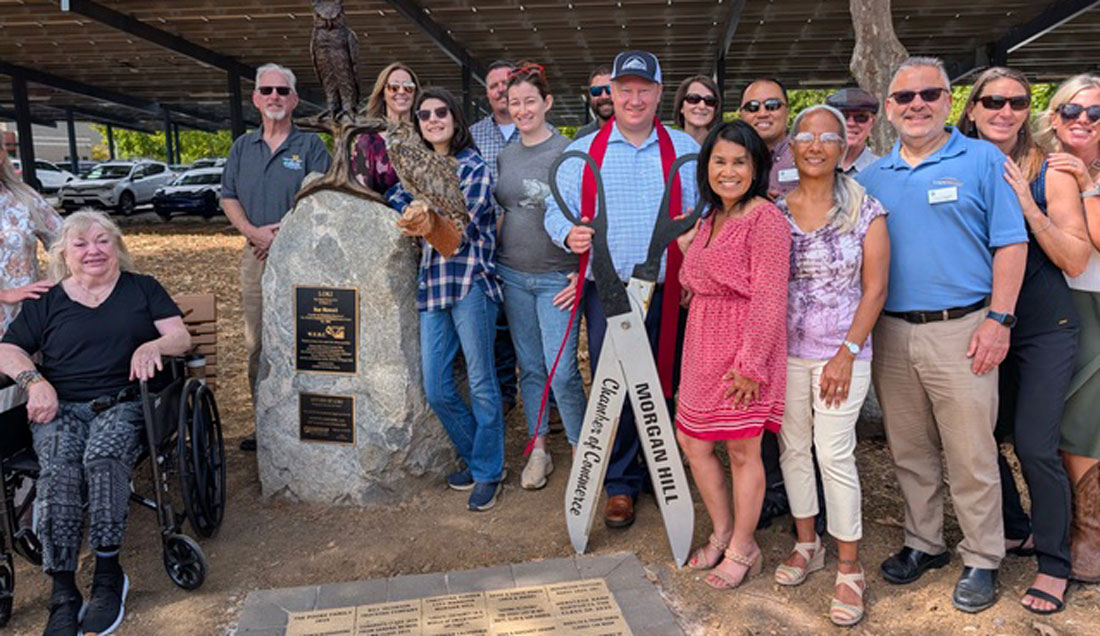
Now, as the nonprofit organization marks its 30th anniversary, Leadership Morgan Hill will celebrate with a gala fundraiser Oct. 4 at Guglielmo Winery. The event honors nearly 500 graduates who have shaped the community through volunteer service, nonprofit leadership and public office.
Leadership Morgan Hill launched in 1995 under the Morgan Hill Chamber of Commerce, following a model from the U.S. Chamber of Commerce designed to increase civic engagement nationwide.
The program became an independent nonprofit organization in 1999, a transition Rubino, who served as program coordinator for 13 years, described as necessary for growth.
“We needed to be independent,” she said. “We had amazing people who stepped up to the plate. We had great classes, we were really immersed into the community. A lot of corporations and businesses were sending people to us because they thought it was such a great idea to be involved in the community.
“Those early years were huge for the growth of Leadership.”
Roger Knopf joined the board in the early 2000s during that crucial transition period, serving roughly 12 years across two stints. He helped establish the financial stability that allows the organization to operate today.
“You’ve got to be financially sound to be a survivor,” Knopf said. “Now they’re able to pay two employees, subsidize some of the participants, and still have enough money to put on next year’s program.”
The nine-month program covers everything from local government to regional agencies and history. Participants also travel to Sacramento for two days to observe the state government.
Knopf describes the curriculum as “a shallow dive into the social infrastructure of your community.”
“You could blow any of those sessions out to a two- or three-unit semester course,” Knopf said. “I love it when somebody says that, because that means they really got into it… that reinforces the effectiveness of the program when somebody says something like that.”
The program has evolved to place greater emphasis on post-graduation service. Classes now dedicate an entire evening session to researching nonprofits, with each participant selecting a local organization to report on.
“They get involved in a nonprofit, and hopefully that’s their foothold into the community, into volunteering and being involved,” Rubino said. “It works. It really works.”
The mark of leadership
Three dedicated class sessions focus on teaching leadership skills, including lessons on conflict resolution and personality types. These skills are then put to the test with the program’s centerpiece: the class project.
“The project gives you the opportunity to see what you garnered about being part of a team,” Knopf said. “The project, in my mind, is probably the one most important factor about the whole program.”
Some projects have left lasting marks on Morgan Hill. Art a la Cart, a program that organizes artistic events for local students, originated as a Leadership project and continues today.
The bicycle racks downtown, the amphitheater lighting at the Community and Cultural Center, the welcome signs at the Morgan Hill city limits—all were LMH class projects.
Not every project succeeds completely. Rubino’s 1999 class never finished their project due to over-reliance on one person, which created a bottleneck that prevented them from completing their project on time. But even failures provide valuable lessons.
“From mistakes and adversity, there are lots of learning opportunities,” Knopf said. “That’s why I love the project.”
Leadership Morgan Hill graduates have included commissioners, city council members, fire chiefs, police chiefs, city managers and department directors; and more than a few prominent local business owners have been through the program.
The program has also served as a foot in the door allowing graduates to engage in community service by organizing their own nonprofits. Rubino was inspired to start Friends of the Morgan Hill Senior Center, which has given nearly $500,000 to seniors over nine years.
Knopf considers Leadership Morgan Hill “probably the most important organization for community building,” paired with the Community Foundation of Morgan Hill, which Tate helped establish while on the city council.
“Leadership focuses on the people component, the human component,” Knopf said. “The Community Foundation focuses on the organizational component. It takes both.”
The $1,500 tuition covers only a portion of the actual cost of about $3,450 per student for the program. To cover the remainder, the annual Leadership Excellence gala (this year on Oct. 4) serves as the organization’s primary fundraiser.
The evening will feature a cocktail reception, silent auction, games, dinner and a program reflecting on the past 30 years and looking toward the future.
“It’s a reflection on the past, a report on where we stand, and a look forward,” Knopf said.
With Morgan Hill’s population growing significantly since 1995, organizers emphasize the program’s continuing relevance for newcomers and longtime residents alike.
“If they want to be part of the community, this is the best way to do it,” Rubino said. “They will be exposed to all aspects of the community, and they can find their place.”
For prospective participants wondering whether to apply, current board members offer simple advice: talk to any graduate.
“Walk down the street, find a graduate, ask their opinion, and they’ll tell you they definitely should go through the program,” Tate said.
Tickets for the Oct. 4 gala are available at tickets.leadershipmorganhill.org.