Growing up in Prunedale, Mike Souza never expected to live in
Italy, let alone be playing the sport he loved in the land of
pizza, wine and olive oil. But there, for two years, Souza was a
member of the Parma Panthers. The San Benito High School football
team’s first-year running backs’ coach was playing American
football with Europeans who smoked a pack of cigarettes between
halves and played simply because they could. Players were as young
as 18 and as old as 40. Most were the size of American kickers, and
the few Americans who played looked more like the Hulk surrounded
by pee wee football players.
HOLLISTER
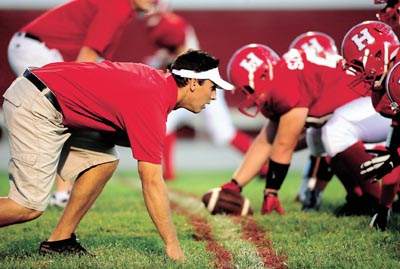
Growing up in Prunedale, Mike Souza never expected to live in Italy, let alone be playing the sport he loved in the land of pizza, wine and olive oil. But there, for two years, Souza was a member of the Parma Panthers.
The San Benito High School football team’s first-year running backs’ coach was playing American football with Europeans who smoked a pack of cigarettes between halves and played simply because they could. Players were as young as 18 and as old as 40. Most were the size of American kickers, and the few Americans who played looked more like the Hulk surrounded by pee wee football players.
“It was the strangest thing,” he said. “Here we are at halftime, and half the players are smoking cigarettes. It was something I really had to get used to.”
And for bestselling author John Grisham, it sounded like the perfect novel. With help from Souza, who was the Panthers quarterback in 2006 and 2007, Grisham stayed with the team over a long weekend in the spring of 2007 learning about the game. The book was published later in the same year.
Souza, now 28, was an instrumental part in Grisham’s learning about the game and the experience of living in a foreign place, according to the book, “Playing for Pizza,” and its author’s note.
“He took us out to lunch a few times. We also had a couple of dinners with him,” Souza said of Grisham, whose other known titles include such books as “The Pelican Brief,” “The Firm” and “A Time to Kill.”
“We just walked him around the city, he went to our game and he was constantly taking notes. But the big thing he wanted to do was eat and drink a lot.”
Everyone on the team was excited to meet the famous author of legal thrillers, he said.
And there are similarities between the book’s fictitious main character and Souza.
Rick Dockery, the main character, was a former National Football League quarterback that blew his chance by losing the American Football Conference Championship game with minutes left. In that game, Dockery was knocked unconscious and injured.
The combination of the injury and terrible play, blowing a 17-point lead, sends Dockery’s career into a downward spiral. The only contract he is offered is by the Parma Panthers, a member of the Italian Football League.
Dockery goes to Italy expecting to run over the league with his expected better talent, but like all sport novels, it’s not that simple. Just transitioning into the different culture, where afternoons are dedicated to siestas and the go-to drink is wine, is troubling for the former NFL quarterback.
And for Souza, the transition wasn’t much different. Coming from the humble background of Prunedale and learning the game from his North Monterey County head coach and father Larry Souza, Italian football was never a place he expected to be.
His career was never as successful as the fictitious Dockery. Souza graduated from North County in 2001 as the school’s and his dad’s starting quarterback.
At North County, Souza made a name for himself and was referred to by his peers as “Mikey,” North County Athletic Director Roger O’Sullivan said. The former track and field coach knew Souza when he was only a ball boy for his dad, but he watched him grow up into a “great” person.
“He was an outstanding student and wonderful athlete, but having said that, he is a better person,” O’Sullivan said.
And it was those attributes that continued to push Souza, O’Sullivan believed.
“He always wanted to explore new things,” he said.
From there, Souza followed his father to Hartnell Junior College, where he played for two years before getting a scholarship at Illinois State University. Souza started both years for the Redbirds, finishing his career with 3,505 yards passing, 20 touchdown passes and 23 interceptions.
His play turned into a one-year stint wit the Calgary Stampeders of the Canadian Football League, but he was cut after the 2004 season.
From there, much like Dockery, Souza thought his football playing days were over. But then came a call by his college roommate Andrew Papoccia.
Papoccia asked Souza if he wanted to join him and play football in Italy. Unlike Dockery, it was hard for Souza to say no. Souza eventually spent both the 2006 and 2007 seasons as the starting quarterback of the Parma Panthers.
Other struggles for Dockery and Souza include learning a new language and the culture of another country. For both, though, it eventually took some time.
“Parma isn’t the biggest town so you have to learn to adapt and learn the language.” Souza said. “The first thing you have to learn is how to order food – you have to eat.”
And for both, driving was an adventure.
In the book, Dockery struggles with driving a stick shift. Luckily for Souza, he knew how to drive a stick, but round-a-bouts where a different story.
“Driving was definitely interesting,” he said.
But sadly the similarities for Souza end there. In the book, Dockery and the Panthers eventually win the Italian version of the Super Bowl, but Souza lost his two chances for the championship. Souza didn’t get his happy ending.
“I still think about them,” Souza said. “The first year we were blown out, but the second one, we were so close.”
Souza still remembers the score and every play of the 2007 Italian Super Bowl, where his Panthers lost 55 to 49 in double overtime.
“It was a rough game to lose,” he said. “We wouldn’t have won anything but bragging rights. For Italians, that’s the biggest thing. They love that stuff.”
Souza still keeps in contact with his former teammates, and one day hopes to return to the place that “changed him.”
“My wife and I want to go back,” he said. “We know we will have a place to stay when we do.”