SAN MARTIN
– The lead agency on the handling and cleanup of South Valley’s
perchlorate contamination problem is forming an advisory committee
to help oversee its work, to take information from and relay
information to the public.
SAN MARTIN – The lead agency on the handling and cleanup of South Valley’s perchlorate contamination problem is forming an advisory committee to help oversee its work, to take information from and relay information to the public.
The state Central Coast Regional Water Quality Control Board on Thursday held an initial meeting in San Martin with government, business and community representatives to discuss the idea of a community group further and possibly begin establishing guidelines for membership and other parameters.
Sylvia Hamilton, San Martin Neighborhood Alliance president, was named chair of the new committee because of her close ties to the community.
“I said yes because, if someone from an agency were in charge,” Hamilton said after the meeting, “there would be less credibility and our number one goal is connecting with people in the community.”
San Martin resident Bob Cerruti is vice-president.
The committee is still forming, though a wide variety of agencies was representated at Thursday’s meeting and Hamilton has issued a call for more public input.
City Manager Ed Tewes and Public Works Director Jim Ashcraft attended for the City of Morgan Hill; Hamilton, Cerruti and Reid Fisher represented San Martin groups and Vivian Varela attended for county health officer, Dr. Martin Fensterscheib. Peter Forest of the East San Martin Water District, representatives for Assemblyman John Laird and Supervisor Don Gage attended. In addition, there were members of Gilroy operations, the Regional Board and the Santa Clara Valley Water District.
“It was a very positive, productive meeting,” Mike DiMarco, spokesman for the SCVWD said. “As with any new group we are trying to figure out how to communicate, how to entice the community to express its concerns and how the committee will present new information to the community.”
The next meeting will be Thursday, May 8, and the public is invited to attend, to offer to join or to send requests for information, Hamilton said. An agency/community-wide meeting to follow up one in February has been firmly scheduled for Saturday, May 3, at Gavilan College. The times are only tentative at this point – 10 a.m.-1:30 p.m.
The board is looking for community input on all of Olin’s soil and groundwater cleanup proposals, said Harvey Packard, a senior water resources control board engineer with the agency based in San Luis Obispo. The committee’s life span will probably last “quite a while,” he said.
The committee started work on a mission statement, Santa Clara Valley Water District spokesman Mike DiMarco said.
“The language is not definite yet but they made it clear that they want to act as liaison between the community and the Regional Board so the community has a say in the solution, he said.”
Tewes said he was satisfied with the way the meeting went.
“We are pleased that the Regional Board has recognized that this particular cleanup issue has many different aspects and a heightened community attention, unlike some other recent cases,” Tewes said. “It will require technical, regulatory and legal solutions and we are pleased that there will be community input also.”
The agency had considered organizing such a group for a while after both regulatory agencies and members of the community expressed interest in one, said Packard.
“The intent as I see it is to have a group that can gather community concerns and relay them to me,” Packard said Tuesday. “We can hear what the community thinks about what the regional board is doing, what the board should be doing differently or better, and concerns in general.
“It’s also a venue or an avenue I can use to get information out to the community on what we’re doing and what Olin is doing.”
A wide cross-section of the South Valley community was invited to the meeting. Some were tapped because they expressed interest in the idea of a committee in the past, and some were recommended by board staff, Packard said.
The agenda included discussion about the format the group wants to take, frequency of meetings, its size and membership.
The nine-member water board is charged with protecting all waters in its jurisdiction, including groundwater, surface and marine waters.
Hamilton said earlier that she was “very, very pleased” at the prospect of a committee.
“I’ve been talking to (Packard) on a regular basis since the beginning of all this and have told him my feelings that we need to have a way where everyone knows what everyone is doing, and that the community needs a vehicle to be able to share their ideas,” Hamilton said Wednesday. “I think it’s very important that people in the community not be kept in the dark, and that they know what’s going on on a regular basis.”
While there is tremendous interest and passion around the perchlorate issue, Packard said the committee will need to have a “workable” number of people to help it be effective. Meetings will be open to the public but officials hope they don’t draw massive amounts of people.
The overall cleanup effort has been estimated by government officials to last for decades. Olin Corp. delivered two reports on potential groundwater treatment and soil remediation alternatives to the board last week, although it did not select a method for treating water because company officials said they did not have enough information. A report on that issue is expected by June 30.
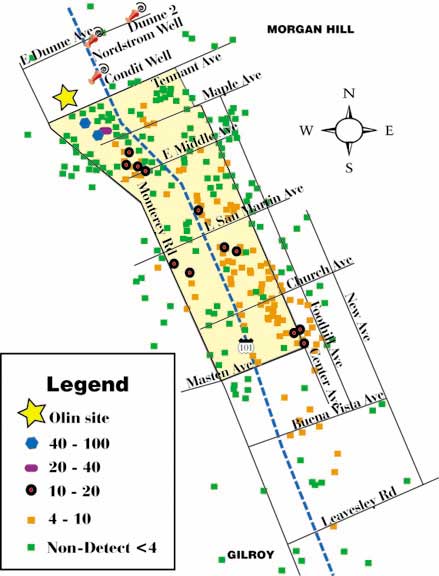
Since mid-January, Olin and the Santa Clara Valley Water District, under supervision by the regional water board, have been testing wells to see how far the chemical has traveled from its origins at Tennant and Railroad avenues in Morgan Hill.
Contamination has been found in well water in the north Gilroy area and in a monitoring well a quarter-mile from one of the city’s municipal wells. In Morgan Hill, several municipal wells have been closed.
Olin and Standard Fusee Corp. manufactured highway safety flares on a Tennant Avenue site in Morgan Hill between 1955 and 1996. Officials say perchlorate was washed from mixing equipment and dumped into a holding pond on the site, and subsequently leached into the aquifer.
For more information on the committee or to express interest in joining the committee, call Packard at 805-542-4639 or contact Sylvia Hamilton at 683-2667.