Mason Weirshauser has seen his share of the devastation caused
by Hurricane Katrina, but he didn
’t watch the events unfold on television or read about it in
local papers. He saw it first-hand during the 11 days he searched
for survivors in the flooded areas of New Orleans as a member of
FEMA’s Urban Search and Rescue team.
Mason Weirshauser has seen his share of the devastation caused by Hurricane Katrina, but he didn’t watch the events unfold on television or read about it in local papers. He saw it first-hand during the 11 days he searched for survivors in the flooded areas of New Orleans as a member of FEMA’s Urban Search and Rescue team.
Though the Hurricane Katrina tale has been told many times, Weirshauser still feels compelled to add his experience to the ever-growing record of devastation.
“I’m not sure why I feel the need to tell my story, perhaps just to help deal with it,” he said.
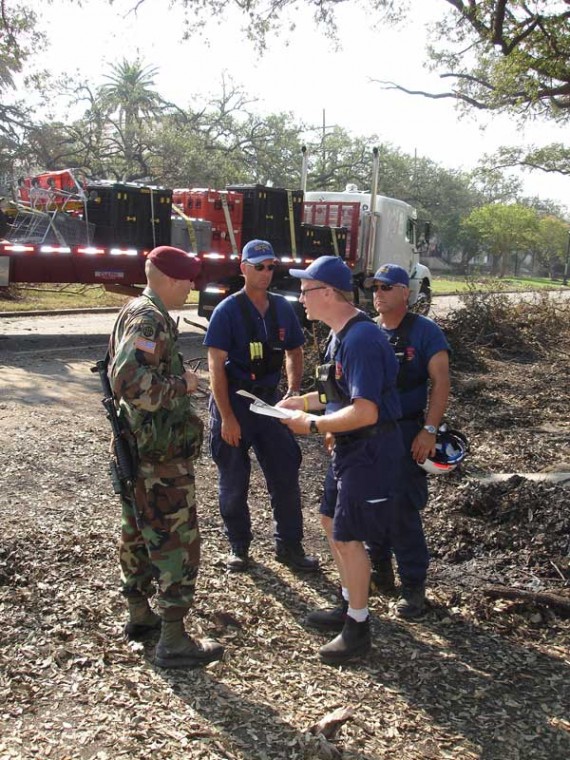
After spending five days in Houston, Weirshauser and his team along with three other California-based task forces, headed to the heart of the storm’s fury to search for survivors on Sept. 7. Though he remembers the people he was able to save, Weirshauser is haunted by those he couldn’t.
“The scope of devastation there was unbelievable with very difficult conditions to work in,” he said. “Most of the areas we were working in, they’re gonna have to bulldoze them. It’s irreparable.”
For the first two days Weirshauser and his team were assigned to primary search areas – where stagnant water was sometimes 13-ft. deep. Patrolling the area in small boats with the Coast Guard and other military protection, they went house to house searching for survivors.
The results of their search were often disappointing, Weirshauser said. During the first two hours of searching, Weirshauser said, a man begged them to check on his parents’ home.
“We found them, dead, up in their attic,” he said. “It was tough. The attic was the only place that was dry, but they couldn’t survive because of the heat up there.”
The high temperatures and humidity pushed the heat index up to 110 degrees most days, Weirshauser said. Mold growing in homes forced rescue workers to put vapor rub on their noses in order to tolerate the stench.
Water searches meant breaking down doors in many homes and having to push through furniture, broken glass, slime, and exposed nails. He described furniture floating upside down and hardwood floors buckled, barring the entries to homes. Sometimes, because water was so high in some homes, it also meant cutting holes into attics.
By the fifth day, their search was called off. Issues had to be resolved “among the politicians,” said Weirshauser. It seemed the police chief did not want the teams to break into more homes. Finally, teams were given the okay to continue their search, but told to knock on doors and yell for people – no more break-ins.
“This became a very big source of frustration for us,” said Weirshauser.
For all the tragedies he saw, Weirshauser also witnessed the tenacity of the human spirit. He smiles while remembering Mrs. Curtiss – one of the survivors he did help.
“She was a Southern belle, about 75 years old, who refused to leave the area,” Weirshauser recounted. “She survived on Saltines and tap water. We had great conversations with her and would regularly check on her, and bring her food and drinking water.”
On Sept. 16, 18 days after the hurricane struck, his team found a 71-year-old man alive in his attic. The man survived by staying up in his attic in the evenings and wading through his water-filled home during the day. His only source of clean water was a 2-liter mug he sipped on for days. The man was in serious condition when he was finally saved – his weight had dropped from 260 pounds to only 180.
A lot of the things Weirshauser saw and experienced tugged at his heart. “I’ve seen a lot of sad things, unfortunately, a lot of bad. Some of the saddest things I saw there were the animals. We were on a search and rescue mode, so we could not pick them up since we only had room for human survivors. There were dogs on trees and pallets, many were scared and hungry and couldn’t be approached.”
He said when they spotted an animal, they called the animal rescue teams, who were able to rescue some canines. “One of the bright spots early on was when we saw evacuees in tears, when they recognized their dogs coming on a boat,” he recalled.
Weirshauser talked about blackened water thick with oil and sewage and being very toxic.
“The E.coli content in the flood waters was at least two to three hundred times the acceptable level. When a group would accidentally get submerged in the water, they would get sent back, scrubbed and sprayed quickly with a bleach solution,” he said.
A firefighter in Santa Clara, Weirshauser joined the Urban Search and Rescue team in Menlo Park five years ago, one of 28 teams nationwide managed by FEMA.
“The bottom line, it was a horrible event, an unbelievable tragedy in scope, but this is what I’m trained for and I’m proud I went, I’m proud of what I did, and I’d go again,” he said.
Twenty-one days deployment was the longest in task force history, said Weirshauser, and a long time to be away from his wife Becky and sons, Cameron, 11, and Chase, 8. The family kept in contact whenever they could via cell phone. Though he lost eight pounds during the ordeal, Weirshauser kept his mind busy by thinking of home.
“After about two weeks, every time I was standing in line to get another bland dinner, I would fantasize that I was about to get seated in front of a plate of chile verde and a margarita from Sinaloa Cafe,” he said. “Needless to say, my family took me to Sinaloa very soon after my return!”