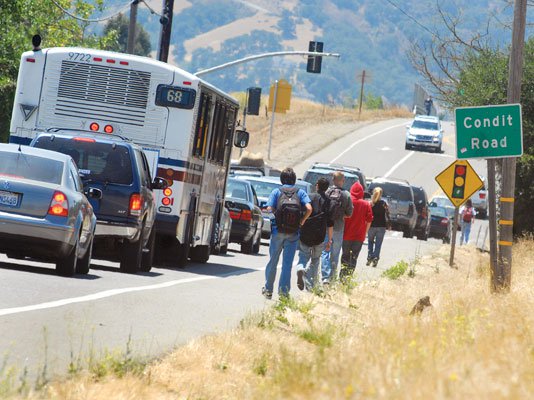
It looks like it’ll be another year of trudging through dirt on
Main Avenue to get to campus for Live Oak High School students.
It looks like it’ll be another year of trudging through dirt on Main Avenue to get to campus for Live Oak High School students.
And it will be some time before the south side of Tilton Avenue from the railroad tracks to Dougherty Avenue is paved. There are 35 projects with 1,310 residences planned in the pipeline right now, most of which are stalled. That means the projects’ corresponding street and park improvements are stalled as well.
Thanks to the city’s strict growth control system, developers often promise street improvements to be built alongside their projects. The Diana Chan project’s road improvements on Main are one. The Capriano development’s road improvements on Tilton are another.
The city’s growth control system keeps population growth at bay. Developers participate in a competition to “win” some of the 200 or so residential units allotted each year. Developers earn points by folding certain improvements, like parks, streets, bike lanes and sidewalks, into their project. The developers with the most points are allotted residential units. If a project is stalled, so are the promised improvements to the neighborhood that came as strings attached.
“We don’t see any of those funds until they move forward,” said Scott Creer, the city’s senior civil engineer.
Two developers have promised a walkway on Main.
DeNova Homes developers promised to build a temporary sidewalk along Main from Casa Lane to Condit Road, as part of their Viento project bid, Creer said.
But then the owners of the property associated with the Diana Chan project, located on the south side of Diana Avenue between Condit and Hill roads, promised to make full roadside improvements there as part of their development, to the tune of $500,000.
So instead of building a temporary pathway that would just be replaced with a permanent sidewalk anyway, DeNova pitched in $286,026 to the city’s Public Facilities Fund to be used for a similar purpose in the future. That’s about how much the developer would have paid towards the pathway they promised to build, Creer said. The city has about $700,000 in the fund now, he said.
So why doesn’t the city just go ahead and build the sidewalk with the money it has in the fund?
Creer said it’s the developer’s commitment, and the city wants to hold them to their promises. And it’s more cost-effective for the developer to do it during construction of their project, considering bulk rates for construction materials and the equipment is already nearby.
So, while the housing market is stalled, Main will remain sidewalkless for 866 feet on the north side. Like the rest of the development community, the Diana Chan project stalled after the housing market collapse. Developers can’t get financed, and so their projects have been pushed back. The city has granted extensions for construction. Currently, Diana Chan keeps its allotments as long as it starts construction by October 2010.
Sgt. Jerry Neumayer said while the lack of sidewalk leading to Live Oak is a concern and they do get complaints, there haven’t been any problems of pedestrians being hurt or injured from accidents. Neumayer pointed out that the 16-year-old girl who accused taxi cab driver Tarandeep Singh of kidnapping her in March was standing at the bus stop across Main from the school, which has a sidewalk.
Principal Nick Boden said the lack of sidewalks hasn’t been a problem in the five years he’s been principal at the school.
But it looks like there will be several more classes of Live Oak students who will one day tell their children: “I had to walk 866 feet in the dirt … “