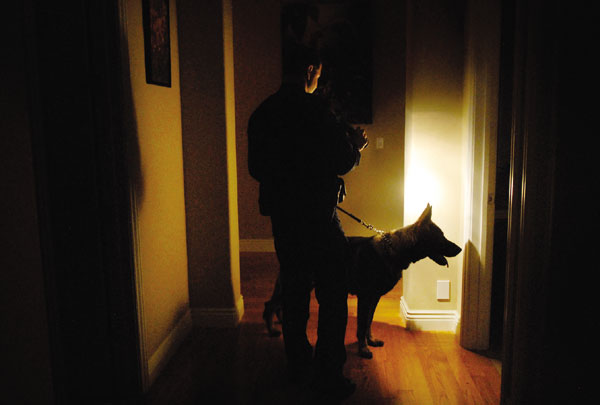
Pax, a pure-bred German Shepherd from the Czech Republic who can
find out in a few seconds if someone is still inside a burglarized
home and make hardened criminals surrender from dark corners with
the sound of his bark, has been on patrol for the Morgan Hill
Police Department for about eight months.
Pax, a pure-bred German Shepherd from the Czech Republic who can find out in a few seconds if someone is still inside a burglarized home and make hardened criminals surrender from dark corners with the sound of his bark, has been on patrol for the Morgan Hill Police Department for about eight months.
And Pax’s presence in Morgan Hill is the result of a community effort to step up and raise the money to bring back a program that local officers hail as an indispensable law enforcement mechanism, after years of city budget constraints forced a halt to the K-9 unit.
“K-9s are an invaluable tool in any police department,” Chief Bruce Cumming said. “It’s good for the community to have this level of safety, and it’s a good resource because officers can find people quicker and be a lot safer, and we save money.”
Pax was purchased, trained and deployed with funds raised last year by the Community Law Enforcement Foundation, a local nonprofit organization that benefits police efforts. The group presented the MHPD with a check for $75,000 in July, and is committed to funding the program for as long as Pax is able to serve.
“These dogs are expensive to outfit, train and purchase. Pax wouldn’t be here if it were not for CLEF and the donations they’ve been able to gather over the last couple of years,” Cumming said.
Since Pax began patrolling with his handler, officer David Ray in August, he has performed a couple dozen searches of homes and commercial buildings that had been broken into and helped secure the arrest of several criminal suspects, all while attending regular training classes.
One evening earlier this month, Ray said he and Pax, who work the graveyard shift, responded to a home burglary call near Peebles and Taylor avenues. While it would have taken a human officer a few minutes to search the home for a remaining, potentially dangerous suspect, it took Pax about 30 seconds to search this particular home and let Ray know it was empty.
Furthermore, Ray has noticed that any suspects who are present are less likely to fight with police, or even try to run away, if they know a 100-pound dog with a menacing growl and sharp teeth could come after them on his handler’s command.
“Most of the time they submit when they know there’s a dog there,” Ray said. “When he’s in that function, he’ll bark to let them know the dog is there. Once he does that, everybody has submitted to police custody.”
In one week last September Pax, responding to patrol calls with Ray, found two potentially violent suspects who were trying to hide. One of those was a domestic violence suspect concealed in a tool shed, who came out with his hands up as soon as he knew Pax had found him, according to Field Operations Commander Joe Sampson. In both incidents, the dog was able to sniff out the suspected criminals without even entering the closed quarters that could have posed a threat to a bipedal officer.
Pax has also assisted in high-risk traffic stops in a “stand and guard” function, ensuring that suspects don’t try to resist arrest or flee. Ray said in early March, they stopped a vehicle containing a passenger who had a felony warrant out for his arrest. At least partial credit for the incident-free arrest goes to Pax, Ray said.
“Nobody wants to be bitten by a dog,” he said, noting that Pax would bite if given the command that Ray has not had to utter since he was deployed. And Ray noted that another unique aspect of well-trained police dogs is that if Pax is given the command to bite, his handler can call him back before inflicting injury if the suspect suddenly decides to give up after all.
“You can’t pull the trigger on a gun, and call your bullet back,” Ray said.
It is also likely that Pax has reduced the number of incidents in which officers have had to use their guns or tasers, Sampson added.
The typical service life of a K-9 dog is six to 10 years, according to police, and Pax, who is 2, will be able to perform more duties as he continues his training, which he and Ray practice to a varying degree every day. In a couple months, Sampson said Pax will be trained to search for drugs.
Pax is also useful as a man’s best friend, a public relations tool for the police. Ray said the dog knows the difference between work and play, and is friendly with children when giving presentations.
As Cumming put it, “Everybody likes a dog.”
“When he’s at home, he’s a dog,” added Ray, 32, who lives near Morgan Hill with his wife and two young children, three pet dogs including Pax, a horse and some chickens. “He plays with my (3-year-old) son and my other dogs. But he knows when it’s time to go to work.”
Ray, who has worked for MHPD about eight years, has extensive experience working with animals. He started his law enforcement career as an animal control officer in San Joaquin County, and he and Pax have been through about 160 hours of training classes together in the last eight months, with a contractor in Menlo Park that specializes in police dog training.
Growing up in San Jose, Ray said his family always had at least one pet dog, and he has always been around animals. The job he has now is one he has wanted for several years.
“When I got into law enforcement it was always an aspiration to be a K-9 officer. The amount of teamwork and the relationship the handler and his dog have is an amazing thing,” Ray said.
One reason Pax is so well-trained is it is in his genes as a sixth-generation sporting dog, known as Schutzhund in Eastern Europe. Ray said Pax was purchased from a trainer in the Czech Republic who only breeds these kinds of dogs, and begin training the dogs how to bite and let go on command at the age of 4 months.
Plus, Ray and Pax, whose commands are ordered in German, work with other K-9 units at Witmer-Tyson, the training facility in Menlo Park, at least once a month. That’s where the dogs learn skills like searching, which are not taught by the breeders in Germany.
Cumming said acquiring Pax after the K-9 unit was cut in 2004, and because the city has been unable to fund the program since then, the department has learned how “invaluable” the four-legged officer is.
“I wish I had more (police dogs),” Cumming said. “There’s a need for a dog on each shift.”