County officials create 10-year strategic plan addressing needs
of aging population such as anti elder abuse education programs
Morgan Hill – They call it the “Age Wave.”
Americans are having fewer children and living longer lives, leading to an increase in the number of older adults in the population.
And while experts say the ripples are already being felt, the number of adults age 60 and over will nearly double in Santa Clara County by 2020, rising from about 220,000 to 428,000. By that time, that older cohort will represent 21 percent of the county’s population, up from 13 percent in 2000, according to a report on aging jointly released by the county and the City of San Jose.
“Right now, four million senior citizens (nationwide) have Alzheimer’s disease. Sixteen million will have Alzheimer’s disease in another 20 years,” said Nancy Hikoyeda, a gerontologist at San Jose State. “You have implications for the health care system, for family caregivers. It’s huge.”
Santa Clara County and San Jose officials don’t want to get caught flat footed under “wave.” They’ve partnered to create a 10-year strategic plan – which cost $210,000 – to meet the increasing needs of older adults.
But with the plan now done, future funding for its full implementation is uncertain in the context of the county’s $200 million budget deficit.
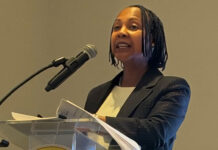
Nevertheless, advocates last week gave an update on the achievements of the plan at the 15th annual Adult Services Resource Faire in San Jose, attended by more than a 1,000 people. They cited improvements in services and activities that are underway, as related to areas of information, transportation and language access for older residents.
“Our best responses now rely on partnerships that help us build a service infrastructure to ensure our older adults well being,” said Supervisor Don Gage, who co-chaired the Strategic Plan Advisory Group with San Jose City Councilman Ken Yeager. “Given the financial challenges on the horizon, if we do not work together, we will all pay a much higher price. It is a matter of time before their needs will become our needs.”
Some of the accomplishments highlighted at the faire included San Jose’s new hotline, (408) 979-7912, to provide telephone assistance to seniors and caregivers, and an updated 156-page senior services directory by the Council on Aging Silicon Valley, a nonprofit organization. County officials also noted a recent awareness campaign on elder abuse that included multilingual radio, television and print ads.
Betty Malks, director of the Santa Clara County Department of Aging and Adult Services, said meeting the needs of older adults will be one of the biggest challenges that the county will face over the next 25 years. Malks said the plan, which was released in February 2005, has already led to increased communication and coordination between private and public agencies. Duplication of services has been reduced, she said, and some service gaps have been filled.
The plan identifies 10 areas of need that include housing, in-home care, transportation, senior center programs and language access. Officials assessed these needs by hosting town hall meetings, holding focus groups throughout the county and conducting a telephone survey of older adults.
“The big issue is the population is becoming very diverse. Probably more so in California than in other states because there are so many immigrants. There will be a need for more care giving and we need to do that in a way that’s sensitive to different cultures,” Hikoyeda said, adding language barriers on automated phone answering services and in doctors’ offices alienate those who speak Vietnamese and Chinese dialects.
In 1994, San Jose responded to the phenomenon by adopting its own 10-year plan on aging. Working groups included community and county workers. By the late 1990s, former San Jose City Councilwoman Alice Woody and others recognized a need to update the strategies. A partnership with the county was formed, resulting in more money and a larger planning scope.
While funds were allocated in 2000 for the plan, it was later developed during a period of economic hardship. City and county funding dropped as additional cuts were projected. The plan did not make specific funding recommendations.
“Sure, funding is needed. We have more seniors, we have less services, and we need more services. This population explosion has never occurred in history. We have to do something about that,” Malks said.
For more information on services for older adults, call Betty Malks at (408) 975-4848 or visit the Santa Clara County Department of Aging and Adult Services, 333 W. Julian St., San Jose.
Tony Burchyns covers Morgan Hill for The Times. Reach him at (408) 779-4106 ext. 201 or
tb*******@*************es.com.