Rahmatullah and Seema Rahyab left Kabul, Afghanistan more than
20 years ago, with terrorist bombings and bullets following closely
behind.
Rahmatullah and Seema Rahyab left Kabul, Afghanistan more than 20 years ago, with terrorist bombings and bullets following closely behind.
They left behind good jobs – he as an account manager and she as a personnel manager at a hospital – to bring themselves and their young son to safety from the escalating conflict among the government and radical Islamic factions.
“It was like a civil war,” said Rahmatullah, 60. “They fired a lot of rockets. We knew the situation was going to be worse.”
After spending nearly 15 years in refuge in India, where both adults worked as teachers, they made it to what they plan to be their ultimate destination – America – in 2003. They started out in San Jose.
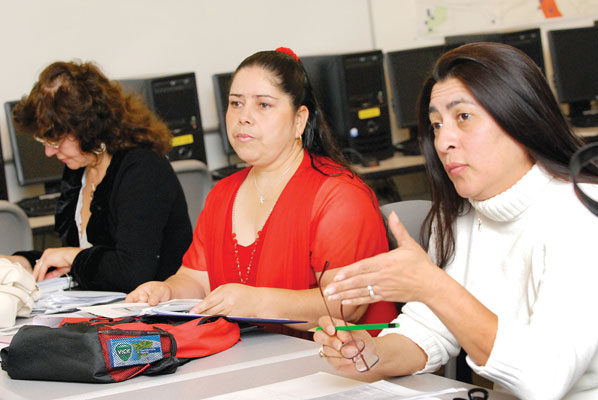
Now they make their home in Morgan Hill, and are enrolled in Gavilan College’s citizenship class at the school’s local campus. Hoping to become naturalized U.S. citizens, they are learning the English language and improving their knowledge of American history and government in order to pass the U.S. Citizenship and Immigration Services exam.
“The people are very good (in America),” said Seema, 52. “Very good culture. The people are very friendly.”
“That’s the greatness of America,” Rahmatullah said.
They are particularly pleased to have escaped the despotic governing practices and extremist religious beliefs of the rebels who have fought to gain power in Afghanistan for decades.
“Women’s lives are nothing. They are used like animals,” said Rahmatullah, who is Muslim. “This is not Islam.”
All of the 15 or so students in Gavilan’s Morgan Hill citizenship class are just learning how to speak English, but many of them, including the Rahyabs, can’t stop talking about why they immigrated to America, the obstacles they overcame to get themselves and their children here, and what they left behind in their native countries.
This effusiveness might be a tribute to their teacher, Ellen Yu Costa, who encourages constant practice as a way to improve both their use of the local language and their knowledge of the new country’s culture – both of which are among the keys to eventual citizenship. Incorporating video and audio recordings, classroom readings, chalkboard exercises and history lessons into her teaching method, Costa strives to prepare her eager pupils for everything the USCIS might throw at them on exam day.
Teaching a heritage
The exam includes language-related questions to ensure the prospective citizens can speak, listen and write the English language. Exam questions are also designed to ensure the immigrants have a working knowledge of American civics, and some knowledge of the culture.
In one recent lesson, Costa wrote a sentence about the U.S. Constitution containing errors on the chalk board. She asked the students to identify and correct the errors.
The classes are light-hearted as the students, ranging in age from early-20s to late-50s, are all eager and excited to learn the language that will carry them to their long-sought American citizenship.
The keys to citizenship that Costa can’t provide her students are their enthusiasm, patience and determination to become citizens.
“These people left their professions to come here, but they made it,” said Costa, herself an immigrant from Taiwan and a Morgan Hill resident. “They did it for their kids.”
She described another of her students, a political double-refugee of sorts, who fled from China to Hong Kong only to be abused in protective camps there, and then to America. Another prospective U.S. citizen is a former top-level technology researcher for the Colombian government, who found himself wanted and his family threatened by a drug cartel that desired his scientific expertise.
Olga Razdolgina, 58, moved to Morgan Hill from St. Petersburg, Russia about three years ago. A former editor for a Russian publishing company, Razdolgina didn’t come here fleeing persecution – rather, she talks about how she misses her friends she left back home. Her two daughters moved to the Bay Area several years ago and became citizens, and she came to live with them.
“You have really kind people here,” she said. “When you go to the store it’s very pleasant. There’s a very good climate in Morgan Hill, and people can study for cheap or free (in America).”
Rahmatullah and Seema’s son gained his U.S. citizenship in September 2009. He graduated from college in San Jose in 2007. He now works in a gas station, but hopes to pursue a career as a medical assistant.
The family received significant help from the United Nations Refugee Commission, which gave them money to pay for rent and food. Catholic Charities U.S.A. also helped them move to the New World.
One recent lesson in Costa’s class had to do with Sojourner Truth, an African-American woman born into slavery in New York, who escaped to freedom as an adult in 1826. Parsing one of the abolitionist’s documented speeches, Costa and her students discussed the meaning of some of the passage’s epochal words: “ain’t, lashed, plowed, husked.”
The teacher and her class also watched an Internet video of different readings of the 160-year-old speech they had just read. Costa encouraged her students to use youtube.com in their ongoing quest to improve their use of the English language.
“You can listen instead of just reading it,” Costa told the class of about 15 immigrants who came to America from diverse foreign countries, and for a variety of reasons.
The homework for the evening was to report the meaning of the words “abolitionist” and “suffrage.”
Costa said later that immigrants to America often miss such cultural references in their everyday lives.
“Part of U.S. citizenship is to teach about historical and cultural aspects of America,” said Costa, who speaks five languages – English, Spanish, German, Chinese and French. “We need to know about some of the national history, but as immigrants we aren’t exposed to some of these iconic things.”
Emotional oath-taking
Maria del Rosario Yanez just passed the citizenship exam and was sworn in as an American citizen a couple weeks ago. She couldn’t stop smiling as she talked about her new country.
Yanez moved to America in February 1993 with her husband. Since they got here, they have worked at Mariani Orchards, picking fruit. They came to the U.S. to improve their lives.
“There’s more opportunity for school here, and more opportunities for work,” Yanez said.
The couple now has two kids – a 16-year-old son who attends Sobrato High School, and a 13-year-old daughter who attends Martin Murphy Middle School.
“My kids are happy,” Yanez said. “My son said, ‘You passed the test, Ma!'”
She has been enrolled in Costa’s citizenship class for three semesters, but she has taken other English learners’ classes with Costa for about five years. She will continue taking the English classes in an unending quest to improve her use of the language.
Mexico contributed the highest number of naturalized American citizens of all other countries in 2008, with 231,815. The same year, a record number of people from all countries – about 1.05 million – became American citizens.
The swearing-in ceremony for U.S. citizens is a “tear jerker,” Costa said. She was sworn in about 30 years ago, after moving to the U.S. as a teenager. Before arriving in America, Costa lived all over the world with her parents; her father was a Chinese ambassador to the U.N.
Costa remembers taking the oath with hundreds of other citizenship candidates in big hall, with relatives, children and spouses lining the walls.
“You aren’t aware until that moment in time, when you realize all you had to do to get here,” Costa said. “Everything comes to this point.”