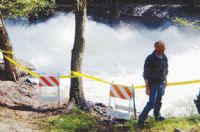
If Anderson Dam were to fail in the event of a large earthquake
– less than a 1 percent chance – the drinking water behind it could
flood downtown Morgan Hill to a depth of 35 feet.
If Anderson Dam were to fail in the event of a large earthquake – less than a 1 percent chance – the drinking water behind it could flood downtown Morgan Hill to a depth of 35 feet.
That’s why the Santa Clara Valley Water District announced earlier this week that the preliminary results of a study of the dam’s integrity indicate a retrofit costing up to $100 million is needed.
“Based on other dams that have had similar issues, it could cost tens of millions to a hundred million dollars” – a cost that would be funded with groundwater charges paid by the district’s customers, according to the district’s deputy operating officer Frank Maitski.
The study by Oakland-based AMEC Geomatrix found that “significant slumping” could occur if a 7.25-magnitude earthquake or larger occurred on the Calaveras fault, within two kilometers of Anderson Dam, according to a statement from the water district.
The lower, inside portion of the dam contains loosely compacted dirt-like material that could liquefy in the scenario that such extreme earth-shaking happened. In that event, the shell on the upstream and downstream sides of the dam could slide downhill, causing the water in Anderson Lake to spill over the slumping dam, Maitski explained.
“The rock shells would slip and move downhill to some degree. ‘Significant’ means it’s not a foot or two – it’s more like 10 (feet) or more,” Maitski said.
A retrofit would likely entail a combination of two options – replacing the loosely packed materials inside the dam, and reinforcing both sides with more rocks, Maitski explained.
More findings from the consultant, detailing in what combination and to what degree these efforts are required, are expected in about two months, Maitski said. The final study is not expected to be complete until May 2011. Based on similar work that has been performed on other dams, a retrofit of Anderson Dam could take up to six years to complete, Maitski added.
Since January 2009, the water district and the California Division of Dam Safety have cautiously kept the water level in Anderson Reservoir at 40 feet below the top of the dam or lower. The water level is currently about 60 feet below the dam crest, and the latest study by AMEC Geomatrix suggests the elevation should be no higher than 57 feet below the crest until the dam retrofit is complete.
Maitski explained that at lower elevation, the dam is thicker and would be more reliable if liquefaction at the bottom of the dam occurred.
In January, 2009, the district hired AMEC Geomatrix to conduct the evaluation of Anderson Dam. Since then, the consultant has drilled borings at various locations on the dam and conducted testing and analyses to determine if the materials used to construct the dam are sufficient to withstand a major quake, the water district statement said.
An earthquake geologist from the U.S. Geological Survey said the probability of an earthquake of 6.7-magnitude or larger in the next 30 years anywhere on the southern portion of the Calaveras fault – where Anderson Dam is located – is less than 1 percent. So an earthquake of 7.25-magnitude, as suggested by the water district’s consultant is the minimum size quake that could liquefy the inside of the dam, is even less likely, according to David Schwartz of the USGS.
“We think, in general, that part of the Calaveras fault likely produces earthquakes up to around 6.5-magnitude,” Schwartz said. “That’s what has happened historically, since the 1800s,” and the Morgan Hill quake that happened on the Calaveras fault in 1984 was only 6.2-magnitude.
While other faults in the Bay Area are capable of producing substantially earthquakes, it is “difficult” to estimate how big and how close such quakes would have to be to Anderson Dam in order to cause a failure, Schwartz said. He added that the district’s cautious approach to the dam is “smart.”
Anderson Dam “performed quite well” in the 1984 temblor, as well as in the 1989 Loma Prieta quake, Maitski said. Anderson Dam was constructed in 1950.
He added the latest study focused on the “maximum possible earthquake,” and did not consider other specific quake scenarios on other faults. “The intent of this study was to say if this is a problem (or not),” Maitski said.
Funding for dam retrofitting would come from groundwater charges, Maitski said. The water district’s long-term groundwater charge projections, which predict a groundwater charge of $325 per acre foot in South County in 2020, assume that a portion of the charges paid by customers will pay for retrofitting at any of the district’s 10 reservoirs where such needs exist.
The portion of groundwater charges allocated to dam repairs in those projections was unavailable at press time. Groundwater charges for South County are currently $275 per acre foot.
The water district provides wholesale drinking water and flood protection for 1.8 million residents of Santa Clara County. It has an annual budget of $315 million.