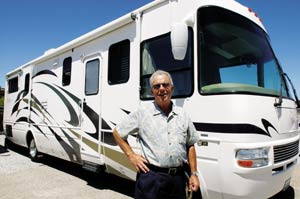
Residents with motor homes may be preparing to take them on the
road now that official vacation season has arrived, but owners need
to be aware that their recreational vehicles may be parked on city
streets outside their residence for 10 hours only, a municipal code
ordinance that some feel is too restrictive.
Morgan Hill – Residents with motor homes may be preparing to take them on the road now that official vacation season has arrived, but owners need to be aware that their recreational vehicles may be parked on city streets outside their residence for 10 hours only, a municipal code ordinance that some feel is too restrictive.
“When we get back into town late, it has to sit outside for more than 10 hours, because the storage facility is closed, and when we’re preparing for a trip, maybe leaving early in the morning, we park it outside the night before,” said resident Dennis Busch, a retired San Jose police officer.
The issue of parking these vehicles and other recreational vehicles such as boats and trailers with jet skis, for example, on city residential streets came up less than 10 years ago, Morgan Hill Mayor Steve Tate said.
“This is deja vu, I thought we had taken care of this,” Tate said, hearing Busch’s concerns.
The city’s municipal code states that residents are not allowed to “stop, stand or park an oversize vehicle in a residential zone … except for the purpose of loading or unloading food, supplies, equipment or cargo or due to a temporary and unplanned inoperability. Such exemption period shall not exceed 10 consecutive hours.” The ordinance was updated in 1999.
“When we dealt with this before, we came to a compromise of sorts, and the 10-hour limit seemed to be the best solution,” Tate said.
He added that if Busch and others feel the code needs to be reconsidered, contacting him and council members would be the best way to take action.
Morgan Hill police Cmdr. David Swing said if one of the department’s community service officers or multi-service officers finds a motor home or other oversized vehicle parked on a residential street, the officer would leave a warning on the vehicle, and likely return again 10 hours later to see if the vehicle is still there.
“If the council members determine there is something that warrants looking into, they would direct city staff to do so and prepare a recommendation to bring back to them, if necessary,” Torres said.