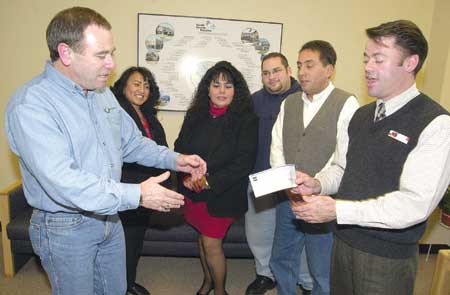
South County Housing, an affordable housing provider in South
Valley, has received a donation of $10,000 from Wells Fargo
Bank.
South County Housing, an affordable housing provider in South Valley, has received a donation of $10,000 from Wells Fargo Bank.
The non-profit organization earned honors as Gilroy Hispanic Chamber of Commerce’s Business of the Year for 2003.
“South County Housing being an avenue for low-income housing … Wells Fargo understands the importance of economic and financial stability, and it’s our commitment to helping that, helping customers and even non-customers have access to housing,” said Robert McDowell, Wells Fargo Gilroy branch manager.
McDowell said Wells Fargo awards donations to their respective communities annually, selecting the recipient based on community and Wells Fargo employee feedback.
South County Housing Executive Director Dennis Lalor said the donation will go to the organization’s Neighborhood Services Department, which provides training and programs to involve neighborhood residents in their community.
South County Housing continues to push for more affordable housing options throughout the South Valley.
In Morgan Hill, SCH has worked with the city’s Redevelopment Agency on the Villa Ciolino development – behind Albertson’s – that replaced a very much below standard trailer park with fresh, new units that won national and regional design awards. The RDA and SCH are currently building Jasmine Square Village, a similar development, plus commercial space and a day care center, just south of the post office on Monterey Road.
Working together, SCH helps the city meet its state-mandated requirements for affordable housing.
At a recent last week, Lalor asked Neighborhood District Task Force members to consider developing a proposal to create an inclusionary housing program in Gilroy.
“This is mostly just to get the conversation started,” said Lalor, who sits on the task force.
An inclusionary housing ordinance would ensure that housing developers provide minimum levels of affordable housing in new developments. For example, the city might require that 8 percent of a developer’s housing units be affordable to very low-income households, those who earn less than 50 percent of the area’s median income. Minimum percentages of housing units affordable to low-income (50 to 80 percent of median income) and moderate-income (80 to 120 percent of median income) households would also be required.
“It’s not the policy that’s important, it’s the outcome and the intent,” Lalor said. “What do we need to do to ensure that this opportunity exists for the people that live here to be able to have access to affordable housing?”
Inclusionary housing ordinances are in place in communities all over the state, Lalor said. Task force members asked Lalor to further research other models to discuss the subject again during the group’s Jan. 27 meeting.
The task force is responsible for determining how different types of housing, such as single-family homes or higher-density rentals, will be incorporated into new developments.
“The task force would be an excellent vehicle to get comment on the direction they want to go,” said Bill Faus, the city’s planning division manager.
Faus cautioned that the inclusionary housing proposal is as yet tentative.
“Even to call it a proposal is premature,” he said.