Morgan Hill businesses and households can expect to receive
higher water and sewer bills come January if the city council
decides to go along with staff recommendations.
MORGAN HILL
Morgan Hill businesses and households can expect to receive higher water and sewer bills come January if the city council decides to go along with staff recommendations.
The council may vote on the matter following a Dec. 5 public hearing.
The recommendations, based on the Water and Sewer Rate and Fee Study done for the city by consultant Bartle Wells Associates and presented to the council Sept. 19, are to increase water fees 5 percent over the next two years and the sewer fees 7.2 percent per year over a three-year period. That means an average monthly water bill will increase by $2.07 to $22.18 from $20.11, and the average monthly sewer bill will increase by $6.96 to $36.97 from $30.01, according to the study. The increases would go into effect Jan. 1.
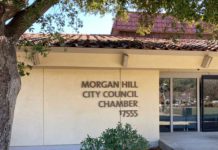
City officials were on hand to discuss the rate increases and other proposals in the study at a Morgan Hill Chamber of Commerce meeting held Thursday at City Hall. Finance Director Jack Dilles told the audience of several business owners, developers and a city councilmember that the city could no longer afford to rely on its reserves to cover deficit spending related to water and sewer operations.
“We are concerned with our reserves dropping,” Dilles said. “We had so much money in the bank we wanted to (wait) before going to consumers and businesses.”
The last water rate study was done in 2002, after which annual increases of about 3 percent have helped to balance revenues and expenses in the water operations fund. Sewer rates haven’t been adjusted in a decade, and with revenues falling short of expenses, the current budget has an estimated $1.9 million deficit, according to the study.
Officials also discussed increases on impact fees, the one-time fees commercial and residential property developers pay the city when new projects go in. The study recommends that water fees be increased by $944 to $2,940 from $1,996 for single-family residences and by $845 to $2,646 from $1,801 for multi-family residences and businesses. Sewer fees would go up $2,447 to $11,507 from $9,060 for single-family residences and up $2,113 to $9,781 from $7,668 for multi-family residences.
If approved, the new impact fees go into effect in February, Dilles said. The city received about 20 letters against the increases, he said.
Wayne Chin, who opened a franchise of the Kiddie Academy Child Care Center with his wife 14 months ago with the help from a low-interest city loan to cover part of the $100,000-plus in impact fees, said the proposed fee increases would hurt his business. Chin works full-time at another job and at the 7,400-square-foot center on the weekends, while his wife runs it day-to-day and his brother helps with cleaning. As with any start-up company, Chin said he doesn’t expect to be in the black in the first year of business and the water and sewer fees would hurt the bottom line even more.
“That would push us further back,” he said. “We want to establish our roots … How do we do that if we have increases everywhere?”
To better justify the increases, city councilwoman Marby Lee said she would like staff to compare the water and sewer rates in San Jose and Cupertino, in addition to Watsonville, Gilroy and Hollister, which the study included.
“I think to be comprehensive it wouldn’t hurt to look at those,” said Lee, adding that she hasn’t made up her mind about how she would vote.
” At this point I’m still learning. I’m concerned with the sewer increases. I want to hear justification,” she said.