Weeds, thistle and other fire-season troublemakers are quick
work for mowers, but the Santa Clara Valley Water District has
found a novel way to rid the plants from those hard-to-reach
spots.
San Martin – Weeds, thistle and other fire-season troublemakers are quick work for mowers, but the Santa Clara Valley Water District has found a novel way to rid the plants from those hard-to-reach spots.
“We can’t mow those piles of dirt — they’re too rocky … And crews with weeders are pretty expensive,” said Judy Ingols, senior operations administrator at the water district. “So they came in to ‘mow’ the fire breaks,” the 20-foot space between property lines and undeveloped ground.
And who exactly are “they?”
“Goats,” Ingols said. “We’re looking at them as an alternative type of vegetation control, mainly for areas where we do fire control.”
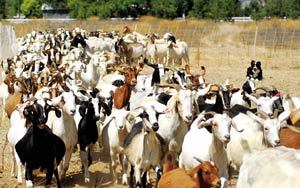
Drivers passing the southeast intersection of Maple and Murphy avenues, in San Martin, may have noticed this week the hottest trend in eco-friendly weed control. Hundreds of goats – 300 to be exact – clambering up dirt mounds and munching mustard, Star Thistle and other noxious brush and weeds on three acres of the water district’s property. The week-long pilot project is costing the district between $500 and $1,000 per acre, compared to the $1,500 per acre they would spend for a weed-whacking crew.
The district doesn’t plan to replace all of its lawnmowers with goats any time soon, Ingols said, but they are planning to use them as one piece of an overall land-maintenance strategy.
Next month, for instance, the agency will use the goats on a flood plain in Milpitas. But first, the animals will help tame properties for a few local businesses and homeowners in Morgan Hill and San Martin, according to Andrew Johnson, owner of Intensive Grazing Projects, a Santa Cruz company that clears land using goats and sheep instead of mowers, weed whackers and herbicides. Johnson, who works in partnership with California Grazing, a Coalinga company that owns the animals, said that intensive grazing may not always be the most efficient method, but it’s often the one that will let eco-minded property owners sleep well at night.
“In an age where mowing and spraying have proven to cause problems, environmentally and with health, we provide an alternative,” Johnson said.
Unlike traditional land clearing, intensive grazing requires patience and boldness. About 300 goats typically clear an acre each day, as opposed to the tens of acres a landscaping crew could do in the same period. In addition, the sea of goats often cause drivers to stop, gawk and take photographs.
Organizations that can handle the attention will reap environmental and landscaping benefits, Johnson said. Intensive grazing does not use fossil fuels, leave behind dangerous chemicals or present a fire hazard, as does traditional mowing or spraying. In addition, the goats eat all parts of the brush, eliminating the seeds that typically are spread through weed whacking, and leave behind an abundant fertilizer.
People often remark that Johnson, 26, should be paying landowners for the goats to eat on their land, but he points out his operating costs. He must pay for fuel to transport the animals, water and supplemental food, 24-hour staffing, food for Border Collies that round up the animals, an electric fence, and biologists to survey the land. When Johnson sells the sick and old goats in winter, they rarely fetch more than $100 a head.
Still, Johnson said business is booming as he manages to win over skeptics. His company has executed more than two hundred jobs in its four years of existence, with the longest being a more than two-month graze in a housing development along the northbound side of U.S. Highway 101 near its intersection with Highway 85.
“A lot of people are like, ‘I don’t know … I’ve been weed-whacking a long time,’ ” Johnson said. “But they’re seeing it work.”