Off to a brand new start at a new school for a new school year
with supplies purchased and excitement bubbling, beginning teachers
often hide their anxiety well.
Morgan Hill – Off to a brand new start at a new school for a new school year with supplies purchased and excitement bubbling, beginning teachers often hide their anxiety well.
The Beginning Teacher Support and Assessment program, better known as BTSA, is the perfect remedy for the kind of jitters experienced by teachers in their first or second year, according to district officials.
The program was created by the New Teacher Center of Santa Cruz, and this year will serve 59 teachers in the district.
The program, however, is much more than a pat on the back or words of encouragement offered by veteran teachers to new educators. It is a highly organized, comprehensive two-year course of study with regular classes and meetings designed to ease the new teacher into a demanding career and ensure that he or she has the tools needed to provide the best education for students and motivate them to stay in the profession.
“This is another initiative we began to implement before it was a state requirement,” said Morgan Hill Federation of Teachers President Donna Foster. “We could see that new teachers were struggling, we knew we had to change something.”
Just the adjustment to being in the classroom can be a challenge to a new teacher, Foster said. Student teaching is a different environment than being the sole teacher in the classroom.
Foster said the program was formalized after conducting a one-year pilot test. Now, the law requires school districts to train new teachers.
Foster said that with the BTSA program, the teachers continue to do university classwork as they work with the mentors.
There is a ratio of mentors to new teachers, favored by the New Teacher Center, of typically 1 to 15. The Morgan Hill Unified School District has 59 first- and second-year teachers, including 32 first-year teachers, and three mentors, and is in the process of hiring a fourth mentor, according to Assistant Superintendent Jay Totter, who handles human resources for the district.
Patty Healy, Mary Jane Grover and Kathy Hendricks, already teachers in the district, were selected as mentors after their applications were reviewed, and they participated in an intensive interview process, Foster said.
“We rotate our mentors every three years, because to be most effective, the mentors have to remain in close touch with the classroom,” she added.
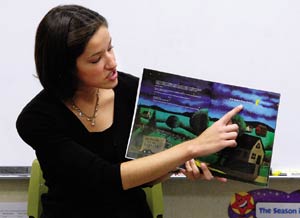
First-year teacher Megan Bair, who teaches first grade at Paradise Valley Elementary School, said though she grew up in an educational environment, the first few weeks of school were still an adjustment.
“My mom is a teacher, so I’ve grown up with it, but it is still a little overwhelming,” she said. “I’m getting used to the schedule, to all the paperwork coming at you from all different areas. Kathy Hendricks, my mentor, has been just wonderful with all of this. I have a great first-grade team, and my principal has been very supportive. It’s great, though, to have that additional level of support.”
She noticed quite a difference between being in the classroom with another teacher and being on her own, Bair said.
“It’s exciting having my own class, but it’s quite a responsibility,” she said. “The parents have been great. I was afraid they would worry that their kids were in the class with a brand-new teacher, worry that their kids were guinea pigs, so to speak, but that hasn’t been the case. They’ve been so supportive.”
Entering the classroom for the first time can be intimidating, the three mentors agreed, even if a teacher has been extremely well-prepared and given examples of what to expect.
Challenges that veteran teachers face daily can loom even larger when the teacher has little or no experience, they agreed. The problems of trying to bring lower-performing students up to grade level, while still challenging the and higher-achieving students is a challenge for most teachers, and the BTSA program offers strategies for teaching all students the standards.
Bair said that her mentor helps smooth her entrance into the teaching profession and give her the opportunity to meet periodically with other new teachers through the program.
“It’s amazing, knowing you’re not alone, being able to connect with other people with the same worries and concerns,” she added.
Healy, Grover and Hendricks explained one of the program’s biggest functions is to provide classes so new teachers can complete state requirements to earn their teaching credentials.
“Our teachers complete course work at the graduate level they need to clear their credentials,” Totter said.
Some of the new teachers hired are not credentialed, and some of them are working on credentials in a second subject.
The mentors also spend at least one and a half hours per week with each of their teachers, sometimes more. And there are seminars and meetings the teachers attend, outside of any school or district meetings.
Foster said all of the aspects of the program provide different tools for teachers to use in the classroom, as well as for themselves.
Healy agreed, saying the purpose of the mentors is not to provide a “script,” but in fact the opposite.
“We’re here to encourage new teachers to take risks, to try something new,” she said. “We all know we have to teach the standards, but we want to help them develop their style. We’re there to encourage them, to talk to them about what went right with what they tried and what went wrong.”
What’s good for the teacher is good for the student, Superintendent Alan Nishino said.
“(The BTSA program) is a critical piece of providing an excellent education for our students,” he said. “I don’t think we’ve done a good a enough job nationally working with new teachers. I am very optimistic about where we are headed … I am a firm believer in staff development.”