The pastoral life is alive and well at Ann Sobrato High School,
despite downward trends elsewhere in the city and the country.
Morgan Hill
The pastoral life is alive and well at Ann Sobrato High School, despite downward trends elsewhere in the city and the country.
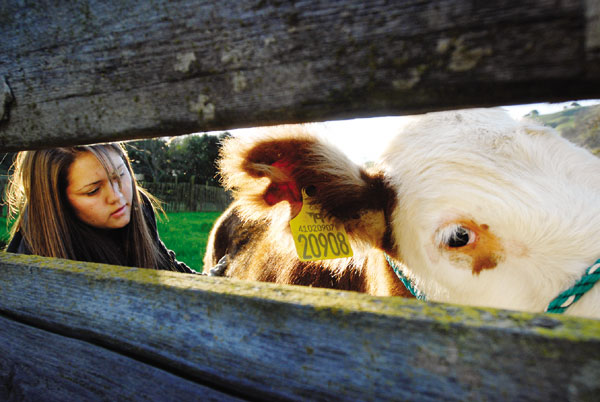
Sobrato’s branch of the National FFA Organization has exploded in five years. What started with just 26 members is now a 281-member campus group that boasts popular events during lunchtime and competes in statewide tournaments.
The lure lies in the hands-on experience and business skills learned when taking agriculture classes, students said.
“It’s not just biology,” junior Kathleen Bello said.
Myndi Muzic is in her second year teaching the program. Her co-teacher Tanya Salo is in her first. Both are Cal Poly San Luis Obispo graduates.
Muzic grew up on a five-acre farm in Southern California. While she was an avid cheerleader, Muzic enjoyed “living off the land,” which she learned from her grandfather who survived the Great Depression.
“We had a horse, chickens, a large vegetable garden,” Muzic said. “That’s why I became an agriculturist.”
The two teachers’ enthusiasm seems to be paying off. Many of their students have their eye on careers directly related to the field.
Junior Briana Wallash originally joined so she could work with animals.
“I thought it was cool,” she said. Now, Wallash is interested in being a soil chemist.
Junior Tracey Salvador is interested in a field in floral design, sophomore Joey Cassibba wants to be a large animal veterinarian and Bello would like to be a farmer.
While this is music to the teaching duo’s ears, they know that not all students will pursue careers in agriculture.
“When county fairs started, 98 percent of Americans were in production agriculture. Now, it’s just 2 percent,” Muzic said. Because of that reality, FFA isn’t just about tilling fields and raising livestock anymore. Since students can pursue specialized careers in law, government and communications – to name a few – there are three components to agricultural education that diversify the subject. There’s traditional book learning in the classroom, a leadership component and the hands-on supervised agriculture experience project. Together, the three parts “help prepare (the students) as people, not just agriculturists,” Muzic said.
Live Oak High School has a long tradition in FFA. The two organizations follow the same national program and do not compete, Muzic said.
Bouyed by recent success, Muzik and Salo have high ambitions for the program.
“Our goal is to teach ag literacy in our community, in the region and the state and even the nation,” Muzic said. “What that 2 percent does is directly related to the other 98 percent. It’s important to get ag literacy.”