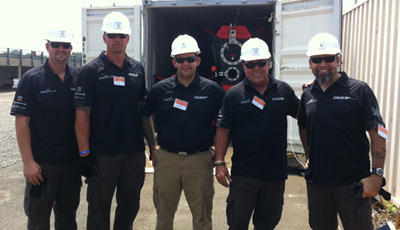
Many people know Dan Creighton as the owner of Huntington
Station, the popular downtown Morgan Hill restaurant and bar. What
might not be as well known is by October, Creighton and his other
company, Vor-Tek, could be the $1 million winners of an elite
contest to find the most promising new technology in the oil-spill
cleanup industry.
Many people know Dan Creighton as the owner of Huntington Station, the popular downtown Morgan Hill restaurant and bar. What might not be as well known is by October, Creighton and his other company, Vor-Tek, could be the $1 million winners of an elite contest to find the most promising new technology in the oil-spill cleanup industry.
Creighton, 49, is a partner and the project manager for Vor-Tek Recovery Solutions. The company is one of 10 finalists in the Wendy Schmidt Oil Cleanup X-Challenge, an exclusive international competition organized by the nonprofit X-Prize Foundation to encourage the innovation of technology that can achieve unprecedented results.
The winners of the competition – $1 million for first place, $300,000 for second place, and $100,000 for third – will be announced next month in Washington D.C., according to the X-Prize website. Creighton and his teammates are optimistic, not only that they’ll win but that their patented oil extraction device will set a new standard.
Vor-Tek was the first team to test its equipment for the X-Challenge, at the OHMSETT oil spill research facility in New Jersey in July, Creighton said. While their official results won’t be revealed until October, unofficially the team knows they can far exceed current industry norms.
“We did the best we could, and I have a great feeling about it,” said Creighton, who can hardly wait until the winners are announced.
The X-Challenge is one of numerous technology competitions organized by the X-Prize Foundation, according to the X-Prize web site. Each contest has a different theme, and the purpose of the oil cleanup competition is to “inspire a new generation of innovative solutions that will speed the pace of cleaning up seawater surface oil resulting from spillage from ocean platforms, tankers, and other sources.”
Previous X-Prize competitions have resulted in new technology for space-traveling aircraft, and breakthroughs in fuel efficiency for motor vehicles, according to the foundation’s website.
The oil challenge was inspired by last year’s Deepwater oil spill in the Gulf of Mexico, which spewed about 215 million gallons of oil into the gulf – creating an oil slick up to 4,000 square miles on the surface of the water, according to the X-Challenge website.
And that’s just one incident. Creighton said there are at least 50 oil spills daily worldwide, and each year more than 700 million gallons of waste oil enter the ocean. The environmental as well as the financial costs of such pollution are overwhelming, with the Deepwater spill alone estimated to cost more than $1 billion by the end of the year.
Current methods of cleanup rely on decades-old technology – such as containment booms and skimmers – that are inefficient and able to extract small amounts of oil, Creighton said. Some methods, such as chemical dispersants, themselves have unknown detrimental environmental impacts.
The oil extraction standard for the X-Challenge is higher than what most technology is capable of, as Creighton said the contest is known for setting “unrealistic” goals. The winning teams have to be able to recover oil from the sea surface at a rate of 2,500 gallons per minute, with a 70-percent oil recovery rate.
“The standards for this competition are well above today’s capabilities,” said Cristin Dorgelo Lindsay, X-Prize Foundation vice president of prize operations. “What we’re looking at here is a radical step forward in terms of the performance of mechanical cleanup technologies.”
While she couldn’t reveal any of Vor-tek’s testing results as four teams still haven’t tested for the competition, Dorgelo Lindsay said the team was able to quickly set up and disassemble their equipment – another criteria to win.
“That means they are able to deploy and break down in a real-world time frame,” Dorgelo Lindsay said.
Vor-Tek’s technology is known as the Emergency Extraction Line system – or EEL. Vor-tek founder and president Ashley Day described it as an “integrated boom line,” a series of mechanical intake boxes that float on the surface of the water, connected by containment lines and hoses.
The EEL is unique because it “contains and sucks” oil from the water, Day said.
The current top 10 finalists in the X-Challenge were picked from a field of more than 350 entrants from all over the world.
Ironically, one reason the EEL system has tested well so far is because it was developed by a team that might have a wealth of knowledge in technology research, but “zero experience” in oil extraction, Creighton said.
The EEL system is a modification of a device that Day had already been working on to remove plastic trash from the ocean.
“We’re trying to revolutionize the industry by looking at it from a different angle. We’re not influenced by the industry,” Day said.
Vor-Tek’s six-person team has decades of experience in the scrap metal industry, but now occupy a “hodge-podge” of careers, Creighton explained. One partner is a former airline pilot, one is a tattoo artist and Day is a former professional basketball player.
And Creighton is a restaurant owner who opened Huntington Station with his wife Deb at its current Third Street location last year. Before that, the couple ran the restaurant as Glory Days just a block over.
But Dan Creighton has also been a builder, designer and fabricator in the steel industry, developing car shredders and metallics separators.
He is excited to now be part of a state-of-the-art system that is a potential “environmental game changer.”
By contrast, half of the teams in the X-Challenge are “experienced and known in the industry,” Dorgelo Lindsay said. Five of the teams hail from Europe. The international panel of judges are experts from the industry.
Even if they don’t win the contest, the Vor-Tek team is confident the EEL can win big in the market, as it can also clean up oil below the surface of the water, and be rapidly deployed from the decks of oil rigs and other vessels for use not only in emergencies but also in routine maintenance, Creighton said.
“This has been one of the best experience I’ve had. It’s the most fun I’ve ever had in research and development,” Creighton said.