Community members who
”
graded
”
Morgan Hill school trustees on their second round of completed
goals as part of the Times’ Accountability in Community Leadership
Project gave them average grades and most board members were
equally demanding as they graded themselves.
Morgan Hill – Community members who “graded” Morgan Hill school trustees on their second round of completed goals as part of the Times’ Accountability in Community Leadership Project gave them average grades and most board members were equally demanding as they graded themselves.
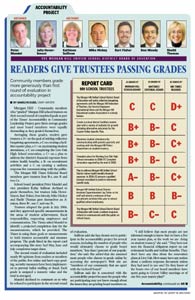
Averaging those grades, readers gave trustees a D+ on the goal of settling collective bargaining agreements, a C on creating a facilities master plan, a C+ on maximizing student attendance, a C on completing the Live Oak High School renovation, a C+ on a plan to address the district’s financial exposure from retiree health benefits, a B- on recruitment activities and a C on creating a uniform response for communicating with the public.
The Morgan Hill Times Editorial Board members gave trustees four B-s, one B and two Cs.
School board president Peter Mandel and vice president Kathy Sullivan declined to grade themselves, but trustees Julia Hover-Smoot, Bart Fisher, Don Moody, Mike Hickey and Shelle Thomas gave themselves an A-minus, three B+, one C and one B-.
Trustees adopted the goals in July 2006, and they approved specific measurements in the areas of student achievement, fiscal responsibility, respecting employees and communication. The Times asked Mandel to identify a projected completion date for the measurements, which he provided. The Times is using those goals or measurements to hold trustees accountable and measure progress. The goals listed in the report card accompanying this story had May, June and July completion target dates.
The second round of evaluation included nearly 80 opinions from readers or members of the public. For online and hard copy grading, security measures have been implemented to prevent ballot stuffing or fraud. Each grade is assigned a numeric value and the total is averaged.
Mandel declined to comment as to why he refused to participate in the second round of evaluation.
Sullivan said she has chosen not to participate in the accountability project for several reasons, including the number of people who would ultimately choose to grade board members, “less than 1 percent of our population,” she said. She added that she assumed most people who choose to grade online by accessing the newspaper’s Web site are “members of our community that are upset with the (school) board.”
Sullivan said she is concerned with the accountability project because the people who are participating may not know enough about the issues they are grading board members on.
“I still believe that most people are not informed enough to know that we have a five year master plan, or the work we are doing on student truancy,” she said. “They have not seen the financial obligation report on our retirement health and welfare benefits. They don’t have any idea about the renovation plans at Live Oak. How many have any notion about a uniform response document unless they had need to use one? Do they know of the hours two of our board members have spent going to Coyote Valley meetings or of our five year master plan?”
Trustee Thomas’s report card contained a mixed bag, with a few Fs, several Cs and an A. She gave the best grade for the goal of looking at the district’s financial exposure for retiree health benefits.
“The plan has been presented to the board as prescribed by law,” she commented. “The District is in sound financial health due to a ‘pay as you go’ approach utilized by the business office.”
Thomas gave the district’s recruitment goal a C.
“The human resource staff has worked hard to replace administrators, teachers and classified employees. With 75 teachers leaving this year, approximately 25 percent retirees, recruitment is crucial,” she said. “There are still hard to fill positions in special ed, speech, math and science … Working toward retention would reduce the scope of this problem in the future. Recruiting and retaining qualified teachers must be given top priority by the district.”
Thomas gave an F to the board for its goal of creating a uniform response criteria to respond to the public on school issues.
“I would like to know the ‘process’ developed addressing public concerns so that I could share it with people who contact me and people who speak before the board on issues could have a response,” she commented.
Trustee Julia Hover-Smoot gave good grades to board efforts, with As for most goals, two Cs and a B. She awarded the district’s recruitment activities a B, but said her “big issue” is the fact that the recruitment doesn’t necessarily mean that quality teachers are being hired.
“Although we have made a good effort (with recruitment), I am not completely satisfied with who we are hiring,” she commented. “Too many interns, not enough experienced credentialed teachers and too many temporary teachers. The number one indicator of educational quality is the teacher. We must focus on the quality of the teacher in the classroom.”
Hover-Smoot gave the board a C on the goal to create a uniform response criteria to communicate with the public on school issues.
“We must involve parents more actively,” she commented. “We still must improve our overall communication and make a greater effort to help parents understand how important they are in the education of our children.”
Trustee Mike Hickey graded the board well, giving As for the facilities master plan, maximizing student attendance, addressing the retiree health benefits financial exposure, recruitment and response criteria.
“I believe the district staff works exceptionally hard to help us fulfill our goals,” he said. “If you look at what has been accomplished in connection with the goals, we’re doing very well.”
He gave two Bs on the report card, one for the collective bargaining and the other for plans for finishing Live Oak High.
“Even though our district has been working diligently to complete Live Oak, I do not feel comfortable giving us an A grade until it is completed.” he said.
Trustee Don Moody gave the board high grades, all As except for one C, the lowest grade he gave to the board’s goal to settle collective bargaining agreements.
Trustee Bart Fisher also gave the board passing and above average grades. He gave the collective bargaining goal a C, an A on the district facilities plan goal, a B on maximizing student attendance, an A on the Live Oak High renovation, a B on the retiree health benefits assessment, a C on recruitment and an incomplete on the communication criteria.
“While this (recruitment) goal was fulfilled, we still started the year with some substitutes in place,” he commented. “I would like us to be more proactive and creative, even in the face of teacher shortages, in securing full-time personnel well before the school year begins.”
Three goal measurements remain for the 2006-07 period. Trustees have set two student achievement goals with target dates of August and a communication goal with a target date of September. One of the goals under student achievement is that students will achieve or exceed grade-level benchmarks in statewide assessments; the other student achievement measurement says that the district’s site principals will review, analyze and use all assessment data for English learners to monitor their progress. Under communication, the last goal measurement is that board meetings will be videotaped.
Times editorial board members commented that they would like to see more “action” rather than plans for action.
On the recruitment goal, David Cohen said he would like to see more information.
“It would be good to know what the turnover rate is, quantify the reasons teachers leave and rank them, so solutions to those issues can be developed,” he said. “Some reasons are not fixable – spouse relocation for example, but others have the potential for solving.”
Times editorial board member Laura Gonzalez-Escoto said she would give the board an “Incomplete” in a couple of areas, the communication criteria and maximizing student attendance.
“What’s missing is the evidence as to whether or not these programs, policies and procedures have produced desired results, namely, increasing attendance,” she said. “I cannot grade without facts – reporting on activities alone do not tell whether or not actions taken have achieved the desired results.”