While most of the local economy has limped along on declining
tax revenues and rising unemployment in recent months, the health
care industry in Morgan Hill is thriving.
While most of the local economy has limped along on declining tax revenues and rising unemployment in recent months, the health care industry in Morgan Hill is thriving.
That’s largely by design, and not just because the need for medical services is assured no matter any community’s economic state. The city’s efforts to attract more doctors, including a variety of medical specialists, began shortly after the closing of Saint Louise Regional Hospital in 1999 and peaked recently with the opening of urgent care services in February.
Plus, the organization that owns both the DePaul Health Center in Morgan Hill and the hospital whose main campus is now in Gilroy, has stayed devoted to establishing a strong regional presence in southern Silicon Valley despite the downturn in the economy, according to SLRH spokeswoman Jasmine Nguyen.
“It is our goal to expand convenient services and access to a broader range of health care services for residents in our communities,” Nguyen said. “Our regional expansion will also attract additional support and resources to both campuses.”
The opening of the DePaul Urgent Care center completed a crucial phase of the development of health care services in Morgan Hill. For the first time since SLRH’s move to Gilroy emptied the 67,000-square-foot former hospital and adjacent medical buildings on DePaul Drive, Morgan Hill residents gained a place to see a doctor for minor medical emergencies when their normal physicians’ offices were closed – without having to drive to Gilroy or San Jose.
Another important milestone in the opening of urgent care is that it occupied the last available spot in the DePaul Health Center, a two-story medical office complex that has slowly filled with primary care and specialty doctors and as of February, is fully occupied for the first time in more than a decade.
“It gives our residents a lot of local options, and they don’t have to go out of town to get the services they need,” Mayor Steve Tate added.
Doctors throughout the complex now offer not only basic primary care and internal medicine – they also offer oncology, cardiology, ob/gyn, dermatology, orthopedics, pediatric, pain management and most other needed specialty services, explained Joe Mueller of the Morgan Hill Community Health Foundation.
The MHCHF was started by the city council about 10 years ago as a direct response to the closure of the hospital, in order to counteract the corresponding flight of doctors from Morgan Hill. The nonprofit’s strategy was to first bring back primary care physicians to make referrals to specialists, many who eventually found an ongoing need for their services in Morgan Hill and available office space at DePaul.
Next, SLRH and the MHCHF will work on opening the former hospital, which still sits empty next to the DePaul complex.
“It all started with our ability to attract new primary care doctors. Now, we’re finding all the primary care and key specialties are covered,” Mueller said. “The final piece was adding urgent care. The next step is to increase outpatient services.”
The foundation continues to follow up on the local health care industry on its web site, where contact and location information about Morgan Hill doctors is listed.
SLRH and its parent company, Daughters of Charity Health System (also the parent company of the DePaul facilities), are in the fundraising process to complete the next phase of the hospital’s regional long-term facilities plan, Nguyen said.
That plan includes reopening the Morgan Hill hospital to offer various outpatient services, including minor surgeries that don’t require an overnight stay, and a retail pharmacy. It also includes an expansion of the emergency room at the Gilroy hospital, which served more than 27,000 patients in 2009 – three times the national average per ER bed, Nguyen said.
SLRH is not operating on a strict timeline to complete these capital-intensive steps in the long-term plan, and there are currently no plans for DOC to develop an overnight ER in Morgan Hill.
The stream of patients seen at DePaul Urgent Care indicates the need for the services probably never left Morgan Hill.
Janine Moreno, 40 of south Morgan Hill, was in need of urgent care services Monday afternoon, when she was waiting for the office to open and her regular doctor – who also has an office at DePaul – was away on vacation. Moreno declined to specify her condition or ailment, but said if the local urgent care facility was not open, she would have had to drive to the ER in Gilroy.
The local facility offers convenience to Moreno and her 7-year-old son, even if they only need urgent care services occasionally.
“We’ve needed something like this a long time,” Moreno said. “It’s nice to know this is here.”
Between February and June, the urgent care center, which is open on the weekends and during weekday evenings, served more than 2,200 patients, Nguyen said.
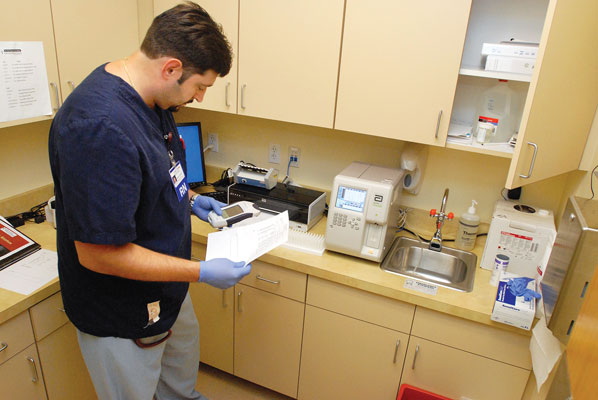
The center is fully equipped to serve up to five patients simultaneously, with “state-of-the-art” equipment and facilities, nurse Hazel Decker said. Nurses and doctor’s on staff at DePaul Urgent Care are all trained to serve in the ER, as Nguyen added that the quality of staff throughout DePaul and SLRH is the organization’s “best-kept secret.”
However they caution that urgent care and the ER are not the same.
“There are things we can’t handle here, like chest pains,” which requires an immediate visit to the hospital, Decker said.
Specialists inside the DePaul Health Center have been pleased with their reception since moving into the bustling medical complex that was almost vacant 10 years ago.
Urologist Amir Saffarian moved his practice into DePaul about eight months ago from Marin. Since then, he has seen about 500 patients in Morgan Hill and his practice has grown steadily.
“We’re growing more rapidly (now) than at the beginning, when we started (in Morgan Hill),” said Saffarian, whose wife runs his front office. “The community of physicians out here is so supportive of new doctors.”