When the going gets tough, the tough get praying. So say Morgan
Hill religious leaders and churchgoers
When the going gets tough, the tough get praying.
So say Morgan Hill religious leaders and churchgoers. They’ve formed a tighter-knit community, seeking emotional and sometimes financial solace as well as a sense of larger purpose and community during these trying economic times.
Churchgoing, they say, provides a feeling of belonging and a sense of security: believers needn’t fear since, as their faith teaches, they can trust in a higher power.
Crossroads Christian Center Pastor Jim Wallace said he has counseled people who are dealing with depression and other issues related to the economic challenges. There are more families in the church’s monthly food program, which has gone from a distribution of 60 boxes per month during the fall of 2007 to about 100 for the past several months.
“The biggest concern that people have is taking care of their family,” Wallace said. “Family members that in the past have been able to help aren’t as able to do that.”
Churchgoing helps families realize that they’re not alone, he said.
“They have God’s help and also the encouragement of God’s people with them. The scripture talks about the fact that if we trust in him, we don’t have to worry about what we eat or having shelter. If he takes care of a sparrow, he’ll take care of us.”
Margarita Saenz, a single mother of three, said this sense of security has sustained her over the years. She’s met other single mothers, and has had the support of other parishioners.
“We’re just a big family,” she said.
Saenz said that without the church’s “blessings,” which included prayers, community and gifts, her family’s Christmas would have had little celebration.
Her faith has been her “main source of strength and hope,” she said.
For thousands around Morgan Hill, the story is the same.
Even for those who are not having economic difficulties, their faith sustains them in other needs. The Kirchners leaned on religion when going through an arduous international adoption process.
“It’s an important element of life and family,” Nick Kirchner said of faith.
Brianne England sought the stability church provides after her father’s death and having two children.
“It was a great support in my life at that time,” England said. “I feel extremely blessed to have what I have.”
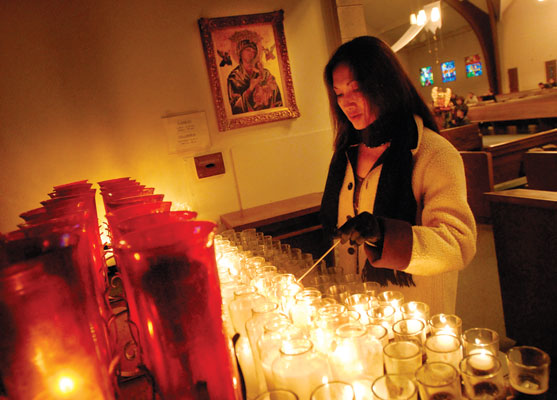
These churchgoers, who celebrated a Sunday Mass at St. Catherine’s Catholic Church, agreed that if they had economic problems, they would no doubt turn to their faith for sustenance.
Still, the verdict is out on a larger trend of church attendance being affected by financial markets. A December New York Times article theorized that evangelical church attendance spiked during economic woes, based on a temperature read of churches nationwide and a scholar’s essay. A few days later, Gallup pollsters debunked the theory using 2008 data, with a steady 42 percent of 1,000 people polled saying they attended church weekly or almost weekly, with no increase September through December.
Congregation Emeth Rabbi Debbie Israel said since opening their first permanent synagogue in Morgan Hill, attendance is up. She hesitated to attribute any uptick to families seeking spiritual relief from economic worries, though.
“Congregants who are attending our services and programs are as frightened and concerned about the economy in general and their personal finances in particular as everyone else in America,” she said. “Hopefully, through the prayer experience, those who attend religious services are finding solace and comfort.”
Israel said the best “religious” response to the economic turmoil is to reach out to those in need.
“Be proactive, checking up on our relatives, neighbors and friends,” she said. “What do the people around us need to sustain themselves and what is within our power to do?”