


Religion: Ramadan: A season to reflect and be generous

This Saturday, April 2, Muslims will begin our month-long daytime fasting. Fasting in its infinite variations is practiced by many faiths, East and West. For Muslims, Ramadan goes beyond fasting; it is a season to be generous and forgiving.
It is said that the Gate...
Guest view: 2017: The year in water

2017 will be a memorable year for Santa Clara County, especially for water resources management.It was the year that broke our state’s longest dry streak with record-setting precipitation. A year of transition between extremes—from drought to floods. A year for big decisions on the future of our water supply. And it was a year to redouble our commitment to preparing for wet and dry years to ensure safe, clean water for a healthy life, environment and economy for the Silicon Valley.As Board Chair of the Santa Clara Valley Water District, I am proud to reflect on some of the year’s highlights. A historic flood along Coyote Creek was a vivid reminder that flood risks persist in our county, and our hearts go out to those affected. Despite our investments of close to $1 billion in flood protection projects over several decades protecting nearly 100,000 parcels, our work is far from complete. The Coyote Creek flood has ignited a new urgency in our fight to reduce flood risks and help keep communities safe.This year, we completed the Lower Silver Creek Flood Protection Project in east San Jose. The project extends approximately 4.4 miles from its connection at Coyote Creek to Cunningham Avenue. When the Lake Cunningham detention basin is complete, it will protect approximately 3,800 homes and businesses. After the Coyote Creek flood in February, my colleagues and I led advocacy efforts in Washington, D.C., to seek federal funding and support changes to the regulatory process, which has delayed many important flood protection projects. At home, we took immediate action to build short-term flood barriers at the Rock Springs neighborhood, remove invasive vegetation along Coyote Creek and remove downed trees and potential creek blockages. The board also approved new operating parameters at Anderson and Coyote reservoirs to create more storage space, further reducing the chance of flooding.In one of the most critical decisions of the year, the water district board voted to participate in the California WaterFix project to improve the infrastructure that carries water from the Sacramento-San Joaquin Delta. Our board developed a list of seven guiding principles to examine a less costly, scaled-down and staged project that would serve Silicon Valley’s needs, as well as those of our partner agencies.To further improve reliability of our imported water supply sources, we applied for $484.5 million in state funding for the potential expansion of the Pacheco Reservoir. Located about 13 miles southwest of San Luis Reservoir, this project offers emergency and drought-year supply, fish habitat enhancement, flood protection and other benefits. Another way we are preparing for the future is through expanding the use of recycled water.No doubt about it, 2017 was a forward-moving year. I wouldn’t expect anything less for the Silicon Valley, and I am humbled to have led the efforts this year. Follow more of what we accomplished throughout the year in our 2017 annual report, available at valleywater.org.John Varela represents District 1—which includes Morgan Hill, San Martin, Gilroy and hills east of San Jose and Milpitas—on the Santa Clara Valley Water District Board of Directors. He can be reached at [email protected].
Guest view: Substation site would impact rural area

The Times noted in the Sept. 30, 2015 article on PG&E’s proposal to build a new substation in South County, "The last open house took place Sept. 28 at the Morgan Hill Community Center. Two previous sessions took place in Gilroy and San Martin.The trio of meetings was sparsely attended, but the public can continue to provide feedback to PG&E via email, phone or the internet.”I believe the sparse attendance was by design on PG&E’s part and not apathy on the part of those who will be negatively impacted. I was completely unaware of this project as were most of my neighbors when we just recently learned of the plan and the eight possible locations for the substation. We learned that mailers had been sent out, but were intermingled with other ads and junk mail, and easily dismissed rather than in an envelope PG&E would normally send customers regarding matters of importance.Many of us are now scrambling to understand how these eight sites were determined. It obviously wasn’t using valuable public feedback.Three of the sites are particularly distressing to the residents along the scenic Watsonville Road Wine Trail corridor. The “Watsonville C” site location is particularly troubling for my family in that it will be built directly across the street from our house! My neighbors are understandably equally troubled.This is such a scenic area that it is hard to fathom how PG&E would even consider a 6-acre substation and its devastating impact. The impacts are devastating in potential health effects for those living in the vicinity, environmental considering the impact to Little Arthur and Uvas creeks, and loss of property value.I am also wondering where our county stands on this very important matter. I have yet to hear back from our District 1 County Supervisor Mike Wasserman to whom I have sent several emails. The county should have been giving PG&E guidance, direction and input from the start because there are obviously so many zoning, planning and permit issues.Redwood Retreat Road has by county ordinance been designated as a scenic road and as such the county has placed limits on building in order to preserve the beauty of the area. So again, my question is, why wouldn’t the county be involved and also keeping us informed? Mike Wasserman has never mentioned the South County Power Connect Project once in his newsletters—leaving me to wonder, why?John Tepoorten and his family have lived on Redwood Retreat Road for 19 years. PG&E is in the outreach phase of its South County Power Connect project, which will add a new substation and new transmission lines to South County to enhance the electrical grid. To learn more about the project and the eight substation site options, visit pge.com.
Religion: The positive power of faith traditions in the community

Dr. Martin Luther King Jr., in teaching about faith, stated “The God whom we worship, is not a weak or incompetent God. He is able to beat back gigantic waves of opposition, and bring to low, prodigious mountains of evil. The ringing testimony of...
Guest view: School site needs better soil/air testing
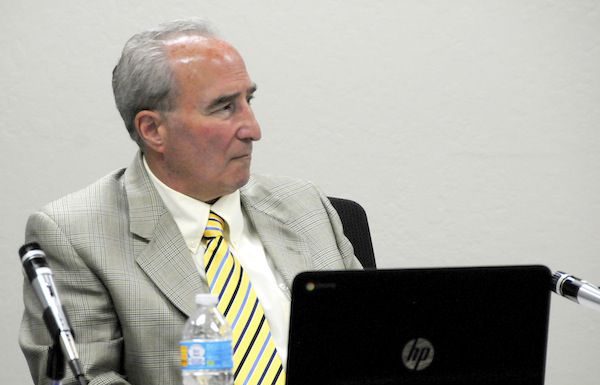
On June 27, the Morgan Hill Unified School District Board voted yes to go forward with remediation on the Peet Road/Borello property, where the district plans to build a new elementary school. The vote was four in favor, three against. On June 28, an article was written in the MH Times that did not reflect some key concerns highlighted during the meeting that questioned the successful monitoring of the safe levels of the toxin dieldrin during the projected August remediation.I did an extensive research into the district’s Removal Action Plan (RAW), as I was concerned about several factors, namely: the placement of only three or four air monitoring units described; the environment unique to Morgan Hill, primarily our winds and gusts; the 24-hour turnaround for the actual results; and exceeding the fence line “stop work” number of .05 mg/m3.I spent a majority of my career working with designing/analyzing measurement and testing equipment. I saw a disconnect in the amount of air monitoring units proposed in the RAW, coupled with the lack of information about the accuracy of these units. These two factors alone are concerning. The RAW indicated prevailing winds in that region of Morgan Hill as 3 mph. This is incorrect; I have personally been monitoring winds and gusts in Morgan Hill on key meteorological sites for 60 days. The actual winds and gusts are in the area of 9 to 16 mph.I then called Thermo Fisher, the maker of the measuring unit. The technical expert indicated the accuracy is +/- 5 percent based on constant calibration (manual) of the temperature and humidity; this information was not indicated in the district’s RAW. The Thermo Fisher expert then indicated the diameter of the air chamber is only 1 inch wide by 3 inches long. This expert then asked the length and width of the area being measured. I replied, nine acres, and he suggested 91 units are needed to accomplish a 95 percent confidence level. I asked if we can reduce the number of units and he said you can halve the 91 units to 40 at a distance of about 5 feet apart, but the confidence/success level will be reduced. This information was not included in the RAW report.At the June 27 board meeting, I asked the consultant of the Peet Road project, with a Department Of Substances Control representative on the phone via teleconference, if he knew the accuracy of these measuring units and the answer was NO. I asked if he knew the diameter of the air chamber, and the answer again was NO.I expressed my concerns that the RAW is only recommending one-tenth of the air monitoring that the experts say we need to protect the surrounding community with a high degree of success. The consultant and DTSC were unable to answer my questions regarding the wind/gust factors relative to when dirt dries and becomes airborne given temperatures above 80 degrees.The district’s RAW raised many other questions that need answering including why the soil wasn’t retested in the area that encompasses the proposed grassy area that students will be playing on. This planned grassy/field area is almost 56 percent of the Borello property.Our children will be exposed to TOXINS on a daily basis unless DTSC initiates further testing to be absolutely sure of the level of toxicity/Dieldrin in this quadrant of the land. I have a duty of care as a Trustee, I voted not to proceed.Gino Borgioli is a Morgan Hill Unified School District Trustee. He was elected to the board of education in 2014. He can be reached at [email protected].

