As the California High-Speed Rail Authority goes back to the
drawing board on an environmental report for the train segment
through South Santa Clara County, city officials will continue to
push for a track alignment along U.S. 101 through Morgan Hill.
As the California High-Speed Rail Authority goes back to the drawing board on an environmental report for the train segment through South Santa Clara County, city officials will continue to push for a track alignment along U.S. 101 through Morgan Hill.
The current alignment preferred by the state board overseeing the 800-mile, $45 billion high-speed rail system has the tracks running along the eastern side of existing Union-Pacific tracks. City officials, however, have long noted a preference to place the 220-mile-per-hour train next to or in the middle of the freeway.
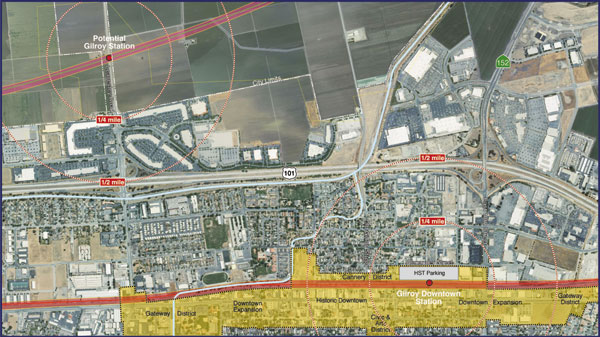
On Wednesday, the city council approved a joint resolution with the city of Gilroy to support a U.S. 101 alignment through Morgan Hill. The resolution also supports developing a station for the train system in downtown Gilroy at the existing Caltrain station, and expresses both cities’ desire not to allow the station location to determine the tracks’ route through South County.
Morgan Hill City Manager Ed Tewes said the intent of the resolution is to display a “strong voice” among local cities for support of an HSR route over Pacheco Pass to get from the coast to the Central Valley.
“Our concern is if there is not a strong South County voice, as there is a strong Peninsula voice, the (HSRA) might get the impression we were not supportive of the Pacheco Pass option,” Tewes said.
The resolution also notes that if the station location in Gilroy turns out not to be viable, then both cities would support a high-speed rail station in Morgan Hill.
Although the HSRA has proposed a track alignment through downtown Morgan Hill east of the Union-Pacific tracks as its first preference, the city hopes the environmental report on the Pacheco Pass option will study the option of an alignment along the freeway, according to Planning Manager Jim Rowe.
The proposed route along the existing tracks would create a new barrier dividing the community with an elevated track, aesthetic impacts and loud noise, according to a staff report presented to the council.
At an HSRA meeting in Sacramento Thursday, the state board voted to scrap its working environmental report on the Pacheco Pass segment from San Jose to Merced, after Sacramento Superior Court Judge Michael Kenny ruled in August that portions of the environmental impact report for the Bay Area-to-Central Valley route would need to be rewritten.
Specifically, the rail authority needs to conduct additional studies on the impacts of the vibrations of trains running at full speed through urban areas.
Kenny also ruled that the HSRA must consider alternatives in case Union-Pacific does not allow them to use their right of way.
Rowe noted that Union-Pacific has indicated it will oppose any option that places the high-speed train on its right-of-way, making further study of an alignment along the freeway more important.
Another option being considered by the HSRA is to carry the train into the Central Valley via the Altamont Pass instead of the Pacheco Pass. A route along the Altamont Pass would completely bypass Santa Clara County, Tewes said.
Riders on the high-speed train could travel the 123-mile stretch through Pacheco Pass in 45 minutes.
Also at the HSRA meeting Thursday, board member and former county supervisor Rod Diridon convinced the board to keep the option of a trenched alignment through downtown Gilroy on the table. Morgan Hill officials have not taken a position on whether the tracks through the city should be trenched or elevated, Rowe said.
Dave Mansen, regional manager for Parsons Corporation and regional team manager for the Authority, said that trenching the tracks near Gilroy would add as much as 20 percent to the costs of the San Jose-to-Merced portion of the project. Although the entire project is expected to cost $45 billion, specific costs of the various project alternatives have not been determined.
Staff discussed a number of options for the train’s exact route, whether it should be trenched or elevated in certain areas, and station locations. Running the tracks along U.S. 101 in Morgan Hill was discussed.
Other viable options recommended by staff included running the tracks east of U.S. 101 near Gilroy, which would eliminate 10 more homes than the UP alignment, or running them through downtown Gilroy.
Further north, staff said the authority could consider running the tracks along U.S. 101 near Morgan Hill, allowing for wildlife crossings in the Coyote Valley area.
The high-speed train’s impact on existing structures in Morgan Hill is unknown as the studies have not progressed that far yet, according to Rowe. However, he said the impact would be less here than in Gilroy.
Details of an alternative alignment option along U.S. 101 through Morgan Hill and South County, including where it would turn west to reach downtown Gilroy, have not yet been determined, Rowe said.
The HSR system will include routes from San Diego to Sacramento and to the Bay Area, transporting passengers at speeds of up to 220 mph.