The 8.0 earthquake hit the Morgan Hill area at 3:30 a.m. Police
and firefighters went into action but were almost immediately
overwhelmed by the extensive damage and number of casualties. Gas
and water are leaking from mains all over the city and the phone
systems are out or overloaded.
The 8.0 earthquake hit the Morgan Hill area at 3:30 a.m. Police and firefighters went into action but were almost immediately overwhelmed by the extensive damage and number of casualties. Gas and water are leaking from mains all over the city and the phone systems are out or overloaded.
All freeway overpasses are down except for Main Avenue, safe only to foot traffic. Saint Louise Regional Hospital was badly hit and the emergency room is operating at 30 percent.
At the same time, teams of neighborhood volunteers, trained to assist the first responders, also went into action, working to bring order out of chaos, to identify the most badly injured, douse small fires and to search and assess damaged structures. These are the Community Emergency Response Teams (CERT).
This was the scenario faced Saturday by 20 almost-graduates of the latest disaster preparedness class offered by the South County Neighborhood Disaster Preparedness Project (SCNDPP) and the Morgan Hill Police Department’s Office of Emergency Services (OES).
The Homeland Security Dept. in Washington, D.C., has decreed that every city will prepare for terrorist attacks. Seattle and Chicago held disaster exercises a week ago that received nationwide coverage. Santa Clara County is already ahead of the pack, holding regular meetings to plan and coordinate between first responder agencies and, also to train civilians to step in when police and firefighters would need help.
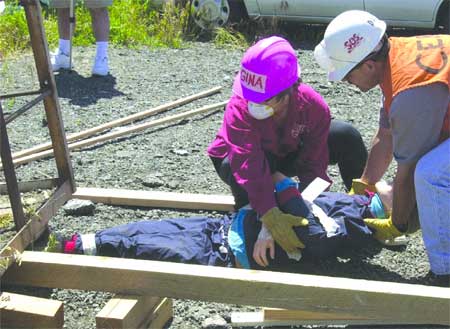
When the whistle blew at the California Department of Forestry station on Monterey Road Saturday morning, the team members left the building to find one structure “heavily damaged with a gas leak and small fire” and a second disaster site with “trapped and injured victims, another fire and downed and live power lines.”
It was impossible to ignore the screams coming from “victims” who were covered with fake blood and gore since the Live Oak High School drama students who volunteered for victim duty got into their parts with gusto.
Dividing into four teams – medical, search and rescue, logistics and command – the class fanned out to begin dealing with situations they had only seen in print or on screen. A live disaster, they found, is different.
Things did not go as well as planned.
“Everybody always screws up,” said Paul Staudenmaier, the program’s leader. The point of Saturday’s exercise was to make mistakes so, when a real disaster hits, they won’t be made again.
CERT classes offer training in disaster first aid, search and rescue, fire suppression, hazardous materials, communications and many other vital areas,” said Deborah Suzuki, an OES volunteer. “Instructors are usually professionals in a related field and certified FEMA instructors,” she said. Classes are part lecture, part “hands-on.”
A unit on terrorism was added to this latest series as a response to recent events.
The series of seven three-hour classes prepared the class to determine what they could handle with training and what they could not. A “chemicals inside” sign – on a building or any hint of terrorism should be considered “stop signs” to CERT teams.
“CERT does not respond to terrorism” is a mantra for trainees. Too dangerous.
Potential rescuers must leave those situations to the experts since getting involved without proper training or equipment will endanger the team, taught to watch out for their own safety first.
Several procedures were learned from previous disasters such as the Oklahoma City bombing and the Kobe, Japan and Mexico City earthquakes. Oklahoma City, psychologist Jan Masuda said, was so traumatic for rescue teams that at least half of them resigned afterwards. Rescuers now receive a psychological debriefing after an emergency.
The Morgan Hill Police Department offers such debriefing for officers after any major operation – disaster or not, said Bob Kelley, the director of the city’s OES.
Class members also learned how to prepare for major risks and threats before an event and what to do for themselves and their families until help arrives. Each class member learned how to put together a “72-hour pack” to sustain themselves during an emergency. Each member keeps a knapsack with protective disaster gear – hard hat, work gloves, goggles, mask and boots – nearby.
Several class members were youngsters who attended with their parents and became valuable members of the team. Sabrina Garcia and Amanda Sevilla, both 14, acted as communications runners between the command center and other teams.
“I liked today’s exercise (the blood and gore part) best,” Garcia said. Her cousin, Ceci Quiroz, said her favorite part was fire suppression where everyone got to douse a fire – properly – with a fire extinguisher.
“I took the course to get my family prepared,” said Anna Beasley, a former nurse. “Next time I want my daughter to take the class.” She said the main difference between Saturday’s exercise and her nursing experience was that she was used to more advance equipment. In a disaster you use what you have.
Saturday’s exercise was not without real casualties. One pretend victim became a real victim when she was somewhat overcome by smoke from the smoke-making machine before rescuers extracted her from the building.
Fortunately, CDF paramedics were on the scene – next door, actually – and turned her over to her family. She would be okay, they said.
Christie Dent’s casualty was different. When the Live Oak drama student tried to wash off the fake blood and gore covering her face and hands, she found that the red coloring stayed behind.
“Tonight is the senior prom!” she exclaimed, not terribly calmly. “If I can’t get this off I can’t go to the prom!”
Catastrophe was avoided when Staudenmaier recommended cold cream. The coloring came off, slowly. Dent managed to avoid panic and, actually, handled impending disaster with some humor and aplomb.
“Thank you for rescuing us,” yelled the departing drama victims.
A discussion of the LDS program of preparedness can be found in Chuck Flagg’s column on page D3. of today’s edition.
Editor’s note: Reporter Carol Holzgrafe was a member of the spring CERT training class and took part in Saturday’s exercise and, along with others completing the course, received the CERT certificate. The next class will be given starting in early October. A separate series given in Spanish will be offered at the same time. Reservations are necessary but there is no charge for the classes. For details contact Paul Staudenmaier at pa***@****ic.com or 776-1225 or Deborah Suzuki at js*****@****ic.com or 779-1722.