Crouched behind a barricade of desks, several Morgan Hill police
officers grow even more tense as they listen to the shooter open
the door, sprinting into action, they quickly apprehend the
teenaged suspect.
Morgan Hill – Crouched behind a barricade of desks, several Morgan Hill police officers grow even more tense as they listen to the shooter open the door, sprinting into action, they quickly apprehend the teenaged suspect.
But his gun and the guns the officers carry are fake, and there are no students in the school where the “active shooter” roamed at large before he was “captured.”
Too often, these situations are real, resulting in tragic deaths and injuries to students on a campus, usually a high school.
Following national events including the shootings at Columbine High School, the 9/11 terrorist attacks and more recently, shootings at Virginia Tech University, police departments are required by the California Commission on Peace Officer Standards and Training (POST) to ensure officers participate in training to handle a situation that involves an active shooter.
Morgan Hill Police Department prepared this week for one of the most volatile situations a law enforcement agency can face.
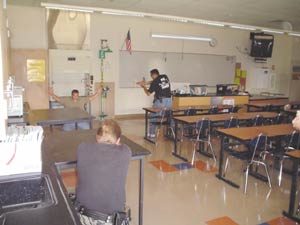
The department recently completed eight hours of in-house training to hone officer skills in dealing with these kinds of situations. Morgan Hill police Cmdr. Joe Sampson said officers received four hours of classroom training in addition to four hours of practical training, for which Sobrato High School served as the stage for their dangerous drama. Students and MHPD Explorers volunteered as actors, while officers rotated to various positions of the incident teams.
Active shooter situations are handled differently from other incidents that might involve calling out the department’s SWAT team, for example. Even for the training, officers are instructed to come “as you are,” without taking the time to dress out in protective gear, because in an actual incident, that’s what would happen, Sampson said. Officers also do not take the time to establish a perimeter, as they would normally do.
“The situation is too dynamic, the potential for loss of life is too great if you have those kinds of delays,” he said.
MHPD Cpl. Mindy Zen said the training focuses on what is immediately important.
“You specifically address the threat,” she said. “You go directly to the threat, whether it’s someone barricaded, whether you have hostages, whether you have someone wandering the halls.”
Sampson said aside from POST requirements, he believes providing this and other kinds of training as often as possible benefits the community. And if the training can be provided by the department, so much the better.
“If we had to send someone outside the city to POST training, you have the hotel costs and expenses for meals in addition to the cost of the course,” he said. “Although POST does reimburse some of the costs, not all of the costs are reimbursed. And of course you have the cost for backfill.”
The cost to pay another officer to take the shift of an officer involved in training or otherwise unable to work their regular shift is known as backfill.
“We have a number of officers who have expertise in various areas,” Sampson added. “It is more cost effective for us to provide this kind of training in house.”
Zen praised the work of fellow officers MHPD Sgt. Troy Hoefling and Cpl. Bill Norman in organizing the training.
“It was one of the best trainings I’ve participated in,” she said. “It is so important to have the opportunity to prepare for a situation like this. Good training, like what Troy and Bill put together, teaches tactics and gives an opportunity to put those tactics into action.”