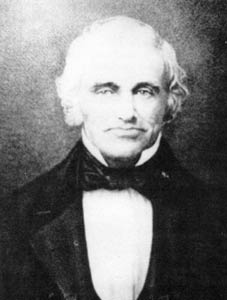
Morgan Hill – One morning in 1850, Martin Murphy, Sr., a silver-haired Irish gentleman, rode on horseback to the top of a cone-shaped mountain overlooking the southern region of Santa Clara Valley.
Accompanying him was New York Tribune journalist Bayard Taylor who had come to the newly formed California to write about the Constitutional Convention at Monterey.
History never recorded what the two men chatted about that day as they gazed upon Rancho Ojo de Agua de la Coche, Murphy’s vast estate below dotted with oak trees and grazing cattle. But no doubt Taylor recognized the fact that Murphy was a true pioneer of the West.
There, on that mountain locals called Murphy’s Peak, Taylor must have discussed with his 65-year-old companion the remarkable rags-to-riches journey that made him one of California’s leading citizens.
Majorie Pierce’s book “The Martin Murphy Family Saga,” details Murphy’s journey from a small farm in County Wexford, Ireland. He and his wife Mary decided to move their growing family to North America. With Catholics in Ireland being persecuted for their beliefs by the Protestant ruling class, Murphy saw the New World as an opportunity for religious freedom.
“A new farming community is being developed in Canada, and Mary and I feel it offers us and our children a chance to be free from the domination of the British,” he told his neighbors. “We all believe the Protestants plan to destroy Catholicism in Ireland and reduce us Catholics to total ignorance.”
The Murphy family sailed to Quebec and settled in Frampton, a village 30 miles from Quebec City. They purchased a farm there, but unfortunately the land’s rocky soil was not productive for growing corn and wheat. So in 1840, Murphy moved his wife and nine children (five sons and four daughters) to Missouri to start a new farm near St. Joseph.
In this new location, tragedy struck when Murphy’s wife died during a malaria epidemic.
A Jesuit priest named Father Hoecken, who had come to tend to the many settlers who had grown sick from the disease, told Murphy about the fertile soil and religious freedom that could be found in Mexico-controlled California.
Murphy knew the journey would be dangerous, but he decided the rewards of heading farther west into unknown territory were worth the risks. So in the spring of 1844, in what’s now the city of Council Bluffs, Iowa, he and his family joined a wagon train of 40 men and their wives and children led by an onerous mountain man named Elisha Stephens.
The immigrants took nine months to journey to California, according to the PBS-TV documentary “Forgotten Journey: The Stephens-Townsend-Murphy Saga.” At various points along the way, they faced death in the arid deserts from lack of water, potential Indian attacks, and the a blizzard storm while crossing the rugged Sierra mountain range. Amazingly, no member died during the trek. And two women gave birth, increasing the party’s population from 50 to 52.
In late December 1844, Murphy reached Captain John Sutter’s fort in the Sacramento Valley. He and several of his sons were promptly drafted into Sutter’s army to quench a rebellion against California’s Governor Miguel Micheltorena.
While riding to Santa Barbara on this impromptu military campaign, Murphy passed through the southern portion of the Santa Clara Valley. He admired the fertile region, and no doubt longed to live there. Five years later, he used money his sons made from mining gold to purchase the 9,000-acre land grant from Juan Maria Hernandez and turn it into his beloved ranch. Murphy built a large hacienda at what’s now the intersection of Llagas Road and Hale Avenue.
Proud of his newly purchased property, Murphy couldn’t help show it off to Taylor when the young reporter passed through it on his way to Monterey. That morning in 1850 at the top of Murphy’s Peak, the two men might have discussed the future of the new state of California.
They certainly had no idea that a community called Morgan Hill would one day spread across the fertile plain.
And they also had no idea that the mountain they stood upon would be renamed “El Toro” and would serve as the symbol of that future city.
Carol Verbeeck, a Morgan Hill resident who does pioneer living history events in the South Valley region, believes the seeds of Morgan Hill were planted when Martin Murphy Sr. established his ranch in the area. Murphy’s granddaughter, Diana Murphy, would later inherit the estate. She would marry Hiram Morgan Hill, for whom the community of Morgan Hill was named.
Martin Murphy Sr. and his large family not only had a significant impact on Morgan Hill’s history, but California pioneer days as well, Verbeeck said.
“The Murphy name crops up not just locally, but in general California history,” she said. “As they scattered and began to make their way into early California, they became integrated in all these history elements such as the Gold Rush and ranching. They spread out into so many different communities within California that they really became an integral part of its history.”