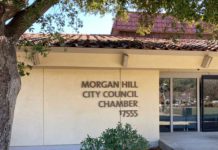
A two-hour workshop Wednesday revealed a City Council and a
Planning Commission determined to build a vibrant, downtown where
people want to visit, shop and live.
A two-hour workshop Wednesday revealed a City Council and a Planning Commission determined to build a vibrant, downtown where people want to visit, shop and live.
To accomplish this feat, some major boulders must be moved up a very big hill. Primarily, planners and developers must find a way to build high-density housing downtown around the city’s growth control Measure C and attract more businesses to downtown
Measure C not only regulates how many homes can be built each year, it also dictates how many units can be built per acre – especially relevant in regards to downtown development. Under Measure C, developers also compete for points based on criteria such as quality of design and construction and, if they rank high enough, are allowed to build a number of units.
The ordinance currently allows construction of up to 18 units per acre, not nearly enough to create the downtown envisioned by the City Council or Planning Commission, according to Planning Commissioner Joe Mueller.
Likewise, the housing densities are not high enough to attract the caliber of projects needed to recreate downtown as great place to live and visit, according to city-hired consultants with the Dahlin Group.
Planning commissioners and council members said they were willing to look at ways to work within the ordinance to allow higher density.
One solution to the Measure C issue would be to separate out downtown projects from the rest of the Measure C point competition. However, amending Measure C would require voter approval and a costly special election to fast track downtown development.
Councilman Greg Sellers said he was convinced downtown must be excluded from Measure C if the concept will ever be successful.
“If all we are doing is nibbling around the edges, tweaking Measure C, we won’t get to where we want to go,” Sellers said. “Why in 15 years have we not had anybody apply to build downtown? We must figure out ways to encourage commercial/retail development and we have not provided incentive.”
Sellers suggested dedicating planning staff, eliminating development fees and doing a smart growth overlay to Measure C with a separate set of criteria for the area.
The planning commission and city staff will also need to determine what densities are necessary to achieve their goals for downtown.
Mueller proposed identifying a core area, Second to Fourth to Depot streets bounded by Monterey, and making it into a gathering place for residents and their friends by providing attractive destinations.
“If we created a critical mass of commercial/retail, we could sow the seeds that would allow the rest of it to happen, but we need a vision,” Mueller said.
Mueller’s three block square is the natural beneficiary of hundreds of potential customers expected to pour in from the new county courthouse that will be built on the other side of the railroad tracks. Third street will be widened to handle the crowd in a new Downtown Plan commissioned by the council.
The street connects Monterey Road with the courthouse and the transit station.
“Once we identify a focus area we can go to the market and say we’re going to put in 100,000-square-feet of commercial/retail in the downtown core, near the courthouse, the transit station, connecting the bus and train service with the residential component,” Mueller said. “We have a great opportunity to make that connection.”
The council and commission also discussed limiting the required number of affordable, below market rate houses. Measure C currently requires 20 percent of total construction to be affordable housing. They asked staff to see how that might be done without threatening the numbers of affordable housing units the regional government says the city must allow.
One potential hang up in moving downtown into a new era is the future of the Downtown Association. The association of downtown business and property owners depends upon the city for financial support to operate.
Council has asked the DTA to find its own source of revenue, which it is seeking in the form of a property based business interest district (PBID). Such a district would assess property owners a graduated tax to be used for marketing, joint area improvements and funding DTA depending on how large and how close their properties are to the downtown core .
But a PBID must clear two hurdles: a majority of property owners must say yes on a petition to bring the matter to a vote and the vote must be positive. So far the petition is not quite successful though Craig and some council members – according to Councilman Steve Tate – are trying to round up signatures.
If the DTA disappears, a major marketing, cheerleading team disappears with it, leaving downtown without much of a united voice.
Tate said he didn’t want to speculate on what the council might do if that happens.
“If we have the problem, then we can look at it,” Tate said, “but I don’t want to give them any hope.”
Carol Holzgrafe covers City Hall for The Times. She can be reached by e-mail at ch********@*************es.com or phoning (408) 779-4106 Ext. 201.