”
That’s just a fake egg! I told you about that!
”
piped Tawny Arnbrister, sliding a hand beneath the feathery
underside of one of her
”
girls.
”
A red hen incubating the prop
– a trick of the trade that encourages chickens to lay eggs –
cocked its head to the side, glancing at Arnbrister
quizzically.
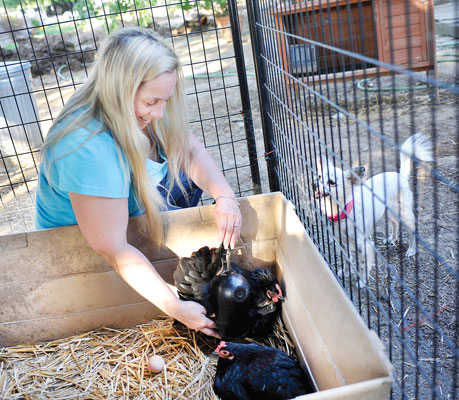
“That’s just a fake egg! I told you about that!” piped Tawny Arnbrister, sliding a hand beneath the feathery underside of one of her “girls.”
A red hen incubating the prop – a trick of the trade that encourages chickens to lay eggs – cocked its head to the side, glancing at Arnbrister quizzically.
Every day is Easter on 11775 Bennetta Lane just a few minutes south of Morgan Hill, where Arnbrister traipses around the back yard in fuzzy bedroom slippers clutching a wire basket. She fills it to the brim with finds of every color, shape and size, which are then cleaned by hand, packaged and sold for $2.75 a carton. Her regulars include neighbors and random passersby who glimpse the “Fresh Eggs” sign fixed to her mailbox.
For consumers shelling up to $5 for free-range, hormone-free and vegetarian-fed varieties in grocery stores, $2.75 is a bargain deal.
“People will just honk and I’ll come out,” laughed Arnbrister, who’s been raising chickens for six years and regularly fills requests from her husband’s coworkers.
Like other residents on city outskirts tending to their personal clan of cluckers, Arnbrister acknowledges a growing trend for fresh-from-the-nest, naturally cultivated, locally sourced eggs – whether it’s do-it-yourself or scoring a dozen from someone who does.
She highlighted the mentality of “living off the land,” a practice “lots of people are getting back to” in the wake of pricey groceries, tendencies toward hyper-local consumerism and a growing health consciousness.
“I also like the fact things we don’t eat, they don’t eat,” said Arnbrister, who lets nothing go to waste. In addition to a healthy mixture of chicken scratch and pellets, she feeds her birds the ends of tomatoes, potato and orange peels, bread, noodles, rice, bananas and various leftovers.
Between her coaxing calls of “heeeeeeere, chick, chick, chicks!” a melange of beaked characters emerged expectantly from their dwellings, Arnbrister identifying several: “Barred Rock Brown.” “Fancy Silkie.” “Ameraucana.” “Rhode Island Red.”
Each breed lays something different, the goods ranging from soft bluish-green, light tan, small brown, large brown, oblong-shaped or creamy-white and spherical, like a golf ball.
Arranged in a carton, protein never looked so cute.
Arnbrister purposefully mixes and matches for variety, occasionally topping the selection with a speckled turkey egg that “tastes just like regular eggs, but the shell is thick,” she reminded. “You have to crack it hard and pry it open.”
As she stood over a sink washing the morning’s finds by hand and laying each on a cloth to dry, Arnbrister said a number of brands sold in stores aren’t fresh within the week.
“Others come from farms that aren’t local to our state, even.”
Not only are local eggs “tastier,” she added, the yolks look different – a variance that can be observed by cracking a farm-fresh egg side by side with a store-bought egg.
Kim Windsor, who also sells eggs from several breeds of “spoiled” chickens supplemented with vitamins, flax and “sometimes music during the day” on their family farm at 2005 Giampaoli Drive in San Martin, echoed this. There is absolutely a taste difference, she asserted.
“It’s interesting to open an egg farm-fresh, where they’ve had access to greens,” she said. “The yolks are amazing because they’re so orange and big.”
A perk for locals, additionally is seeing the environment their poultry comes from. At Arnbrister’s place, chickens meander, forage and nest in nooks, crannies and roomy boxes stuffed with straw. She has two large coops – one draped in the purple curtains of a wisteria plant.
Like Arnbrister, Gilroyan Dean Moon said raising chickens began as a fun side project. Sharing the surplus of his hobby became a regular habit that just feels good, he said.
Moon resides at 4000 Hecker Pass and puts a sign out notifying drivers when he has extra eggs available for sale.
“I’m not really in the business,” he reiterated. “I just went ahead and got myself an incubator, and along came a rooster. It just appeared here one day and fertilized my chickens.”
For Arnbrister and her squawking community of downy friends, “my kids laugh at me because I call them my girls,” she said, picking up one of the chickens. “I like it.”