Haru Matsuri, the Morgan Hill Buddhist Community Center
’s annual spring festival and major fund-raising event,
generated an estimated $25,000 in red ink due to a county health
inspection.
Haru Matsuri, the Morgan Hill Buddhist Community Center’s annual spring festival and major fund-raising event, generated an estimated $25,000 in red ink due to a county health inspection.
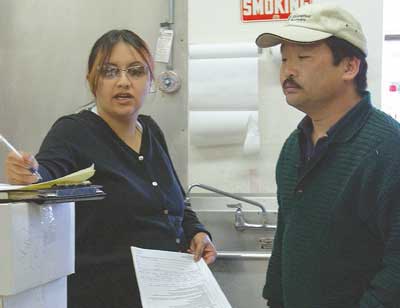
At approximately 1:15 p.m. Sunday, Santa Clara County Environmental Health Inspector Christina Rodriguez told festival volunteers to stop selling the group’s chicken salad and sushi entrees and teriyaki chicken box lunches. She told organizers the food could not be sold because it was not properly refrigerated, festival co-chair Howard Watanabe said.
“She told us basically that we couldn’t sell any of it,” Watanabe said.
Watanabe estimated that about 2,500 of the festival’s 3,500 box lunches – the majority of which are sold before the event – were awaiting pick up at the time. In addition, the group was left with approximately 1,200 sushi entrees and 400 chicken salad entrees that couldn’t be sold.
Because of the food sale stoppage, the event, which normally generates in excess of $30,000, lost $25,000 this year, Watanabe said.
“It is a financial blow,” festival volunteer coordinator Steve Yano said, “But we will overcome this.”
This year marked the 43rd anniversary of Haru Matsuri. It is the longest running cultural festival in South Valley.
An estimated 3,000 people attended, down from the 5,000 to 6,000 in previous years. Organizers attributed the lower numbers to the rainy weather all day Saturday and forecast of occasional showers Sunday.
Many of the arts and craft booths and other activities were moved indoors.
The festival, which offers free admission and parking, was open from 10:30 a.m. to 5 p.m. Sunday.
Lisa Seifert of San Martin waited with dozens of other people to pick up box lunches in the roughly 90 minutes between Rodriguez’s order to stop sales and the festival’s establishment of a refund process.
“My mom always buys (box lunch) tickets, and we always come pick them up. We’ve been doing it for a long time – 10 or 15 years,” Seifert said.
After lengthy discussions that involved Rodriguez, Watanabe, Mayor Dennis Kennedy and a cell phone call to Rochelle Gaddi, Rodriguez’s boss, the decision stood.
“It’s terribly unfortunate,” Kennedy said, noting that the festival has been selling food for more than 40 years without a problem. “I was talking to her boss to see if we could find a compromise solution.”
Rodriguez was not available for comment, but County Supervisor Don Gage said, “The environmental health people have the responsibility to protect the consumer. They don’t have any alternative. They’re just doing their job.”
Ben Gale, director of the county’s department of environmental health, said Rodriguez made the right call.
“Instead of talking about lost dollars, we could be talking about food-borne illness,” Gale said, noting that salmonella and e-coli are just two possible problems from improperly chilled food products. “Growth of bacteria is the concern.”
Gale said the chicken salad and teriyaki chicken, which shouldn’t be stored at temperatures above 41 degrees, was sitting at 56 degrees.
Rodriguez refused to allow the sale of the chicken salad, teriyaki chicken and sushi products.
“Sushi is made with vinegar, and it shouldn’t be an issue,” Yano said.During the confusion caused by Rodriguez’s order, volunteers were shaking their heads and dealing with hungry and disappointed lunch ticket holders.
Festival organizers issued refunds to presold box lunch ticket holders.
Despite the costly controversy, festival attendees enjoyed Haru Matsuri’s many other attractions, including the NorCal Taiko Expo, an exhibit about Japanese-American soldiers who served in World War II, Japanese-themed books, arts and crafts, martial arts exhibitions, plant and fruit sales and a white elephant sale.
The art form that permeates the festival – through sight and sound – is taiko drumming.
“Taiko means the big drum,” said Ikuyo Conant, a sensei, or teacher, with students in Morgan Hill, Monterey and Watsonville. “It has been used for different ceremonies, festivals, communication, timekeeping and as a musical instrument.”
Karen Groppi, a taiko drummer from Watsonville, said people of any race, age or gender can learn taiko.
Conant agreed.
“If you have a heartbeat, that’s the source of taiko,” Conant said. In Morgan Hill, Conant teaches taiko at Seikishin Dojo, located at 685-D Jarvis Ave. She currently has seven students and has room for more.
Organizers aren’t about to be overwhelmed by this year’s financial disaster.
“Despite the rain, we were able to put on all our entertainment,” Watanabe said. “In the whole scheme of things, we’ll just take this in stride.”
Box lunch ticket holders who were unable to receive a refund at the festival should call 779-9009.