Black, gray and white were the predominant colors of the rolling
hills underneath, as a California Department of Forestry and Fire
Protection helicopter took firefighters and a Department of
Corrections official Sunday afternoon to survey the area scorched
by the Lick fire, 95 percent contained by Monday.
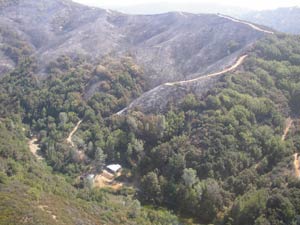
Morgan Hill – Black, gray and white were the predominant colors of the rolling hills underneath, as a California Department of Forestry and Fire Protection helicopter took firefighters and a Department of Corrections official Sunday afternoon to survey the area scorched by the Lick fire, 95 percent contained by Monday.
Smoke still spiraled in the air from several spot fires and islands of fire in the back country of Henry W. Coe State Park. Even before the copter reached the area, which is roughly nine miles across in one direction and 15 miles in another, the smell of smoke was apparent.
The point of origin of the fire, a trash burning barrel beside a residence pointed out by pilot George Johnson, seemed innocently incapable of causing so much havoc. Instead of destroying the nearby residence, the fire swept up the hillside behind the house and then grew with a vengeance, until nearly 50,000 acres were consumed.
A suspect has come forward and is cooperating with the investigation, but officials were not releasing the name of the person by presstime.
Swooping low over the charred hills, the Huey helicopter allows its passengers to see the improvised roads cut into the back country by the fleet of bulldozers and the fire engines and tankers lumbering down them on their way to or from the critical areas of the fire.
“Without bulldozers, we couldn’t have fought this fire,” Johnson said. “How many people would it take to do the work they have done?”
Johnson, CDF senior pilot, has almost 40 years of experience behind the stick. He entered army flight school in 1968 and later flew Hueys in Vietnam. He became a state employee in 1984, and now is based in Columbia, east of Sacramento near the Yosemite National Park.
“The air attack is critical in this state,” he said. “If you don’t get in there fast with the air, it becomes unmanageable.”
In the case of the Lick fire, he said, it takes sometimes three hours for fire crews to get from base camp to the hills where the fire raged. If the helicopters and air tankers were unavailable, the fire could have spread even more. Costs to fight the fire are climbing over $5 million.
Of all of the fires Johnson has responded to, most of them have been small, under 100 acres, he said, and even though he has seen quite a number of them that are 100 or a couple of hundred acres, incidents like the Lick fire are rare.
As he guided the helicopter into position for passengers to see flames from a spot fire, Johnson said a major incident like Lick requires a crack command team to coordinate all of the agencies involved.
“It takes a certain amount of finesse, it’s really like a chess game,” Johnson said. “Everything from food to the tent city to response, it’s all carefully planned.”
Johnson and his crew were first responders to the recent Angora fire in South Lake Tahoe.
“We could see the header (column of smoke) when we took off from Columbia,” he said.
Smoke hung heavy in the air on Sunday, limiting visibility near several spot fires.
“This is great, much better than we had a couple of days ago,” Johnson said.
Johnson positioned the copter so passengers had a clear view of a fire technique known as a “ping pong drop.”
“It’s very rare that anyone ever sees this,” he told his passengers as they watched another helicopter hover low over the fire spot then release hollow balls filled with chemicals.
Flying low over a fire is risky business for a copter, with winds buffeting its dangling body, but they are perfect for dumping buckets of water and flame retardant.
“We were surprised there were so many reasonable water sources,” Johnson said of the pocket lakes and ponds tucked around the hills. “We didn’t have far to go to pick it up (with the buckets).”
Returning to the heli-base near Casa de Fruta, which earlier in the week also housed four National Guard helicopters, two of them Blackhawks, Johnson pointed out other hazards copter pilots have to watch out for, power lines and large birds.
Fire crews have already begun “demobbing,” or leaving the area for their home bases, and officials hope to begin shutting down the camp at Christmas Hill Park today, completely packing up within a day or two.
LICK FIRE FACTS
-
Fire started 1:45 pm, Sept. 3
-
Close to 50,000 acres burned
-
Affected area nearly nine miles by 15 miles
-
Fifteen structures destroyed
-
No major injuries to fire crews
-
Costs climbed over $9.2 million
-
100 percent containment, Sept. 10