Despite claiming he had no intention to erect a casino on the
6,500-acre span of sacred Native American soil just south of
Gilroy, a website touting La Jolla developer Wayne Pierce’s name on
the contact link implies the opposite.
Despite claiming he had no intention to erect a casino on the 6,500-acre span of sacred Native American soil just south of Gilroy, a website touting La Jolla developer Wayne Pierce’s name on the contact link implies the opposite.
“It appears … this website may be valid for the purpose of soliciting an investor to keep Sargent Ranch from going into foreclosure,” said Valentin Lopez, chairperson of the Amah Mutsun Tribal Band. “That’s my guess.”
For a number of developers who’ve come and gone over the decades – Pierce being the most recent – Sargent Ranch, a vast expanse of undulating hills, pristine streams and unsullied natural beauty, remains tempting forbidden fruit.
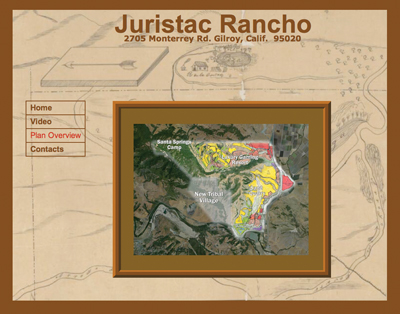
The website displays an aerial snapshot of the property, located on the west side of U.S. 101 between the Castro Valley Ranch and the San Benito and Santa Cruz county lines.
Beneath “Plan Overview,” blueprints designate unincorporated ranchlands into a “Luxury Gaming Resort” “Sand Quarry,” “New Tribal Village” and “Santa Springs Camp.”
Skip Spiering, Pierce’s representative who’s also listed as a contact on the website, did not specifically define the purpose of the website.
As for the website being two years old, Lopez said “it does matter in the sense they continuously said they were not interested in gaming, and here they’re presenting a proposal for gaming, and we believe that was their intention all along.”
Lopez suspects the idea is a last-ditch effort to secure a lifeline for Pierce’s company, Sargent Ranch LLC. As of last January, the company was under Chapter 11 bankruptcy proceedings.
Former Santa Clara County supervisor and Gilroy mayor Don Gage said he hasn’t seen Pierce “pop” his head out in a long time. He agrees the website may have been an attempt to revitalize development efforts and avoid going into foreclosure.
“He’s had a lot of schemes over the years,” he said.
Either way, Gage doesn’t see it going anywhere. He attributes additional building roadblocks to the territory’s earthquake faults and the fact that it’s a habitat to endangered species such as a trout species called steelhead.
“Sargent Ranch LLC is still in bankruptcy,” confirmed Spiering Monday morning. “Quite frankly I don’t know what’s going to happen.”
The battle over what to do with the property, for that matter, is emotionally heated and involves conflicting interests.
For the Amah Mutsun Indians, a band of Ohlone/Costanoantorn Native Americans torn by two opposing tribal councils, the territory is a hallowed domain of heritage and history.
A petition now standing fifth in line (in 2004, it was number 13) for review by the Office of Federal Acknowledgment is currently claimed by two tribal councils of the Mutsun.
One is headed by Lopez, and another led by Irenne Zwierlein, who resigned as chairperson of the main tribe in 2000.
Both have different visions for the ranch.
“We would like to see the land preserved and protected,” said Lopez, reiterating a stance he’s taken since the early 2000s.
He’d like to work with local environmental groups or county parks and recreation officials, to ensure it’s never developed and, at the same time, allow the Mutsun to use it for ceremonies, prayer and preservation.
Zwierlein pursued a different strategy, forming her own group and striking a multi-million dollar land deal with Pierce.
With the Mutsun vying for tribal sovereignty – the right of federally recognized tribes to govern themselves – the Mutsun would not be subject to county zoning regulations. By partnering with Zwierlein, the deal would have allowed Pierce to sidestep county zoning requirements and lay the groundwork to develop the property once the Mutsun were granted sovereignty.
Under an economic development plan Zwierlein submitted to the BIA, Pierce would have provided the Amah Mutsun with $21 million for a cultural center and 3,500 acres of the 6,500-acre ranch.
Of that, 500 acres would be reserved for tribal members’ homes and businesses, as well as open space and the cultural center. The remaining 3,000 acres would be leased back to Pierce.
“Wayne and Irene both repeatedly said that a casino was not part of the plans,” said Lopez.
In a Sept. 16, 2005 letter to the editor, Zwierlein wrote, “(South Valley Newspapers) alleged that ‘obtaining sovereignty’ is nothing more than a ‘key first step’ in opening a casino. This is insulting to tribes like ours that have no interest in gaming (and have adopted constitutional provisions to prevent future gaming), and to all tribes that have worked to restore their government-to-government relationships with the United States.”
Reached Monday at her Woodside home, Zwierlein declined to comment.
Developing the land where their ancestors fished, hunted and raised families, was never a goal for the Mutsun in the first place, Lopez said.
Federal scrutiny of Pierce’s past dealings has played a major role in thwarting progress. When Sargent Ranch, LLC filed for bankruptcy in January, it owed more than $90 million. If the company has not yet been foreclosed on, it’s plausible Pierce could be open to finding an investor, Lopez said. But amidst such hiccups, Lopez can only reiterate his bottom line. Sargent Ranch should stay preserved and protected.
“It may be private property,” he pointed out. “But sacredness and power are still up there. We hope to be able to go up there and do ceremonies, pray and dance for the rest of time.”