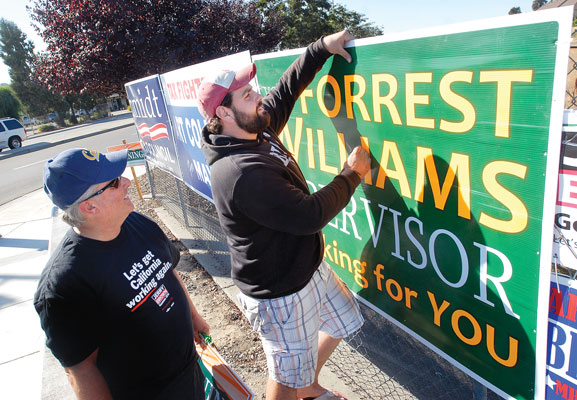
Dozens of local, statewide and district candidates set to appear
on the Nov. 2 gubernatorial election ballot have turned almost
every chainlink fence, high-profile intersection and publicly-owned
yard in Morgan Hill into collages of colorful political signs.
Dozens of local, statewide and district candidates set to appear on the Nov. 2 gubernatorial election ballot have turned almost every chainlink fence, high-profile intersection and publicly-owned yard in Morgan Hill into collages of colorful political signs.
What many of these candidates – or their campaign volunteers who placed the temporary placards – may not know is that the placement of these signs on some of the most visible real estate in town is illegal.
But they might be relieved to know that the city is unlikely to strictly enforce its regulations on the placement of both temporary and permanent signs.
That’s why city staff are hoping to raise awareness of the sign laws among candidates so they might take it upon themselves to be in compliance.
“We do not have the resources to enforce every violation of the sign regulations,” city manager Ed Tewes said. “There are literally hundreds of (sign) violations by both businesses and candidates in Morgan Hill. There would be lots of enforcement to do if we had the resources.”
The city’s lengthy sign ordinance regulates every kind of directional, commercial, temporary, memorial and informational sign (and even Christmas decorations) that one might seek to post in the city limits, at any time of year. Many of these signs require permits from the community development department, whether they are placed on private or public property.
However, temporary political signs are specifically exempt from that requirement, as long as they are placed on private property. Political signs are not allowed on public property that is owned by the city or another public agency, unless the sign owner acquires an “encroachment permit” to install them.
“In summary, people can put political signs on their own property without a permit,” city attorney Danny Wan clarified. “However, people cannot put any kind of signs on public property without a permit.”
The sign ordinance also specifies when political signs can be posted – no sooner than the close of the filing period or 90 days before the election. They must be removed within seven days after election day.
The 11 candidates for mayor and city council were notified of these requirements in the information packet they received from the city clerk’s office when they qualified to run, Tewes said.
Some of the most popular publicly owned spots where groves of political signs flourish are the chainlink fences above the flood channel along Butterfield Boulevard, at the intersections of Dunne, Main and San Pedro avenues. These canvases are owned by the city, Tewes said. Another chainlink fence plastered with signs – at La Crosse Drive and Vineyard Boulevard – is owned by the Santa Clara Valley Water District.
As of Wednesday, no candidates have sought or acquired permits from city hall to post signs on any public property in the city limits, Tewes said.
Another popular public spot for political signs is the “parking strip” on roads throughout the city – the area between the curb and the sidewalk on each side of the street.
Political signs, described by volunteers and candidates as an important part of campaign strategies, sprout up mostly in the same locations prior to every election. A key difference this year, Tewes noted, is the unusually high number of local candidates. On the Nov. 2 ballot will be 19 candidates for two seats on the city council, the mayor’s seat and four seats on the Morgan Hill Unified School District board of trustees.
Not to mention, a long list of hopefuls for county supervisor, state assembly, state senate and U.S. congressional candidates have scattered names like Wasserman, Williams, Whitman and more throughout South County.
Residents, motorists and the candidates themselves occasionally complain about the unsightliness of the clusters of signs, the litter they cause when their owners don’t remove them, and the potential traffic hazards they can create by blocking the view of oncoming vehicles.
One circumstance under which the city would remove political signs is if they pose an “egregious” traffic hazard, Tewes said.
Dan Kenney, a volunteer with the Morgan Hill Democratic Party, has placed a number of signs promoting his party’s candidates – including county supervisor candidate Forrest Williams and gubernatorial candidate Jerry Brown – this election season.
He said the party is aware of the sign regulations, and has attempted to comply with all aspects of the local ordinance. The party received written permission from the water district to erect signs on the chainlink fence at Butterfield Boulevard and Dunne Avenue, Kenney said, even though the property is owned by the city.
Furthermore, after every election Kenney makes sure to remove all the signs he posted.
“People get tired of looking at them after a while, but I don’t take anybody else’s signs down,” Kenney said.
The signs are a “very important” aspect of political campaigning, Kenney said – especially at high-traffic intersections where voters drive by every day. The signs make people aware of the names of who is running, and prompt undecided voters to seek more information on the candidates’ websites, in the newspaper, and by seeking campaign representatives to talk to.
“If they don’t see the signs, they might not think about it until Nov. 1,” Kenney said.
The local Republican Party hasn’t organized an umbrella effort of sign installation for its candidates, but it provides a map of local private properties whose owners have traditionally allowed Republicans to plant signs there, according to Morgan Hill resident and Gavilan College trustee Mike Davenport.
Davenport, one of the Republican Party’s chief organizers in South County, said each candidate is responsible for installing signs or organizing volunteers to do so.
“Our practice is to make sure we get permission before we post the signs (on private property),” Davenport said.
He allows the candidates he supports to place signs on his private property near the intersection of Hill Road and Main Avenue. But he’s noticed that some candidates he did not give permission to have also posted signs there.
“I feel free to remove those, because it is my property,” Davenport said.