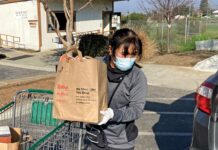
Members of one San Martin family wash their infant child
– and its clothes – only in bottled water in order to avoid the
prospect of using water tainted with perchlorate.
Members of one San Martin family wash their infant child – and its clothes – only in bottled water in order to avoid the prospect of using water tainted with perchlorate.
Meanwhile, another area mother is seriously considering draining her swimming pool, worried that children will accidentally gulp some contaminated water while playing.
With stories of fear and extreme measures like this as a backdrop, a special committee of doctors, health officials and residents has formed to gain information on the most pressing concern in South County’s perchlorate contamination problem – the chemical’s impacts on health.
The Perchlorate Medical Advisory Group met for the first time Tuesday night at the county government center in San Martin. While the group is in its infancy, so far its members hope to review the existing body of medical information on perchlorate’s health effects and also network in order to learn as much as they can.
Eventually, the group could also advise the county and other agencies on what their next steps – such as a survey or study here – should be, and how to go about them.
Like many things about perchlorate, answers on its health effects are not yet extensive because the chemical is such a new issue. The idea of the committee is that many minds and backgrounds working on the issue here are better than one.
“I don’t think any one of us has the experience alone to tackle this,” said Dr. Martin Fenstersheib, the county’s public health officer.
The committee will report to the larger community action group organized by the lead agency on the perchlorate issue recently organized by the Central Coast Regional Water Quality Control Board. Like that group, members hope to keep the health committee fairly small to keep things manageable.
Members present Tuesday included Fenstersheib and two other staffers from the county’s Public Health Department, representatives of the California Department of Health Services and federal Department of Health and Human Services, three private physicians and South Valley residents Sylvia Hamilton, Bob Cerruti and Evelyn Heinrichs.
Hamilton is president of the San Martin Neighborhood Alliance and chair of a newly formed Citizens Advisory Group acting as liaison between the communities, Olin Corp. and the agencies responsible for the perchlorate study and clean up. Cerruti is vice-chair of the advisory committee, which will meet next on Thursday, May 8, 10 a.m.-noon at the San Martin Lions Club, 12415 San Martin Ave.
Heinrichs is former owner of The Water Outlet in Morgan Hill. The Water Outlet treats tap water four separate ways including distillation, one way to remove perchlorate from water.
The group may also include a pediatrician and members to represent migrant farmworkers and the agricultural community. Other independent observers of the perchlorate issue – such as members of the Environmental Working Group – may also be invited to help counterbalance government representation.
The committee agreed Tuesday that it should begin by reviewing the existing body of medical literature on perchlorate in order to get up to speed and determine how to proceed.
“It sounds like there’s certainly a lot of information out there we can learn about,” Fenstersheib said.
San Martin wells are not the only ones contaminated with perchlorate. The chemical entered the underground aquifer from the former Olin Corp. plant on Tennant Avenue at Railroad Avenue in Morgan Hill during the 40 years (1955 to 1996) when highway safety flares and skeet were manufactured on the site. Perchlorate is used to make such products, rocket fuels, air bags for automobiles and other products involving explosives as well.
The “plume” traveled in a southeasterly direction from the source, through south Morgan Hill and as far as Leavesley Road in Gilroy. At the same time, the chemical began showing up in some Morgan Hill City wells and a few private Morgan Hill wells, all north and east of the source site.
Down the road, an issue the group could address is whether – and how – to pursue attempts at epidemiological studies or surveys on perchlorate’s health effects in San Martin and a correlation between the contamination and illnesses or conditions. Fenstersheib said the first order of business would be to gather information to determine what kind of study to do – something the group’s experts and residents can help with.
“We want to use our resources the best way we can,” he said.
Officials can review medical literature for a number of different purposes, including both setting regulations on exposure and trying to understand what a given exposure may mean to a community, said Dr. Richard Kreutzer of the state’s health department’s Environmental Health Investigations Branch.
Regulatory levels are meant to be safe for a very large population, and are usually set well below potential levels that could be associated with a specific change in the way the body functions, he said. Because of this, they’re also usually substantially lower than the levels where officials would expect to measure a health effect – such as an illness – in an individual who has been exposed.
“By looking at the literature to answer two different questions, it’s important to agree what question is being asked,” Kreutzer said.
There could be several challenges in gauging whether perchlorate has produced measurable human health effects in a population.
Thyroid problems generally aren’t tracked as a reportable disease, although they are screened in association with newborn infants. Newly enacted regulations on the privacy of medical information could be a complicating factor. Different people may respond to perchlorate in different ways or severities – just as they do with, say, cigarette smoke.
Initially, there are some mixed opinions on whether a study would be useful.
Dr. Robert Doll, a private physician from Morgan Hill, warned that it may be impossible to do a meaningful study in San Martin with its small population.
“I see our committee being more educational and finding out what else is out there, rather than doing our own study,” he said.
Dr. Sabir Khan, a nuclear medicine specialist with Kaiser Permanente health care, thought at least a preliminary study should be conducted to gauge if a problem exists.
Officials could start by identifying people who receive thyroid medication and then looking at their health and potential exposure to the contamination, he said.
According to the California Environmental Protection Agency, scientific studies have suggested perchlorate can disrupt thyroid hormone production. Inhibited thyroid function can result in hypothyroidism and in rare cases, thyroid tumors. High exposures to the chemical have also been implicated in mental retardation in children and other health problems.
Sensitive populations include pregnant women, children and people who have health problems or compromised thyroid conditions.
The Santa Clara Valley Water District is providing bottled water for most residents with contaminated wells or whose wells are being tested and hoping that Olin Corp. will reimburse them for the cost.
The Regional Board and the water district have organized a second meeting for the community to meet with and ask questions of agencies and experts involved in the perchlorate issue on Saturday, May 3, 10 a.m.-1:30 p.m. at several sites on the Gavilan College campus, 5055 Santa Teresa Blvd. in Gilroy.
In the intervening weeks, Olin and the agencies have tested more than 1000 wells to discover the shape and character of the perchlorate “plume” and collected what research is available, which they will share with the public at the May 3 meeting.
INFORMATION • Santa Clara Valley Water District: www.valleywater.org or 888-HEY-NOAH • Regional Water Quality Control Board: www.swrcb.ca.gov/rwqcb3/ • San Martin Neighborhood Alliance: www.smneighbor.org • Environmental Working Group: www.ewg.org • Larry Ladd – Rancho Cordova perchlorate project: www.perchlorate.org • City of Morgan Hill: www.morgan-hill.ca.gov