Happy Meals turned un-happy this week
– toys linked to unhealthy meals at fast-food and restaurants
will be outlawed in unincorporated Santa Clara County.
Happy Meals turned un-happy this week – toys linked to unhealthy meals at fast-food and restaurants will be outlawed in unincorporated Santa Clara County.
It’s a symbolic piece of legislation to fight childhood obesity, proposed by Board President Ken Yeager – fewer than 100 restaurants will be affected and fewer than 10 actually offer toys with meals. But, its distinction as the first ban in the United States of toys connected to unhealthy children’s meals has garnered national attention.
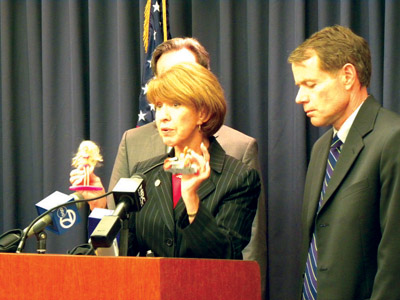
“This ordinance does not attack toys. Obviously, toys, in and of themselves, do not make children obese,” said Yeager, who proposed the ban. “But it is unfair to parents and children to use toys to capture the tastes of children when they are young to get them hooked on eating high-sugar, high-fat foods early in life.”
The Board of Supervisors approved the ordinance 3-2 Tuesday morning, with Don Gage and George Shirikawa voting against the ban.
“It’s the wrong approach to the solution. The solution is to educate parents,” Gage said. “A 3-year-old shouldn’t be in charge of the family, or making decisions on what to eat. The issue is making people aware.”
The problem of obesity is real, he said, but he takes issue with the approach.
“Put your money where your mouth is and do education, teach children when their young,” Gage said.
Restaurants that sell toys as “rewards for buying foods that have excessive calories” will be penalized with first a $250 fine that will increase up to $1,000 for excessive infractions. Public health officials will have jurisdiction over enforcing these laws and Yeager responded that if places like McDonald’s or Burger King receive bad publicity – since the fines are minor – then his message is effective. The ordinance will allow for toys to be offered with healthier meals.
“We hope that other municipalities, counties and states will follow suit in helping to level the playing field for parents by passing similar ordinances,” Yeager said.
Morgan Hill city councilmember Marby Lee said she would never support a similar ban in Morgan Hill.
“I feel it’s kind of misguided and silly – I don’t know why three out of the five supervisors under their guise need to tell parents how to raise their kids, and what they should do or shouldn’t do. I think they have better things to do with their time.”
Gilroy councilman Peter Arellano, a physician who is running for county supervisor, said he believed the ordinance was “well-intentioned” but ultimately missed the mark.
“Children do not walk into McDonald’s – it’s the parents who take them through the drive-through,” he said.
On the other hand, he said he would support preventing local restaurants from serving trans fats, although he said the council has higher priorities right now. He also believes that health warnings should be placed on place mats to help educate parents.
“Concerning this particular ordinance, parents tell us they want to have the right to make their own decisions,” according to a statement from McDonald’s. “Our customers are smart, and they will continue to make choices that are right for them.” No McDonald’s will be affected by the ordinance.
“Happy Meals are right-sized for kids, a concept that has not changed since its introduction in 1979. We are offering small Chicken McNuggets or a small hamburger; a small drink choice, including low-fat white milk and a choice of small fries or Apple Dippers,” the statement read.
The ordinance outlines the caps for unhealthy meals for children: More than 120 calories for a beverage, 200 calories for a single food item, or 485 total calories for a meal.
The closest fast-food restaurant to South County that cannot sell toys with unhealthy meals is Burger King on Race Street in San Jose. No businesses in unincorporated South County sell meals with toys.
Before becoming law, the ordinance must be read again May 11 at the board’s meeting and then a 90-day grace period will follow. Restaurants are given the opportunity during that time to offer alternatives to the ban but that also meet the goal of linking toys to healthier meals.
Yeager drew upon other laws that require children to wear seat belts in cars or helmets when they ride bikes, for example, when asked if the government was meddling in the private sector.
“The government acts all of the time to help the health and wellness of children,” Yeager responded.