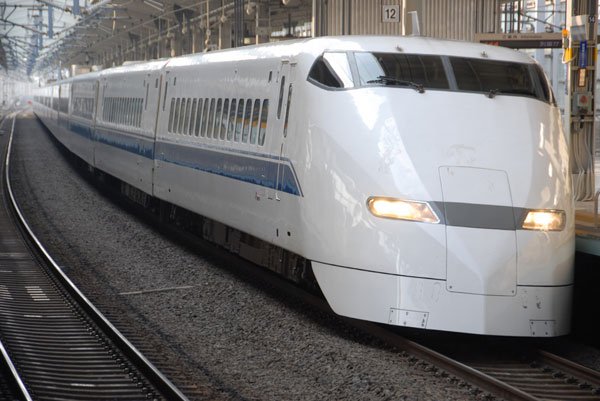
South County residents have a trainload of questions about the
possible impacts associated with the state’s high-speed rail
project, which could send passenger trains through downtown Morgan
Hill at speeds up to 220 mph.
South County residents have a trainload of questions about the possible impacts associated with the state’s high-speed rail project, which could send passenger trains through downtown Morgan Hill at speeds up to 220 mph.
However, most of those questions won’t be answered until the California High-Speed Rail Authority completes its draft environmental study of the 123-mile section of the track that will go from San Jose to Merced, over Pacheco Pass.
A standing-room-only crowd attended a meeting of the South County Joint Planning Advisory Committee at City Hall Thursday. More than 100 people from Morgan Hill, San Martin and Gilroy were drawn by a report from HSRA spokespeople on the agenda about the possible bullet-train alignments through South County.
More than 20 people addressed the committee and HSRA consultants, offering comments and asking questions about the train’s possible impact. Wide-ranging concerns presented at the meeting include the impact of the noise coming from the train, how many privately owned properties along the proposed routes could be taken by the state, the train’s economic impact to the community, and even the possible dangers posed by electrical currents straying off the tracks and what kind of “debris field” the train will carry with it as it speeds from one end of the state to the other.
“Can the high-speed rail be done in South County without doing more harm than good?” asked Gilroy resident Yvonne Sheets-Saucedo, echoing the sentiment of many others in the room.
Spokesmen from Parsons Corporation, an engineering consulting company hired by the HSRA, presented maps indicating the possible routes through South County. The six potential routes currently on the table would cross north-to-south through Morgan Hill, either along U.S. 101 or through downtown.
The $45-billion, 800-mile California High-Speed Rail system, is expected to begin carrying passengers in 2020.
An alignment alternative along the east side of U.S. 101 would enter South County on an aerial track to make room for wildlife crossings, returning to ground level just north of the city. Then the tracks would ascend to an aerial structure to cross over Cochrane Road, East Main Avenue and East Dunne Avenue.
South of Dunne Avenue, the route would diverge easterly from the freeway as it crosses over the city’s Outdoor Sports Center on Condit Road. After crossing Tennant Avenue, the train would return to ground level and realign with U.S. 101 near East Middle Avenue, eventually reaching an HSR station east of Gilroy, on Leavesley Road.
Another alternative would carry the high-speed train along the east side of U.S. 101 until it reached Maple Avenue south of Morgan Hill. At that point, the train would pass underground through a trench to the west side of the freeway, en route to the state’s preferred station site in downtown Gilroy.
Both alternatives that travel along U.S. 101 would require the train to be trenched underground through the CHP truck scales on the freeway, and adjacent to the South County Airport. The tracks have to be underground near the airport, as a 30-foot-tall aerial structure would carry trains through restricted airspace, according to Parsons Senior Project Manager David Wemmer.
But the HSRA’s preferred alignment is still along the east side of the existing Union-Pacific and Caltrain tracks – a route the railroad company steadfastly objects to. Through Morgan Hill, this alignment would require new grade separations to bring major streets over the UP and HST tracks, as well as Monterey Highway, north of town.
At Cochrane Road, the train would continue along the UP tracks along an aerial structure through downtown, until it returned to ground level at Maple Avenue. The route would then swerve to the east or west in Gilroy, depending on where the South County station ends up.
This option would also require relocating Monterey Highway to the east on the north side of Morgan Hill, in order to create room for a bullet train right-of-way up to 60 feet between the UP right-of-way and the road.
Morgan Hill officials have noted that they prefer a track alignment along U.S. 101, as it would not create a new dividing line through the community as a downtown track would.
The California High-Speed Rail Authority board examined possible routes June 3 for the San Jose-to-Merced portion of the project following several months of gathering community input. Now, rail officials plan to gather more input from local residents as they aim to assemble a draft Environmental Impact Report by July 2011.
The most common complaint aired at Thursday’s meeting were from rural property owners who live in close proximity to the different alignments and are worried about property values and other impacts – including the possibility that the state will take their properties.
“One of the reasons I moved here was because it was quiet, and now that’s going away,” said north Gilroy resident Ginna Raahauge.
Supervisor Don Gage, chair of the SCJPAC, said in between public comments that the HSR, which is partially funded by a $10 billion bond approved by voters in 2008, will become necessary as the state’s population grows, though questions remain about the total funding for the $45 billion project. Already today, he said, planes leave the San Jose airport every hour to bring passengers to Los Angeles.
“If you don’t plan now for the future, then forget it,” Gage said Monday. “For moving people (from north to south), you’re going to have to do something because otherwise you’ll deadlock the state, and you won’t be able to do anything (to create) jobs.”
He added that the county will become more involved in the HSR process when the draft EIR is completed.
At Thursday’s meeting, HSRA spokespeople assured concerned attendees that the environmental study will thoroughly consider their questions, and present more details about the positive and negative impacts of the train.
The California High Speed Rail Authority plans to host an informational meeting from 6 to 8 p.m. June 28 at the Hilton Garden Inn, 6070 Monterey Road.