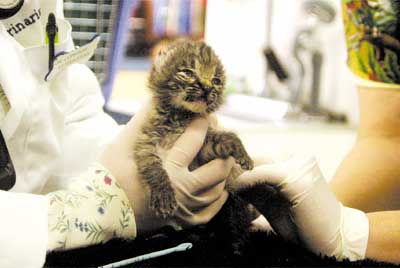
Two baby bobcats arrived Friday in Morgan Hill to learn how to
catch mice, fend for themselves and, above all, to fear humans.
Delivered to WERC (the Wildlife Education and Rehabilitation
Center), the two-week old kittens were given a thorough medical
check up and went to their new home with WERC volunteer and bobcat
supervisor Evelyn Davis.
Two baby bobcats arrived Friday in Morgan Hill to learn how to catch mice, fend for themselves and, above all, to fear humans. Delivered to WERC (the Wildlife Education and Rehabilitation Center), the two-week old kittens were given a thorough medical check up and went to their new home with WERC volunteer and bobcat supervisor Evelyn Davis.
The pair will stay in a specially prepared room and learn to how to survive in the wilderness for the next six to eight months – untouched by human hands and never, ever hearing a human voice.
WERC, led by director Sue Howell essentially “wrote the book” on raising bobcats in a way that allows them to be reintroduced into the wild – and survive on their own. A bobcat without a fear of humans is doomed in the wild, Howell said after the last complaining kitten was bundled off to its new lair.
And, of course, they need to catch their own food and not rely on mouse-providing humans.
Caretakers never show themselves to their charges; they rub themselves with herbs or eucalyptus leaves and bobcat urine to cover the human scent, then don masks and gloves made from spotted, bobcat-like fabric.
The WERC method of rehabilitating bobcats is now the official method adopted by the state department of Fish and Game.
The two siblings came to WERC from the Pacific Wildlife Care center in San Luis Obispo. The local WERC, unlike other similar organizations in the region, has the benefit of complete and free and veterinary service, compliments of veterinarian John Quick. Because of the medical care and because of the local WERC’s solid reputation for successful bobcat training and release, San Luis Obispo called on Howell to take over.
This time, though, it wasn’t Quick who handled the squawking infants but veterinarian Shanna Compton, new to Quick’s practice – the Animal Care Center – and a 1996 graduate of the U.C. Davis School of Veterinary Medicine. It was Compton’s first go at bobcats.
An eager group of WERC volunteers and staff gathered round as Compton reached in the carry cage and pulled out a scrawny, mottled kitten, which she pronounced to be a male.
“Then we’ll call him Miguel,” Howell said. The kittens were confiscated from a ranch in the San Miguel area by Fish and Game officials. San Miguel is north of Paso Robles.
Compton popped the kitten into a lidded basket balanced on a scale. The lid keeps small animals from scrambling out and falling while they are being weighed. Miguel weighed 268.5 grams.
“He’s about 14 days old,” she said. He was also somewhat dehydrated.
Compton showed Davis and the assembled WERC volunteers how to tell: she pulled slightly on the skin and watched how long it took to return to shape. This kitten’s skin took a bit longer, she said, than normal.
Poking and prodding, checking eyes, ears and several just-budding teeth, Compton talked continuously to the squirming little cat to reinforce the negative experience.
“I want them to associate the human voice with bad things,” she said.
Miguel did not appear to be enjoying himself. He was measured – 9.5 inches from nose to tip of tail – and had his temperature taken. At 98.6 degrees, Compton said he was a little cold. 99.5 -102 degrees is normal for small cats, she said. Davis said she had a hot water bottle in the car ready to warm him up. Miguel gave blood – rather unwillingly – and a fecal sample – less so – to be tested for disease and parasites.
When Miguel had revealed all his secrets, he was returned to the cage and the second kitten emerged, larger and lighter in color than the first.
“This one’s a girl,” Compton said, “and she looks real perky.”
“Her name will be Samantha,” Howell said. “Sam and Miguel because they come from San Miguel.”
Samantha tipped the scales at 310 grams, stretched to 10 inches and displayed clear eyes and ears too.
“They are both very lively,” Compton said.
The kittens come from an uncertain background. Fish and Game officers were tipped off that they were being raised illegally on a ranch in San Miguel, for what purpose is unclear. Charles Snyder, WERC operations coordinator, said their mother (or a mother bobcat) was found dead inside a barn on the property.
“The kittens had to be confiscated,” Snyder said, implying the people raising them did not give them up willingly. “They could have been raised as pets or for sale as pets or, he said, in the worst case, for fur.”
The reason knowing the kittens’ background is important, Snyder said, is that the first few days with their mother are critical. They learn skills and, more importantly, they gain antibodies and, thus, immunity to disease from the mother’s milk.
“Nature didn’t intend for us to raise them,” Snyder said.
Bobcats are not often given names in rehabilitation. When they are named, they never hear it spoken since they do not hear human voices except during veterinary examinations; the surrogate “mothers” (caregivers are called mothers but are men and women).
Howell said WERC has trained and released many bobcats in the past but it was “Rocky”, “Bobbie” and “Liberty” who were raised from kittens and grabbed the most public attention.
Liberty was released just last May. Bobbie is spotted occasionally by rangers because of an ear tag. Howell said the bobcats are released as close as possible to the habitat where they were found.
Davis, the team supervisor, has been with WERC for four years.
“Liberty was my first bobcat,” she said. She and her husband, Wayne, have turned their daughter’s former bedroom into a bobcat suite.
“We put tarps on the floor and brought in trees and smelly stuff,” she said.
“We turned the library into a jungle,” Wayne added.
Davis and a team of backup volunteers – Yvonne Cunningham is one – will feed the little cats every two to three hours for one to two weeks.
“After that,” Compton said, “every six hours.” She said their chances “look pretty good,” despite the possible lack of early antibodies.
In the six months Sam and Miguel will be in WERC’s care, they will devour about 110 pounds of mice – each, Quick estimated.
“There’s a long road ahead,” Howell said.
“We were ridiculed at first,” she said, about the bobcat suits, the herbs and bobcat urine rub. “But now we get calls from all over the country.”
“Ours (bobcats rehabilitated by WERC) are more wild that the ones caught when they are older,” Davis said.
Compton said the main difference between bobcat and domestic kittens is the size and a slightly different body skeleton shape.
“Bobcats will reach 30 to 35 pounds as adults,” she said.
Quick said that it will be Compton who will make the final determination that Sam and Miguel are ready for release. They will not necessarily be released together, she said.
“Bobcats are solitary animals, very territorial.” Even if released together, they will go their separate ways.
Just before release and at their final medical check, Compton said, bobcats are anesthetized for the procedure.
That is when the surrogates – Davis and her team – can touch their babies and talk to them. They are released back to the wild and the life nature intended them to have.
Bobcats are not the only rescued animals that WERC treats, Howell said.
“We have a golden eagle that was hit by a car up in Willits – he has visual problems – and we have a rare Swainson’s hawk from China Lake that will be released soon near Sacramento.
“We are gearing up now for baby season,” Howell said.
S.O.S. FOR FUNDS
While the veterinary care is free and WERC, founded in 1990, has many volunteers, it does have a paid staff and mounting costs to cover. The team needs special food, mammal formula and medicine. Howell said WERC can use any and all donations – of food and, especially, of money.
Besides supplies and funding, Howell is searching for summer-weight fabric in “bobcat-like” print from which to make new bobcat suits for the volunteers. She said the masks, which cover the shoulders, are lined in kevlar – bullet-proof vest fabric – to protect the caretaker from larger bobcats.
“They will often try to climb on shoulders,” Howell said.
WERC’s goal is to have quarters large enough to have living quarters for an on-site caretaker. It just takes money. And volunteers. Orientation sessions for new volunteers are coming up. Donations of all sizes are welcome. WERC is a 501(c)(3) nonprofit organization dedicated to the care and preservation of native wildlife. Funded by private donations, W.E.R.C. is both an acute care facility for sick and injured wildlife, and a nurturing center for orphaned wildlife too young to survive on their own. W.E.R.C. operates as a temporary refuge for wildlife, for the organization’s goal is not to tame, but to release the animals back into their native habitat healthy, wild, and free.
WERC also supports an extensive educational program, speakers bureau and advisory service. Check the website for a fuller description.
The WERC website is www.werc-ca.org and address is W.E.R.C, P.O. Box 1105, Morgan Hill, CA. 95038-1105.