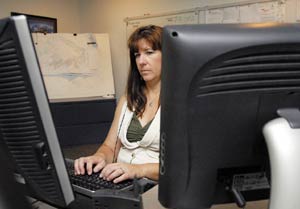
The glow from three different computer screens lights Darcy
Gallagher’s face as her fingers fly over the keyboard, sending a
Morgan Hill police officer to a business alarm while pausing to
take an incoming call about a young patient who has missed a
regularly scheduled medical treatment.
Morgan Hill – The glow from three different computer screens lights Darcy Gallagher’s face as her fingers fly over the keyboard, sending a Morgan Hill police officer to a business alarm while pausing to take an incoming call about a young patient who has missed a regularly scheduled medical treatment.
Another officer radios that he has stopped a car and needs a dispatcher to check the license plate, as well as the license status of the driver. Gallagher, the dispatch supervisor for the department, barely has a moment to exchange a word with her dispatch partner, Toni Maiquez, before she’s back on the radio and on the phone.
As the call about the child who missed a medical treatment ends in an arrest of the mother’s boyfriend on an outstanding warrant, Gallagher has to contact the man’s parole agent to discover the conditions of his parole as she’s fielding incoming calls of varying seriousness, from someone wondering what to do about telemarketers calling her cell phone to a possible physical fight.
Many times, the callers are in an extreme emotional state. Fear, anger and physical distress may result in confusion on the part of the caller, and dispatchers must be able to extract the facts of the situation.
“It can be very stressful,” Gallagher said. “You have to be able to remain calm under pressure.”
Recently, Morgan Hill dispatchers were “tested” when an officer was injured by a drunk driver the evening of Aug. 18. The situation was tense as the dispatchers on duty tried to sort out what had happened, where the officer was located, how badly he and the Explorer scout riding with him were injured. The officer’s radio jammed as the drunk driver smashed into the patrol car, and dispatchers scrambled to get paramedics to the scene as quickly as possible.
But the events dispatchers face are not always as emotional for them, Gallagher said. Though there are always concerns when an officer confronts a suspect or is involved in a pursuit, there are also plenty of “routine” issues.
“It’s all about multi-tasking,” she laughs.
Dispatchers also monitor cameras inside and around the police station. There are cameras inside StriXe Lounge and Village Avante that can be monitored if needed during an incident.
Besides their regular work, dispatchers, who typically work four 10-hour shifts per week, also handle many other jobs for the city in off-hours, when regular city workers are not on duty.
“There are functions that our dispatchers perform that would have to be staffed on a larger level, 24/7,” said Morgan Hill police Cmdr. David Swing.
Public works department calls, releasing vehicles from impound and missing person reports are some of the other tasks dispatchers handle.
Sometimes people entering the position don’t understand the pressures of not only the stressful nature of the job, but also the shift work, Gallagher said. Often law enforcement agencies look for lateral hires instead of an entry level candidate to fill an open position.
The hiring process is arduous, with a thorough background check, a polygraph test and fingerprinting required. Once the candidate has passed a certain level, a psychological exam and a medical exam are necessary.
Morgan Hill’s dispatch department includes eight full-time dispatchers, two part-time positions and a supervisor. Gallagher, who started as a dispatcher in Morgan Hill in 1999, returned to the department after working for CHP and a county sheriff’s office. Her husband was hired as police chief in Los Banos, and she came back to MHPD.
With more than 110 years of combined dispatching experience in the department, Gallagher said many of her co-workers have come to Morgan Hill from other agencies, including San Jose Police Department and California Highway Patrol. Many of them have been recognized for their work, and some have extended their work outside of the dispatch room.
Maiquez, for example, who has 25 years of experience as a dispatcher, will be starting an educational program on 911 targeting first and second graders, “a kind-of DARE for 911,” she said. This is a program she’s taken to the schools before, but had to discontinue when staffing fell short.
“We are very fortunate to have this group of professionals in the department,” Swing said.