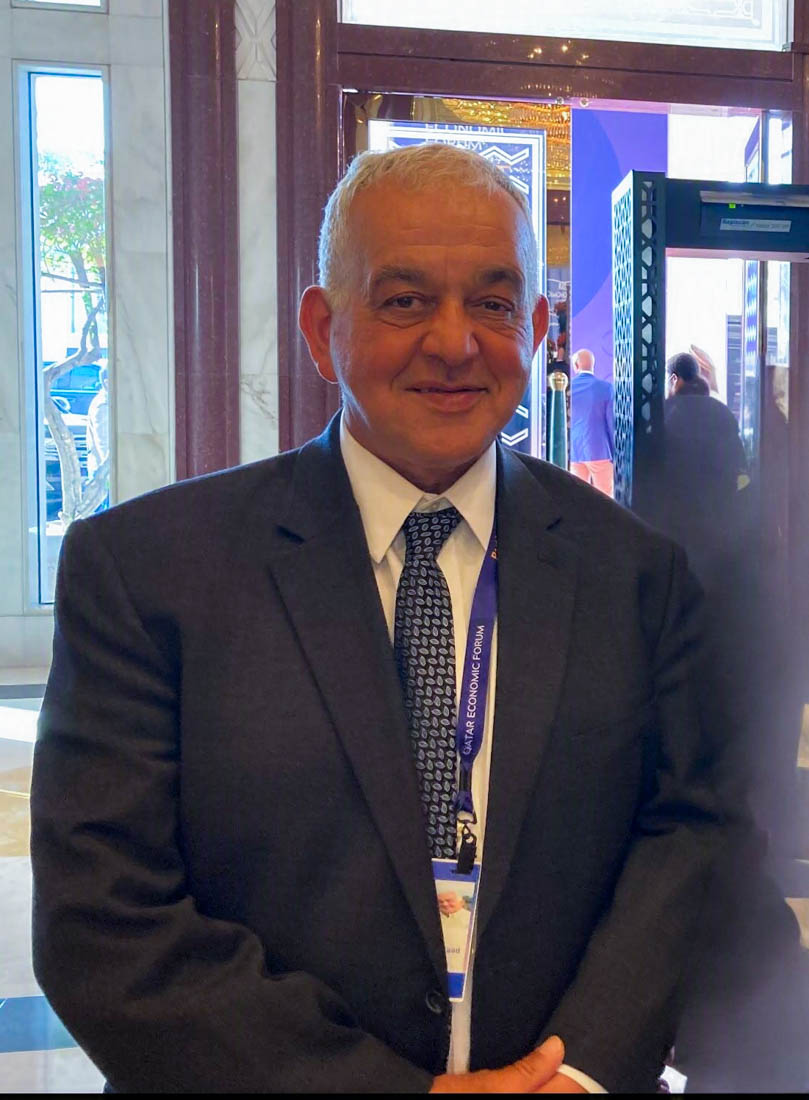
Author Alie Saad synthesized science, speculation and spirituality to develop a narrative that explores the nature of consciousness and the definition of life, and forces the reader to ask hard questions about the role of science, regulation and mysticism in medical cases where the brain goes dark but the person inside may not.
Saad’s book, “Soul Catcher,” was released Aug. 1, the culmination of roughly seven years of writing. The novel follows neuroscientist John Watson as he searches for a way to reach his wife, Jennifer, and her daughter, Samantha, after an autonomous vehicle crash leaves them in a coma.
As Watson tries to determine whether his wife remains conscious behind her stillness, his search pulls him through medicine, law, neuroscience, quantum theory and faith.
“How do you determine what is silence, and what is not?” Saad asks, noting that modern diagnostic tools don’t show the whole picture of what is happening inside the brain.
The story draws heavily on Saad’s own experience. At age 15, he was struck by a motorbike in West Africa, and spent about a week in a coma.
“It takes time for that cloud to lift,” Saad said. “I don’t remember anything from right after.”
Years later, in 2010, two daughters of a close friend spent three months in a coma after a separate incident, an experience that pushed Saad toward the questions that eventually became the novel: how doctors, families and regulators determine what counts as consciousness, and how much of that determination is shaped by science versus by decades-old regulation.
“Most of the regulations date back to the 1950s, ‘60s and ‘70s,” Saad said. “What was considered ‘dignified’ then is different from today.”
The book weaves together neuroscience concepts including spindle cells, theta and gamma brainwaves, and the microtubules within neurons that some theorize may be engaged in quantum processes within the brain, transferring signals not with chemical or electrical signals, but through quantum entanglement.
“A lot of people pooh-pooh it, but the issue is that it could be very real, but we don’t know how to measure it,” Saad said. “Quantum processes don’t work at room temperature; they work at minus 270 degrees Kelvin. Then how is it happening in the warm, wet brain?”
Saad said he researched concepts of the soul across Islam, Judaism and Buddhism while writing the book, deliberately avoiding centering any single faith.
“I try not to use the word ‘soul’ as much as I want to use ‘consciousness,’” Saad said. “‘Consciousness’ takes away religion. The question is, are these people conscious?”
Saad’s path to writing fiction followed a winding career. Born in West Africa, he earned his Ph.D. in England, and later ran a medical school research center in Saudi Arabia for three years.
After moving to the United States in 1985, he spent a decade at Stanford University researching how cancer cells communicate before moving into finance and then telecommunications, where he said he helped design Nigeria’s first CDMA cellular network and later helped build fiber-optic networks in Zimbabwe and Nigeria.
He has also worked in autonomous systems, building his first unmanned aerial vehicle in 2010, and has lectured in China on telecommunications and neuroscience since 2002.
Saad said he has since sent “Soul Catcher” to several medical schools in hopes of sparking interdisciplinary research combining neurophysiology, theoretical physics and mathematics to better understand brain function—including whether communication between comatose patients and the outside world might someday be possible.
He said he is already working on a sequel that will explore further attempts at that kind of communication, along with the political questions it raises.
Saad said he intentionally left many of the book’s central questions, including when life begins, when consciousness ends, and what responsibilities doctors and families have in between, unresolved.
“There’s no way anybody can tell everybody the answers,” Saad said. “The thing to do is question, put questions out there, and let them solve it.”
“Soul Catcher” is available on Amazon in Kindle, hardcover and paperback formats, and may soon be available at local bookstores.