
As a teacher at Britton Middle School from 1998 through December 2015, I understand the value of a school bond. During that time, I knew exactly where to place the trash cans to catch the drips from the leaking ceiling whenever it rained.
Frequently, my assignment during the boys’ basketball season was to wipe the floor dry when the action was at a different part of the court if it rained during a home game. The Athletic Director did the same for me during the girls’ basketball season, as I was coaching.
I strongly discouraged my sons and students from drinking the water in the drinking fountains, as every morning the water was brown and orange from the corrosion in the pipes. I fully understand leaking roofs and old plumbing and the importance of a successful school bond.
I returned to Britton Middle School as Assistant Principal in July 2017, where I remained until I retired in June 2021. The excitement of students having our brand new campus was palpable.
From firsthand experience, I understand the power of a school bond, but only if it passes.
As I mentioned prior to my voting against putting a school bond on the November 2026 ballot, I talked with four members of the 2012 school board that successfully passed Measure G. What I learned was that for more than a year prior to moving forward with putting a bond on the ballot, there were community forums; all schools presented proposals for desired upgrades for their sites; and the Morgan Hill Federation of Teachers (MHFT) was fully on board to support the bond.
Once Measure G was on the ballot, numerous teaching peers and I phone banked and knocked on doors garnering support for the bond. Teachers bought in and did the work needed to pass the bond. This type of stakeholder input prior to placing a bond measure on the ballot didn’t happen in 2026.
The MHFT President, QA Nguyen shared with me that their leadership was unable to bring this bond measure forward for endorsement by their Campaign on Political Endorsement Committee due to a lack of information and collaboration regarding projected funding allocations—all of which are necessary to garner their support and advocacy.
Individual site staff weren’t included in decisions to pursue a bond. Community members were not included, other than those surveyed as part of a marketing survey to determine what language would be most appealing to voters and general level of support when provided information about school needs.
At the meeting on May 28, I also mentioned that I was looking at data that was not presented in public and I didn’t think a bond would pass (see accompanying photo).
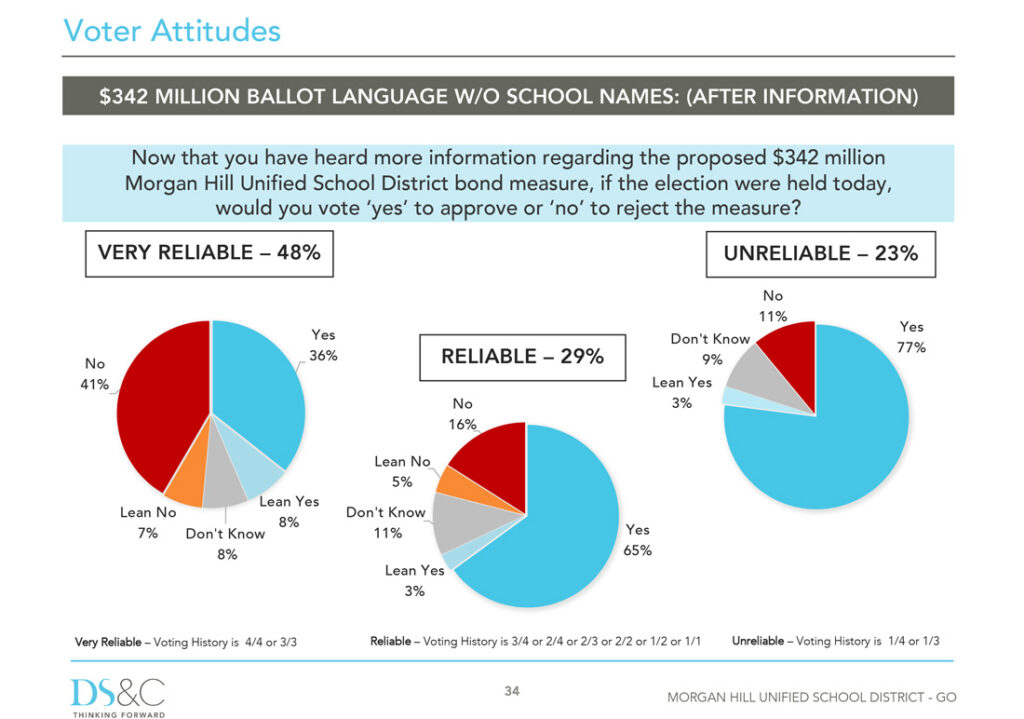
For Angela Herrera, whose Letter to the Editor (Morgan Hill Times, June 19) made incorrect assumptions as to why I didn’t support the bond and stated that she “relies on data to make decisions,” these are the data points at which I was looking. When I multiplied the percentages of each voting group times the sum of “Yes” and “Lean Yes” times the percent of elections in which they participate, always rounded up, and took that sum, it added up to 44% of the voters leaning toward voting yes. That is far short of the 55% threshold needed to pass a bond.
This bond appeared to be doomed to fail. A larger number of voters participate in presidential elections, increasing the chances for passing a bond or parcel tax in 2028.
There is a cost to putting a bond on a ballot, both monetary and in terms of effort. It’s been six years since the last bond initiative failed miserably and we can’t afford another failed bond.
If we start the process following the successful model provided by the school board members and district administration who brought us Measure G, I feel we will be able to get a bond, or possibly even a parcel tax, passed.
My decisions are based on a historical perspective, available data and what I think is best for our students. A failed school bond helps no one, it just makes it that much harder to succeed in the future.
Nancy Altman
MHUSD Trustee