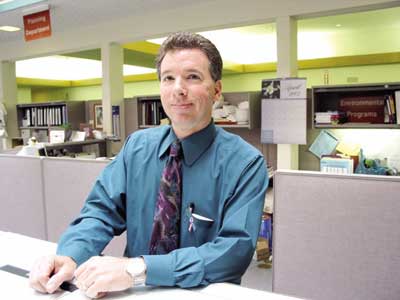
It was a teacher, not surprisingly, that changed Tony Eulo
’s life and, ultimately, Morgan Hill’s. This city employee has
been called “Mr. Environment” but actually has other jobs too. He
is an assistant to the city manager and could also be called Mr.
Technology.
It was a teacher, not surprisingly, that changed Tony Eulo’s life and, ultimately, Morgan Hill’s. This city employee has been called “Mr. Environment” but actually has other jobs too. He is an assistant to the city manager and could also be called Mr. Technology.
Eulo wasn’t always interested in the environment.
“I was a valley boy,” Eulo said about his teenage years in the San Fernando Valley, north of Los Angeles, “but I didn’t like to surf.” Life was studying hard, playing guitar and working in his grandparents’ mail delivery business.
Studying hard got him into Loyola Marymount, a small, highly regarded private college in L.A.
“I was bored and miserable and lasted 10 weeks,” Eulo said. The parents and grandparents were not pleased when he took a year off to find himself by playing in a rock and roll band.
“It became clear (finally) that that wasn’t going to work,” he said. “It (the band) just never came together, so I enrolled at Pierce Junior College in the Valley.” It was at Pierce, as a business major, that Eulo took a class on the environment.
“The instructor had a very dry style,” he said, “but I realized how critical the environmental issues facing the world were and we weren’t doing anything about it.”
Eulo wanted to contribute to the environment.
“So I packed up the dog and went to Davis,” he said.
This next and most important stop – the University of California at Davis – was where he found a major in Environmental Policy, Analysis and Planning – relatively new at the time, and a minor in toxicology. His emphasis was in water quality – prophetic given Morgan Hill’s developing perchlorate in the groundwater problem.
“I loved it (Davis and the major) and stayed 10 years,” he said.
Eulo was especially interested in how human beings and animals respond to toxins and how toxins are metabolized by bodies.
After graduation, Eulo migrated to a job in hazardous waste management for the Sacramento region, to the Local Government Commission and ultimately writing the SACOG (Sacramento’s version of ABAG, the Association of Bay Area Governments) hazardous waste management plan.
In 1994 he broke the mold again and moved to Oregon to experience communal living – something he had always been interested in. He paid the bills by doing environmental consulting in Eugene but decided that what he really wanted to do is to be environmental coordinator for a small-to-medium-sized city in the Bay Area. Enter Morgan Hill. It was 1996.
Morgan Hill’s curbside recycling program started up in 1992 during his predecessor’s reign but, Eulo said, expansion plans were stalled by dissension between the city and South Valley Disposal and Recycling, the city’s waste contractor.
“There were difficulties with the general manager,” he said, “but, when he was replaced, everything got better overnight.”
The program, which always included glass, mixed paper and limited plastics, expanded recently to include yard trimmings and more hard plastics.
“I really want to add scrap metal and maybe food products,” Eulo said. “But not textiles – there just isn’t the market.”
Food recycling would require once-a-week pickup because of the scavenger problem. Food recycling would, he said, cause a major reduction in the amount of trash trucked to the landfill. This is an important goal where state- mandated reductions of 50 percent are not quite being met by Morgan Hill residents.
Several communities up north, he said, mix it all up for compost, pull out the non-recyclables and truck it all away for agricultural purposes.
Morgan Hill’s recyclables are trucked to the San Martin Transfer Station, then to Milpitas where the sorted materials are picked up by various vendors. Mixed paper often goes to Asia.
“On any given day it could go to a different place,” Eulo said.
“What is important,” he said, “is for corporate (offices) to become aware that recycling is a good thing to do.” As there are fewer and fewer trees, the cost of a tree goes up, the cost of recycled pulp goes down.
Current concern is directed towards E-waste. There are 10 pounds of lead in a single television set; computers and monitors are hazardous waste. However, in one bright note, Eulo said there is a bill working its way through the state Legislature – not yet signed – to enforce a “recycling” deposit on monitors and televisions.
“Hewlett-Packard has signed on in that it won’t oppose the bill,” Eulo said. “We need to do something.”
The cities of Morgan Hill and Gilroy are considering a separate E-waste day, he said. “We have to do this and manufacturers must get involved.”
Eulo recently helped judge the Recycling Poster Contest, where dozens of art projects from kindergarten through high school covered a range of talents, ideas and media. The winners will be announced and presented to the public at Wednesday’s City Council meeting. The South Valley Recyclers of the Year will be lauded and presented as well.
Eulo is pleased that the Morgan Hill School District is taking recycling under its wing. Several elementary schools are planning elaborate “Recycle Now” projects and even the high schools are active.
“He’s done a wonderful job on our environmental programs,” said Mayor Dennis Kennedy. “I’m always amazed at how he makes recycling interesting in his columns. Tony is a real asset to the city.”
By 2000, Eulo began to collect more job “hats.” He added the assistant to the city manager hat to the environmental programs manager one and, in 2001, began to handle the information technology part of City Hall life.
“I handle (as assistant to Ed Tewes, the city manager) the external communications,” he said. The job description includes keeping track of city-related legislation by county, regional and state governmental bodies; writing legislators and keeping his boss and the council up to date.
His other new job, communications, has evolved into riding herd on Charter Communications, Morgan Hill’s purveyor of cable TV; redesigning the city’s website; learning to explain the new telephone system and supervising cable Channel 17 that broadcasts council and commission meetings live.
“When we hired him, he had no experience in cable TV issues,” said David Bischoff, planning director and Eulo’s first boss at City Hall.
“But he is a quick study, a great problem solver, very creative. Tony is extremely positive and a great guy to work with. He was one of my better hiring decisions.”
As cities go, Eulo said, Morgan Hill has a small civic organization for its size.
“We all wear a lot of hats,” he said.
“What I like about my job,” he said, “is that I can directly help people. People call when they have a problem and we help fix it. We can impact their lives.”
Eulo praises Tewes who he says is extremely smart.
“He has a great memory and his expectations are really high. ‘You weren’t hired to maintain the status quo,’ Tewes tells his staff. “We’re never entirely comfortable – he is always looking for more.”
Eulo and his wife, Jill, who married on a Friday the 13th in 1996, bought their first house and moved to Morgan Hill last year and, Eulo says, enjoy living near one of the city’s parks. Their children, Auggie, 6, and Maya, 3, frequently walk over with the parents to try out the swings, slide down the slides and pick up grass stains and sand in shoes.
“Now it’s our own community, not just your community,” he said.
CLEANING UP
To take advantage of Earth Day, Eulo has promoted City Beautification Day – this Saturday – where, beginning at 8 a.m. citizens, individually and in groups, gather at City Hall for a pep talk and to be given sprucing-up-the-city assignments. After a morning of congenial and useful work, they all gather at Community Park for a barbecue. No reservations are necessary. Just show up at City Hall, 17555 Peak Ave. with work gloves and some water. Everyone is welcome; everyone can make a difference. Details: www.morgan-hill.ca.gov or 779-7271.