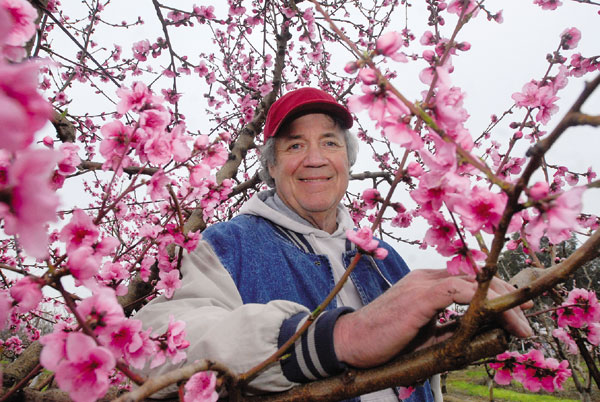
Horticulturalist Andy Mariani is an innovator in one of the
oldest fields in the world. Through creative marketing and
researching, Mariani has made a name for himself in California:
Cherry Man of the Year, an honor awarded by the state’s Cherry
Growers and Industries Foundation.
Horticulturalist Andy Mariani is an innovator in one of the oldest fields in the world. Through creative marketing and researching, Mariani has made a name for himself in California: Cherry Man of the Year, an honor awarded by the state’s Cherry Growers and Industries Foundation.
Not only are his growing techniques innovative, so is his marketing. Looking around at nearby vineyards and their popular wine tastings, Mariani thought he’d bring some direct marketing to his orchard.
“I tell (visitors) we get to the fruit before it ferments,” Mariani said jokingly.
Andy’s Orchard attracts visitors from the region and even across the country, to taste his hundreds of unique varieties of stone fruits and, yes, cherries. Capitalizing on the ever increasing suburban areas around him and the “buy local” movement, Mariani offers tours, “Harvest Walks” where patrons can pick their own fruit in the summer, and opened a store to sell his specialty fruits.
Unlike some of his vineyard counterparts, whom he affectionately calls “gentlemen farmers” for their hobbyist nature, Mariani’s a man of the land. He drives a well-worn brown and tan Ford, with a “Buy Fresh, Buy Local” bumper sticker as old as his vintage blue California license plate.
Sporting a dark blue nondescript baseball cap with tufts of white curly hair peaking underneath, Mariani, a tall, thin, laid-back man, gestures towards his fruit trees and enthusiastically describes the process of pruning, thinning, irrigating and harvesting the fruit, year after year – a timeless process that suits him.
“To me, this is relaxing. You don’t have to worry about dealing with the public. It’s like not working, it’s doing what I feel like,” he explained. “It’s visceral. It’s elemental, growing things. DaVinci said, ‘Simplicity is the ultimate sophistication.'”
No one can wax poetic like Mariani, who sees his 40 acres of orchards as part of a bigger picture, combining old-world methods, recent history and new techniques.
But Mariani’s career would look very different if it weren’t for Prohibition. When his father Joseph Mariani arrived in the Santa Clara Valley in the 1930s, it was high dry time. Santa Clara Valley had before been wine country. A vineyardist, Mariani noted the fertile land’s possibilities for growing fruits and set about planting fruit trees.
Andy Mariani grew up on an orchard in Cupertino before his family purchased the 40 acres on Half Road in 1957. Mariani operates these acres now.
He remembers distinctly one of his first “ah ha” moments, when he recognized the whimsy and wonder of agriculture.
Amid his father’s apricot orchard was one tree that was grafted with branches from two different types of peaches, so that it grew all three fruits on the single tree.
“All around were apricot trees, but here was a peach, and it was just, wow, a peach!” Mariani said fondly, with all the excitement of his 6-year-old self, recalling the seemingly magical tree.
Mariani is still searching for the next great fruit. Hedging his bets, he plants a few acres of specialty stone fruits along with his 35 acres of cherries and boasts one of the most extensive collections of heirloom fruits on the West Coast. He’s traveled to Asia and Russia searching for unique fruit varietals. Much heralded fruits found at Andy’s include the green gage plum, the Baby Crawford peach, and the Moorpark apricot.
“Life’s a journey, you’re always seeking what’s better,” he explained. “I’m always reading, finding stuff that’s new.”
Mariani ambles through his orchard pointing out different varieties of apricots, plums, peaches and prunes, noting proudly the difference between farm-fresh produce and the produce at the supermarket.
“(Some fruits) come from Chile and they were picked three months ago,” he said. “Ours are tree ripened. The last several days (on the vine), the fruit grows tremendously in flavor.”
Mariani’s exuberance has served him well. During the Feb. 20 annual luncheon in Stockton in celebration of Cherry Day, Jim Culbertson, manager of the California Cherry Advisory Board, presented Mariani with a plaque designating him Cherry Man, in honor of his devoted service to the state’s cherry industry. He beat out 600 industry insiders across the state.
“The group felt that Andy had always done a lot of outreach,” Culbertson said. “That’s kind of one of the things we expect out of a Cherry Man of the Year. He’s been a great member of the industry and has been a good participant.”
Mariani sits on the California Cherry Advisory Board’s research committee, and was instrumental in a key development in cherry growing. While reading through research papers from the 1930s and ’40s, Mariani noticed that people were trying to figure out what to do to make cherry crops more productive despite ever-warmer winters. Cherry trees need a long, cold winter. He kept reading about nitrogen being used in South Africa and Asia to kick-start cherry blooms, but the fertilizer wasn’t used for this purpose by California’s farmers. When used as a fertilizer, nitrogen acts as a sort of coffee for the trees, waking them up and keeping them producing steadily and consistently despite the lack of a good, dormant winter. The “Old Guard,” as Mariani calls longtime, traditional farmers in the region, were skeptical of the method – at first. But after much research and testing, nitrogen fertilization became a common practice in California.
Curiously, despite his early love for the field, Mariani left the pastoral life for some time. The youngest brother of three, Mariani left the farm to his two older brothers, since the acres they owned couldn’t support three families. After graduating from Live Oak High School in the ’60s, Mariani earned a master’s degree in public administration, and spent a year serving as Saratoga’s assistant city manager. But that was all he could take of pushing papers, and a stroke of bad luck with a life-threatening skin disease landed Mariani back at home to recover. He said coming back to the farm was one of the best things that could have happened to him.
While many traditional farmers were skeptical of Mariani and his new ideas at first, Mariani is now a well-respected grower – thanks in part to his grand title.
“You would never believe that someone from around here could win Cherry Man,” Mariani said. “It’s quite an honor.”
Culbertson said a Santa Clara Valley cherry grower winning the title was unusual, and couldn’t recall another cherry industry insider here having won the honor. Coming close to it is Gilroy resident Greg Costa, who works out of Lodi and was named Cherry Man several years ago. Costa, who has packed Mariani’s cherries in Lodi and has worked with him for 10 years, was on the Cherry Man selection committee this year.
“He’s a tremendous local resource,” Costa said. “He’s very generous with his time, for people who are just backyard gardeners and growers.”
Costa serves on the research committee with Mariani.
“He’s just naturally very curious. He likes people, he loves to exchange ideas and observations,” Costa said.
Farming isn’t a job for Mariani, it’s a way of life – just as it was for his ancestors.
But it won’t always be this way. Mariani acknowledges that he doesn’t know what will happen with his 40 or so acres once he’s gone. A 62-year-old bachelor, he’s not sure who will inherit his acres. And with suburbs closing in, he’s not entirely optimistic that his orchard will last much longer.
“Each urban use that comes here makes it incrementally harder to make it,” he said.
But, for as long as he can, Mariani will be on these acres, planting, pruning, thinning, irrigating and harvesting cherries that are celebrated not only this year, but every season, by fellow fruit enthusiasts around the world as well as novice fruit aficionados in South County.