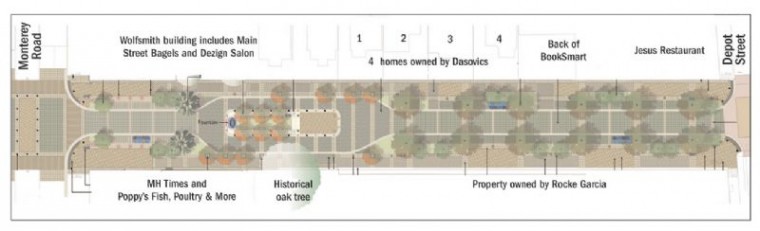
A family that owns four homes on East Third Street and the city
could not reach an agreement that would place the utility lines to
their homes underground.
A family that owns four homes on East Third Street and the city could not reach an agreement that would place the utility lines to their homes underground.
While the Third Street Promenade Project’s most vocal critics have loudly raised parking concerns, the family that owns and mostly occupies four of the six homes there have butted heads with the city on a seemingly innocuous portion of the project: moving the power lines that cross Third and connect to the meter at each home underground.
So the utility undergrounding project was modified to include four utility poles, to be located on the sidewalk in front of each of the Dasovics’ homes.
The $4 million Third Street Promenade Project will reconfigure the street as a pedestrian promenade featuring wide sidewalks, decorative street furniture, pedestrian street lights and new landscapes, much like Santa Monica’s famed thoroughfare.
The $400,000 second phase of the construction project was to move all overhead power lines underground.
The Dasovics, who occupy three of the four eastern homes on the north side of Third Street, have told the city that they very much want the utility poles moved underground. Yet the family and the city were unable to reach agreement on how that would be done and who would be responsible if anything went wrong, according to city documents.
The Dasovics declined to sign either the original or revised versions of the Right of Entry Agreement, which would allow access to their properties so that the project could be completed as designed, according to a staff report to be heard by the council Wednesday night.
Most of the family’s initial concerns about access to the property and the city’s liability were addressed in a March 4 letter by City Attorney Danny Wan detailing the revised Right of Entry Agreement.
The new agreement specified that the city and its contractor, Giacalone Electrical Services, Inc., would be responsible for any damages to the property; that the work would be under warranty for one year; and suggested that, should the family desire more insurance, the city could entertain the idea of having a separate insurance policy for their four homes.
But homes aren’t part of the city’s plans for Third Street. So if a home is destroyed during a project the Dasovics might not be able to rebuild, according to Wan’s letter.
“In the unlikely event that any of your homes are destroyed so that the replacement costs exceed 50 percent of the value of such home, you will probably not be permitted under current regulations to rebuild a single family home within 75 feet of 3rd Street,” Wan wrote. “However, if this situation actually occurs, the City Council may at that time, in its discretion, change the permitted use for your lot(s) to accommodate the unique situation where the city caused the destruction of the building on your lot(s).”
According to the staff report, Diane Dasovic replied in a March 6 letter saying that she was unhappy that her concerns were not properly addressed and stated that it was her opinion that the city was not accepting the proper responsibility for damage or loss caused by the city’s contractor.
“We’ve done literally scores of underground projects successfully,” City Manager Ed Tewes said Monday, adding that in his 35 years as a public administrator he doesn’t recall any property damage resulting from an underground project. “It is their concern, so they didn’t sign the agreement. Their concerns are their concerns. They have to evaluate it from their perspective, and they have.”
When posed with the hypothetical situation that one of the Dasovics’ homes were destroyed during the project, Tewes said that rebuilding a home on their lot would require a site amendment since the area is zoned for commercial uses.
Several members of the Dasovic family have declined to comment for this story. Diane Dasovic requested that questions be e-mailed so that she could run them by all affected members of the family before responding. E-mails to Diane Dasovic March 4 and 14 did not receive responses. Several visits to the Dasovics homes over the past two weeks produced no comment; during most, no one appeared to be home.
Members of the Dasovic family have been present at several of the many Third Street Promenade meetings and have sometimes voiced concerns about the project and what will happen to their four homes among the development of a mainly retail- and restaurant-occupied pedestrian corridor.
“We didn’t want to hold up the project, so if this is the only alternative, we’re willing to take it,” Diane Dasovic, speaking on behalf of her family about the four utility pole outcome, told the council Feb. 25.
Dasovic said in a Feb. 25 letter that she and her mother, Ivanka Dasovic, were advised by attorney Greg Scharff of Palo Alto-based The Scharff Law Group not to sign either entry agreements.
Scharff declined to comment.
“I don’t have any authorization to speak with you one way or the other,” Scharff told the Times, referring calls to the family.
City staff have expressed disappointment that an agreement to underground all power lines on Third Street could not be reached.
“We had a lot of success with this process on Depot Street,” Deputy Director of Public Works Karl Bjarke told the council during its Feb. 25 meeting. “We went through the same process on Third – we went to all of the property owners. But … when we presented them with the (Right of Entry Agreement), they were not comfortable with it.”
According to the staff report to be heard by the council, “due to the rigid scheduling requirements of PG&E,” even if a resolution were reached, the schedule would be set back several weeks.
Actual construction of Third Street is scheduled to begin the third week of May, and the project should be complete by December, the report states.
Tewes said that if there comes a time when the Dasovics decide to redevelop their property, in accordance with the downtown plan, moving the power lines underground would again be addressed.