They’re confident environmental report will succeed
San Jose – City planners at a community meeting last Thursday told people Coyote Valley plans won’t be derailed by a few new politicians at City Hall.
“If there’s going to be any change in that direction, it’s going to take the full council to make a decision about that,” said Laurel Prevetti, San Jose’s deputy planning director, speaking at a public forum at the Camden Community Center on Union Avenue in San Jose.
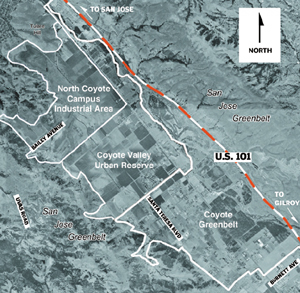
San Jose’s effort to plan a high-density suburb in Coyote Valley began four years ago after Cisco abandoned plans for a sprawling campus in San Jose’s last bastion of open space. The community meeting was the latest in a series of forums to share information and gather feedback on the long-range plan to bring 25,000 homes and 50,000 industry-leading jobs south of San Jose and west of U.S. 101.
A group of about 30 residents including Coyote Valley land owners and San Jose City Council members Nancy Pyle and Forrest Williams attended.
There’s been no official comment from the new Mayor Chuck Reed’s office on the comprehensive plan and, so far, no indication of derailing it with a state-mandated environmental impact report (EIR) due out in March.
But the arrival of new politicians at San Jose City Hall – there are two new council members, Pete Constant and Sam Liccardo – could change the complexion of the council’s vote on Coyote Valley plans expected this fall.
Reed was a council member when the full council voted unanimously in 2002 to move forward with the whole Coyote Valley process.
“The new administration, the new mayor, was actually involved with this process when he was a council member, and I think some people don’t realize that,” said Eileen Goodwin, an outreach consultant for San Jose.
There’s still plenty of work left for planners and the 20-member task force shaping the Coyote Valley vision.
The biggest hurdle, the EIR, entails a 60-day public comment period. Considering the breadth of Coyote Valley plans – 5,000 acres of development, the realignment of Fisher Creek, the construction of manmade lake for flood control, et cetera – public feedback is apt to raise concerns. Cisco’s EIR, after all, drew litigation that failed in court but stalled the company’s development plans until they were economically unfeasible.
But planners and task force members are confident they’ve dotted their “i’s” and crossed their “t’s” when it comes to Coyote Valley’s EIR, which seeks to appease environmentalists with anti-sprawl solutions. The plan is peppered with parking garages and vertical mixed-use buildings. The city of San Jose has consulted with the Santa Clara Valley Water District and the Valley Transportation Authority. Those working on the EIR feel its strong enough to withstand scrutiny.
“We feel we’re in a good place to keep working on the EIR, and quite honestly, we feel having the EIR out in a reasonable time frame will actually help the conversation,” Prevetti said.
The other hurdle for Coyote Valley planners will be a discussion of job-triggers for housing construction. Under San Jose’s general plan, the construction of homes in the valley cannot happen before 5,000 jobs are available. The task force – a mixed group of land owners, residents and politicians – will take up the matter this spring. The pace of Coyote Valley’s development could hinge on what direction the task force takes, with some members leaning toward letting homes and jobs go in at once and others taking a more cautious approach.
San Jose City Councilwoman Nancy Pyle, a task force member, wants to see employers commit before workforce housing is built.
“It’s so important to keep those triggers,” Pyle said. “If we build housing first, jobs could go to the south.”
Others think jobs and homes should go in at once to lure top-notch companies. Task force member Kerry Williams, president of the Coyote Housing Group, a consortium of land owners who’ve paid more than $16 million for the Coyote Valley planning process, said plan should start big.
In either case, Roger Costa, who owns land totaling 20 acres in Coyote Valley, said he’s glad the whole process involves careful discussion.
“Over the last 40 years, we’ve seen isolated development” in the valley, Costa said. “This is very exciting.”
Tony Burchyns covers Morgan Hill for The Times and county issues for the Dispatch. Reach him at (408) 779-4106 ext. 201 or tb*******@*************es.com.