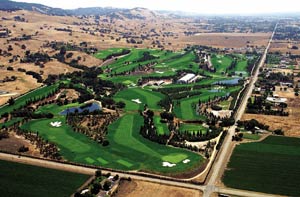
Environmentalists are accusing the city of not ensuring
mitigation measures are met quickly enough at John Fry’s golf
course.
Morgan Hill – Environmentalists are accusing the city of not ensuring mitigation measures are met quickly enough at John Fry’s golf course.
“Is the city doing a decent job? Certainly not,” charged Craig Breon, former director of the Santa Clara County Audubon Society, working now as a consultant for the watchdog group. “Some things should be done by now … but Fry is an influential person.”
Breon’s comments echoed those of Committee for Green Foothills legislative advocate Brian Schmidt, who spoke before the Morgan Hill City Council on Jan. 24. Schmidt informed the council the two environmental groups were tracking some 35 conditions imposed on Fry’s golf course as part of an agreement to allow its development. Schmidt said several of those conditions have not been satisfied and progress was behind schedule.
A decade ago, electronics mogul Fry built an 18-hole golf course on a 200-acre property on Foothill Avenue without getting the right permits from the city. When officials found out about it – after complaints from neighbors – planners forced Fry to do an environmental impact report, restore natural habitat and monitor groundwater quality. The city approved the list of environmental requirements in August 2004 and continues to work with Fry’s consultants to monitor compliance.
While some conditions have not been met – such as mitigating for lost habitat and preparing plans for controlling nitrogen in groundwater – city officials say adequate progress is being made on the project. More importantly, officials deny the implication made by Breon that Fry is receiving special treatment because of his ties to the American Institute of Mathematics, a brainy think tank planning to build a conference center on Fry’s Morgan Hill property. Fry’s Electronics is a major funding source of the prestigious institute, temporarily housed in Palo Alto, which seeks to expand mathematical frontiers through research, conferences and the preservation of rare mathematical books and documents for scholars to use.
“We haven’t cut corners,” said Morgan Hill City Planner Jim Rowe. “We recognized as we got into this some of the time frames were overly aggressive (for the required environmental mitigation). But we intend to hold him accountable for everything in the environmental impact report.”
Kevin Robins, director of construction and maintenance for Fry’s Electronics, would not comment on the environmental mitigations when reached by phone by the Times on Monday.
Manuel Valerio, an official spokesman for Fry’s Electronics, said he could not comment before press time when reached by the Times by phone on Monday. In an e-mail later that day, Valerio said, “It would be unfair to AIM, your readers, and the interested citizens of Morgan Hill for us to attempt to provide detailed answers to questions involving very complex and involved environmental matters in a rushed manner.”
Valerio did not refer the Times to someone else at the company.
An April 2006 status report by city planners regarding environmental mitigations at the golf course notes “While the applicant did get a late start on compliance activities … it is evident to staff that the timeframes set out … were overly optimistic.”
“They are making progress,” Rowe said, “but some of those things aren’t easy to accomplish.”
One challenge has been to replace green, vegetated areas along streams and creeks which were lost when Fry cleared land to expand the golf course. The city originally asked for this to be done by August 2005, but possibilities for restoration have been limited at the golf course so Fry’s consultants have been working with the U.S. Fish and Wildlife Service to preserve 25 acres of off-site land. So far, no appropriate lands have been identified.
Groundwater monitoring reports, a drainage study and a chemical management plan have been submitted and some investigations are ongoing, such as monitoring of frogs, turtles and salamanders on the property.
The next environmental status report from city officials will be released before the Feb. 21 city council meeting.
“We’ve got to listen to what the facts are,” said Morgan Hill Mayor Steve Tate. “There are a lot of circumstances to consider.”
For one thing, Fry’s got a late start on compliance activities because the company changed its project manager and hired additional professionals who needed more time to go through the learning curve, according to the city’s progress report last April.
City Councilman Mark Grzan, who chairs the council’s Utilities and Environment Committee, said the city would do everything in its power to hold the golf course to environmental standards.
“Even though there have been delays, we will make sure Fry corrects the items he needs to correct,” Grzan said. “Otherwise the city will leverage its legal resources to make him comply.”
State law says the city is responsible for enforcing environmental mitigations at the golf course.
In 2003, the Audubon Society sued Morgan Hill in a non-related matter for failing to protect habitat for burrowing owls. The lawsuit was settled out of court, Breon said, with the city paying all legal fees and agreeing to do a burrowing owl plan.