City Hall is closing. It’s part of the most recent,
”
drastic
”
effort by the city to reduce long-term general fund costs and
change the way the city delivers public services.
City Hall is closing.
It’s part of the most recent, “drastic” effort by the city to reduce long-term general fund costs and change the way the city delivers public services.
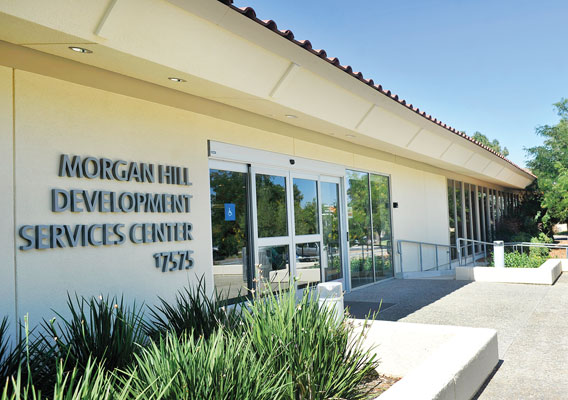
Still in the first quarter of the fiscal year, the city council voted unanimously Wednesday to move the mayor’s, city manager’s and other offices from the city hall headquarters to the Development Services Center on the north side of the city hall campus on Peak Avenue.
That combined with other measures adopted Wednesday will cut another $600,000 annually from the general fund budget, and another $300,000 from redevelopment efforts, city staff said.
The city will also seek a new contract for fire and emergency medical services – possibly with a new provider – that costs at least $500,000 less than the current contract with Santa Clara County’s Central Fire District.
And the council adopted a long-term labor policy that emphasizes, among other things, the need to shift to a tiered retirement system, require employees to pay 100 percent of their retirement costs and contribute more to their benefits.
The general fund-reducing actions are in response to the state redevelopment budget, which was passed just after the city’s $26-million budget and requires the city to help the state pay for basic services in order to keep the Morgan Hill redevelopment agency active.
By July 2012, the city has to pay the state $9.8 million. It’s part of the state’s strategy to cover its own deficit by collecting $1.7 billion from redevelopment agencies statewide, to pay for education, public safety and social services.
Staff and services will move by January 2012, and the city hall building will close by July, according to community services director Steve Rymer. The council will meet in its usual chambers until July 2012, but will then likely conduct meetings at the Community and Cultural Center at 17000 Monterey Road.
Closing city hall will save about $100,000 per year, after the initial one-time moving costs of about $275,000 are recovered, Rymer added. Once the move is complete, the city will seek to lease the facility to a private tenant. That could generate at least $75,000 per year in revenue.
Moving to the DSC – the larger of the two buildings – makes sense because both structures have empty space due to the elimination of city positions over the past three years, the DSC is newly renovated and it would provide a “one stop shop” for city services, staff said.
Currently housed at city hall are the offices of the mayor, city manager, city attorney, administrative services, community services and utility billing. Most of those would move to the DSC, with information services moving to the police station on Vineyard Boulevard by April, Rymer said.
Councilwoman Marilyn Librers said she supports the move “with a heavy heart” and it sends a “very drastic message.”
City hall was built in the early 1970s, and the DSC – then the public library – was built about the same time. The DSC was remodeled three years ago, specifically outfitted to house development, planning and engineering services and facilitate the interaction between staff and customers.
New priorities, new fire department?
The council also approved making a request for proposals for a new fire services provider.
In a shift of priorities brought about by the continually gloomy financial picture, the city’s goal for the delivery of fire and EMS is to “substantially reduce the city’s expenses,” city staff said.
As a result, the city will spend about $50,000 to hire a consultant to conduct the RFP and appraise the fair market value of the two Santa Clara County fire stations in the city limits.
The RFP is intended to yield a proposal from an agency that can give the city a lower cost – preferably lower by at least $500,000 – without a significant sacrifice of service, city staff said.
The city currently contracts with the county’s Central Fire District for an annual cost of about $5.2 million. That contract expires in 2013.
“This could ultimately result in having a new service provider … whose service delivery model may prove less expensive than Central,” a city staff report says.
Calfire officials have said numerous times in the past that they can provide the same services at a lower cost than Central Fire District.
If approved by two-thirds of the voters, such a bond would generate up to $225,000 per year to fund the property purchases, the staff report said.
The RFP was approved unanimously, but Councilman Rich Constantine cautioned his colleagues about making public safety decisions based solely on “dollars and cents.”
“Whenever you do that, sometimes things get left behind that shouldn’t. The dollar amount can’t be the sole reason why we pick one or the other,” Constantine said.
Council tightens up long-term labor costs strategy
The city also has a new blueprint for how it will approach long-term labor costs.
The seven-principle labor policy, drafted by a task force made up of five department directors, is a new way to address the rising employee costs of retirement and health benefits, declining revenues and community pressure from residents and watchdog agencies such as the Santa Clara County Civil Grand Jury, said Morgan Hill police chief David Swing, a member of the task force.
The new strategy – which is not a binding policy – will still attempt to compete with certain sectors of the market.
“The primary goal is to remain competitive in the market place,” Swing said.
But notably to prospective employees, the city will implement a tiered retirement system in which younger hires receive lower pension benefits; it will require employees to contribute more to their retirement; and the city will offer a “fixed amount” for healthcare benefits and require employees to share in future healthcare cost increases.
Council members noted that the new policy, which they approved, is likely the least tangible, most long-term effort to reduce costs. Staff could not estimate the potential savings from following the labor strategy, though it is designed to respond to market and economic conditions.
Contracts with the city’s three unions will expire in 2013, and Carr said the new policy will assist the city in the negotiation of new contracts.
“Closer to 2013 we’re going to be looking for real cost savings from our labor relations strategy,” Carr said.
Also cut by the council Wednesday was about $300,000 in the RDA’s economic development budget. These cuts will reduce services such as funding for the Chamber of Commerce and Downtown Association, commercial loans, facade improvement assistance, and tenant improvement assistance, staff said.
Rejected by the council as cost-cutting measures were items proposed in July by city staff, including furloughs for city employees, turning off street lights, eliminating funding for holiday parades and selling the Friendly Inn.