Students have seen it on television, during the O.J. Simpson
murder trial and
“CSI: Crime Scene Investigation.” Now, they are getting a chance
to try their hands at DNA fingerprinting in local classrooms.
Students have seen it on television, during the O.J. Simpson murder trial and “CSI: Crime Scene Investigation.” Now, they are getting a chance to try their hands at DNA fingerprinting in local classrooms.
Thanks to an applied biotechnology grant awarded to Gavilan College’s Small Business Development Center that is also being used to attract industry and jobs to the area, biotech educational opportunities are just beginning.
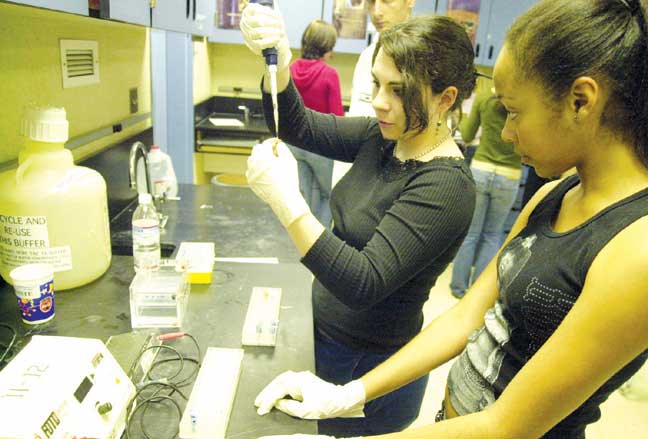
Biology students in Morgan Hill and Gilroy have experimented using high-tech equipment on loan from a nonprofit county biotech group. San Benito County and Gavilan College students will be using the kits later this year.
“The idea is to allow the kids to have hands-on training,” said Rich Gillis, director of the Small Business Development Center.
Sparking students’ interest early can prepare them for biotech jobs in the future.
“Once schools have had some exposure and students have become familiar with DNA technology through these units, the kids may decide, ‘I’d like to study this more in-depth,’ ” said Mary Alice Rathbun, a consultant to the applied bioscience division.
The kits of biotech lab equipment – costing about $50,000 each – and training for 12 local teachers to use them were provided by the Santa Clara County Biotechnology Education Partnership.
The teachers attended a free, week-long training session this summer to bring biotech to South Valley classrooms for the first time.
“As a result of being in the training, those teachers are eligible to borrow kits that have all the equipment and materials to do these science labs,” Rathbun said.
Vera Gomes, a Live Oak High School biology teacher involved with the program, thinks it is just terrific for her students, not only educational but also useful business-wise.
“These are really great skills for kids,” Gomes said. “They learn what DNA is, what a microliter is, useful things. With this training they can work in the industry during college.
“These are just regular kids, not AP students, not remedial.”
Gomes said that, besides helping her students, the program will boost the area’s economy if biotech firms move to the South Valley. She said the new Sobrato High School also would be included in the program.
Jose Hernandez, a biology teacher at Gilroy High School, is currently using one of the kits, which include special gels and micro-pipettes, to handle tiny amounts of liquids.
“What they’re learning is that you can break down DNA into little fragments, and how we can use DNA to identify individuals,” Hernandez said.
For example, Hernandez is teaching his students how DNA can be used to determine paternity and why it was so critical during Simpson’s trial.
“It’s a little outdated in scientific terms, but for us, the kids are enjoying the technology,” he said. “This is equipment that costs … thousands of dollars, so it’s really nice to let them have something they normally wouldn’t, and it’s going to be really useful if they want to go into biotech.”
Biotechnology, or transgenics, is a high-tech science that improves organisms by transferring or manipulating genetic information. It has wide-ranging applications from making crops grow healthier to making pharmaceuticals work better.
Four other high-tech kits were purchased this summer by the Small Business Development Center and donated for use by San Joaquin Valley schools. Those were purchased using the $900,000, five-year grant from California that makes Gavilan College the applied biotech center for a region that spans 17 counties, from Monterey to the Nevada border.
“It was a great aid to us to find (the Santa Clara County Biotechnology Education Partnership) because that meant the grant resources could go further” to serve other counties in the region, Rathbun said.
Supporting biotechnology in high schools is only one arm in a three-armed approach to creating a substantial biotech hub in Gilroy, Gillis said.
Garrett Toy, Morgan Hill’s Business Assistance and Housing Services director, was less optimistic about the future of biotech in the South Valley.
“Generally they want to locate near universities,” Toy said, “and we are a bit far away.”
Toy said he gathered this information from talking to Sierra Biosource, a biotech firm in Morgan Hill.
“Morgan Hill is about as far away from Palo Alto, for example, as they want to be,” he said.
A trained workforce might change this attitude if Gillis and Gomes have anything to say about it.
Gillis has worked with the Gilroy Economic Development Corp. for the past two years to create a biotech industry hub, or incubator, in Gilroy. He is also researching other college’s biotech programs to bring some courses – and eventually a certification program – to Gavilan.
“We think there’s a lot of educational support, and we want to exploit that to encourage (industry),” Gillis said. “They have to have trained employees, and at the same time, you can’t have one without the other.”
Creating a biotech incubator would both support and feed off the developing educational resources. If biotech businesses were to locate here, special courses, internships and work opportunities could be set up for community college and high school students. That experience would also make those students more competitive for higher-paying jobs.
Salaries for biotechnicians usually start at about $35,000 a year. Job ads for technicians at Lawrence Livermore National Laboratory quote a starting salary of $17 to $30 an hour.
“The long-range plan is to have a program in high schools that is aligned with and carefully planned with a community college,” said Rathbun, who founded biotech educational programs in the East Bay. “Then students could qualify for jobs as skilled technicians in bioscience labs.”
A survey of the Silicon Valley economy released last month identified the biomedical industry as one of the area’s fastest growing job trends.
A bioscience program at Gavilan could be launched as soon as next year.
“No question, it’s going to be the next big high-tech area,” Gavilan President Steve Kinsella said.
He said the applications for agriculture are especially relevant in South Santa Clara and San Benito counties.
“The question is, are there technologies that can be applied to make it more profitable than it is now?” he said.