Courage has many faces. It takes courage to put yourself in
danger to save someone else, to stand up for your principles, to
strike out in a new direction that might damage a hard-built
business.
Courage has many faces. It takes courage to put yourself in danger to save someone else, to stand up for your principles, to strike out in a new direction that might damage a hard-built business.
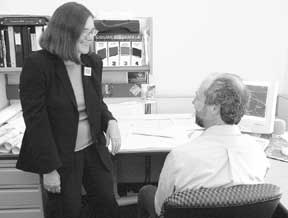
Charles Weston and Lesley Miles fit all of these. The husband and wife team who own Weston Miles Architects have been together since college. They have built up a thriving business in Morgan Hill, recently named the 25th largest architectural firm in Santa Clara Valley, raised two equally independent-minded daughters, Alicia, 20, and Madeline, 15, and still insist on doing things the way they think is right, no matter what.
They also believe in community service. Weston is a Planning Commissioner; Miles is president of the Morgan Hill Downtown Association, the latest in a long list of volunteer positions the two have held over the years.
Framed on the wall of their offices at East Third Street and Monterey Road, in a building they designed and built, is a “Carnegie Medal” for extraordinary heroism. It was awarded to Weston in 1983 after he pulled James Bryant from a burning car and surely saving his life. Bryant’s foot was trapped and Weston entered the car twice trying to get him free.
“The Carnegie Medal is usually given posthumously,” Miles said. The people who receive the medal normally have not survived their act of heroism.
At home in a drawer is Weston’s Soldier’s Medal from Vietnam. The Soldier’s Medal is given for non-combat heroism. Weston, who was not yet 20 at the time, picked up a burning trailer with a fork lift, saving a man’s life.
Miles says that, while she is proud of him, she finds this propensity to act with disregard of his own safety “worrisome.”
“I actually attribute that he’s still alive to a lot of luck,” Miles said.
In February Weston dropped everything and raced for a plane to India. As a member of the Morgan Hill Rotary Club he has been involved in overseas projects building clinics and schools. Last year he noticed that architectural plans for a school would leave the building extremely vulnerable to earthquakes, prevalent in the area.
“I sent them some new plans for their building,” Weston said, “so the kids would have a better chance of surviving.”
The race for the plane happened when he got a call that the builders were about to begin construction.
“I wanted to be there to be sure they did it right,” he said.
Miles is no slouch either at scary events. When she was just 18-years old, she decided to take her training in agriculture and plants to the wilds of Guatemala to teach the local people how to improve their farming techniques and, as a result, improve their lives.
The village where she spent two years teaching was many days by mule away from any medical help or communication with the outside world. And there were guerillas roaming the countryside, looking to harm, and probably kill, Americans working as she was. Trying to teach and staying alive and healthy took up a lot of time, Miles said.
One day, staying alive and healthy involved ripping the skin off a very large snake with her bare hands. Thankfully it was – just – dead at the time. The local people, she said, might have been impressed a little bit; construction workers certainly are. As an architect Miles frequently interacts with macho-types and the snake story sometimes comes in handy.
Miles’ introduction to public service came early. Born in Pasadena (the home of many Greene and Greene houses) but raised in the apple orchard town of Sebastapol (in Sonoma County) during its cannery/hippie years, Miles spent quite a bit of time with her grandparents near Santa Barbara. Her grandfather was a Santa Barbara County Supervisor for 25 years and was a member of the state water board.
“I spent every summer at their avocado and lemon ranch,” Miles said, “where I met people like Pat Brown (Oakland Mayor Jerry Brown’s father and a former governor).” Her grandmother taught Miles her manners and offered the chance to use them.
“From the time I was little,” she said, “I was asked to pass trays of hors d’oeuvres (properly) around at their parties.”
Between the Greene and Greene houses of Pasadena, her grandparents’ hacienda and Sebastapol’s Victorian/Edwardian buildings, Miles was exposed to distinctive architectural styles early on.
Weston was born in Los Angeles and grew up in Hollywood. Before he graduated from Hollywood High School he acted in several sitcoms, including My Three Sons. High school was where he began running – he finished his first marathon in 1970 and has run many since.
“Running is a huge part of his life,” Miles said. “He still runs about 100 miles a week.”
After graduation, Weston enrolled in Los Angeles City College. However, in 1971, young men waited for envelopes from the Selective Service, assigning them a draft number. Weston’s number was 11, which dashed any hopes of finishing school.
He went off to Vietnam as an 18-year-old sergeant where, Miles said, he did not have a good time. Few people did.
Back home, he finished his two years’ duty in the California National Guard and enrolled in Cal Poly San Luis Obispo, knowing that he wanted to be an architect. It was during his fifth year that he met Miles who was studying for a degree in landscape architecture. She qualified as an architect later. The pair spent the summer of 1980 working for the Youth Conservation Corps.
It was during this time the Diablo Canyon nuclear power plant was under construction. Weston, and others protested, objecting to what they considered to be a highly dangerous plant to locate so near an earthquake fault, to say nothing of the uncertain dangers of nuclear power.
One fine day Weston and the others chained themselves to a fence to keep the plant from opening. They were arrested and hauled off to jail for this act of civil disobedience. But he did what he thought was right. But mostly life was about architecture.
“We learned together about the integration of architecture and landscaping,” Miles said.
In 1981 the couple moved to Morgan Hill to work on a Waldorf School that never quite came to fruition. But, Miles said, she learned to relate the principles of architecture to nature.
“We used concrete for part of the building, to form quiet areas for the kids,” she said.
In 1987 Weston Miles Architects was formally established. After a year of working at home on Willow Springs Road, the couple opened an office in the Votaw Building at Monterey Road and East Second, above what then was the Coffee Roasting Club. The very small but inquisitive Alicia one day tore up some important drawings, pointing out the need for a separate space. Today the firm has 10 employees and has outgrown its second set of offices.
Pushing the envelope again, Weston and Miles have bought the derelict Isaacson Grain Co. building on Depot and East Main avenues, and are renovating it, slowly, into a fresh life as industrial-modern looking offices called The Granary. They have designed the building to be the first LEEDS certified “green” building in Morgan Hill. Environmental sanity is high on their list of important goals for buildings and the firm is now LEED consultants registered with the U.S. Green Building Council.
The Granary will go a long way to jumpstart development on the strip of land between Depot and the railroad tracks. Today the only workable building is the little train depot, designed by Weston and about to open as a coffee/sandwich/news shop.
Since The Granary is located at the corner where dozens of men hang out daily waiting for casual labor jobs, WMA offered an unused part of their property to the St. Catherine’s Dayworker Committee and volunteered services for the center. Run by the South County Dayworker Center board, the temporary center will provide a safe haven for dayworkers. Weston Miles will charge the center $1 a month for rent.
Weston and Madeline recently returned from visiting India, where he checked up on the Rotary orphanage and clinic projects. The trip required a bit of courage not found in everyday California.
While he was sitting quietly in the airport buffet in New Delhi, two mice ran across his back.
”This trip is going to be so looooong,” Miles said he told her. Later, after admiring the Taj Mahal in Agra (after 18 hours on a train), the Westons visited the Corbet National Game Preserve, took an elephant ride, went on a jeep safari and, holding true to form, were charged by an irate mother elephant.
Weston said they managed to get out of the way before the huge animal came thundering past.
“This was the highlight of Madeline’s trip,” Weston said. Weston’s highpoint came at an ashram at Hardwar, near the Rotary orphanage project.
“Our next Rotary project is a mobile medical truck to go out to the jungle to help people who won’t come even to small villages to seek medical help,” Weston said.
Weston said he went to India this time for two reasons.
“Because of the Rotary project and to be able to spend three weeks with Madeline before she gets her car,” he said. “Then we will see a slide toward total freedom from her parents.” Weston said they had a great time and Madeline learned to “negotiate” or bargain.
“She learned that what worked in India can work at home,” he said.
Weston Miles’ latest turn is to software. Miles has worked for many years for the Oak Grove School District, modernizing and reconstructing district schools, and some for Morgan Hill School District as well. She designed a web-based digital data management system that allows police and firefighters to call up plans of a school building on their in-vehicle computers. The plans show building names, gates and doors, utility valves and shutoffs – all critical information when responding to an emergency.
The San Jose Police Department appear to be interested in buying the system.
“There were seven incidents at San Jose schools during the past two weeks,” Miles said recently. “They can save time with this system and sometimes saving time saves lives.” The firm’s patent is pending.