Pombo bill to cover some water clean-up costs requires local
government match
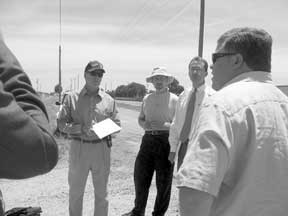
Washington, D.C., came to Morgan Hill last Thursday when Mayor Dennis Kennedy gave a tour of the Olin Corp. site on Tennant Avenue to a representative of Congressman Richard Pombo, R-Tracy. Perchlorate pollution from the site has caused major financial headaches to South Valley residents, well operators and governing bodies.
Along on the tour were Greg Zinnich of the Santa Clara Valley Water District and Aaron Cutler, Pombo’s aide.
Pombo has introduced a bill in Congress to reserve $25 million to repay government agencies, governments themselves and residents affected by the contamination, for the cost of fighting the pollution at the rate of a 65/35 percent match, a wrinkle that has caused some criticism.
The fact that everyone would have to “eat” 35 percent of clean-up costs to get HR 4459 funds has frustrated some members of the community.
San Martin resident Bob Cerruti, whose well regularly tests around 7 ppb, said the matter was discussed at the May 27 Perchlorate Citizens Action Group (PCAG) meeting.
“Some people were not too pleased at Pombo’s bill with the 65/35 percent split,” Cerruti said. “Then taxpayers will have to pay for something Olin caused. It lets Olin off the hook.”
Olin’s former safety flare plant in Morgan Hill, now removed, was the cause of perchlorate seeping down into the South Valley groundwater, causing law suits, water shortages, water rate increases and fears of thyroid damage from long-term exposure to the chemical. Plans to decontaminate the site and clean up the groundwater are underway by Olin Corp., which is under orders to do so by the Central Coast Regional Water Quality Control Board.
While the Public Health goal was set at 6 ppb by the California Office of Environmental Health Hazard Assessment (OEHHA) in mid-March, the City of Morgan Hill still tests down to 4 ppb, the lowest level at which normal testing procedures can detect the chemical.
Olin, however, sent letters to residents saying it would stop supplying free bottled water to residents on private wells testing below 6 ppb as of today, June 4. Cerruti reported that David Athey of the Regional Board said at the PCAG meeting that the Olin would be continuing to supply the water to residents whose wells test between 4 ppb and 6 ppb.
Cerruti said Athey discussed the possibility of installing treatment systems, under kitchen sinks or on multiple-household wells, at the PCAG meeting, The systems under consideration largely use the ion-exchange method which cleans Morgan Hill municipal wells of perchlorate.
The Pombo bill, HR 4459, is called the Llagas Reclamation Groundwater Remediation Initiative and would include federal matching funds for cleanup projects started on or after Jan. 1, 2000. Zinnich said the bill, if passed, would make a “pot of money” available when local action has taken place but, he stressed, there are at least two hurdles between Pombo’s promise of money and the funds actually appearing.
“First the bill must be passed,” Zinnich said, “and then Congress has to appropriate it.”
He also told Kennedy and Cutler that two bills working their way through the Legislature in Sacramento will ease the perchlorate situation by authorizing the cleanup and allowing agencies to recoup attorney fees .
Cutler said he expected other Congressional representatives to add other funding requests to the bill, allowing victims of other perchlorate contaminations to benefit from the bill. But the initial $25 million would be reserved for the South Valley Olin situation.
The money won’t come too soon for Morgan Hill water users. The city recently announced a “perchlorate surcharge” on water bills to pay for treating water from municipal wells testing 4 parts per billion (perchlorate in water) or higher. The City Council has promised to reimburse customers for the surcharge when and if it is repaid by Olin. The city has engaged in legal action against Olin, trying to reclaim some money it spent installing treatment plants on contaminated wells.
More information on the localized treatment systems will be available at the next PCAG meeting, Friday, June 11, 2-4 p.m. at the San Martin Lion’s Club, 12415 Murphy Ave.