South County has officially split, and some are not happy about
the last-minute decision. The Santa Clara Valley Water District
board passed a resolution Thursday morning to adopt the re-drawing
of boundaries that creates seven districts and effectively
bifurcates Morgan Hill and San Martin from Gilroy.
South County has officially split, and some are not happy about the last-minute decision.
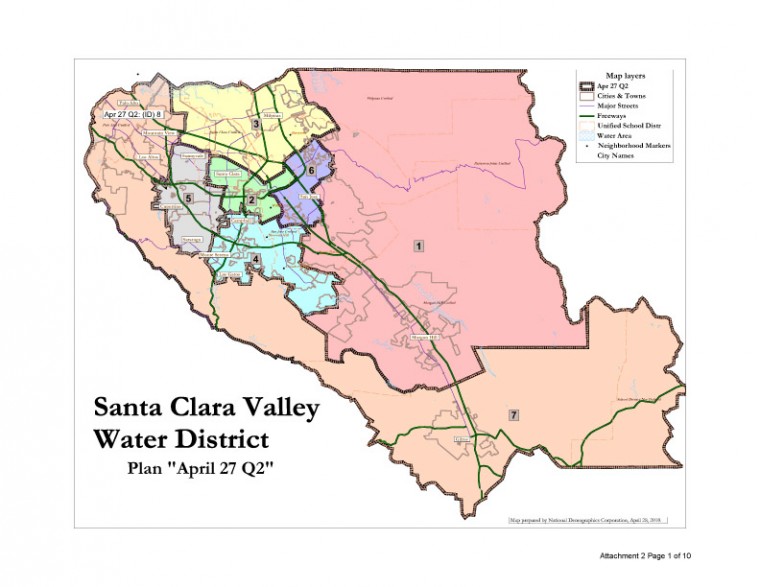
The Santa Clara Valley Water District board passed a resolution Thursday morning to adopt the re-drawing of boundaries that creates seven districts and effectively bifurcates Morgan Hill and San Martin from Gilroy.
The new map, which was produced at the tail end of a 12-hour meeting Tuesday, was supported in a 5-1 vote during a special meeting at the water district headquarters Thursday.
Patrick Kwok, who represents Palo Alto, Mountain View and the Los Altos area of the current District 5, was the one “no” vote. South County’s District 1 director Rosemary Kamei abstained.
The new District 1 includes San Martin, Morgan Hill, the Santa Teresa area and stretches to the top of the county border. The new District 7 includes Gilroy to the bottom of the county then sprawls north along the western border into Los Altos, Mountain View and Palo Alto.
“That’s not what Morgan Hill or Gilroy wanted,” said Santa Clara County Supervisor Don Gage. He said they wanted two representatives like before, one at-large and one in District 1, both representing South County.
“That map wasn’t scrutinized by anyone. They just jammed this thing through,” Gage said. “They had the opportunity to fix it. And instead they just slapped the public in the face and followed their own agenda.”
Proponents say the split gives South County two representatives on the board. But opponents say it divides a region with unique agricultural capabilities and water needs. The two districts could garner representatives from Palo Alto in District 7, for example, or South San Jose in District 1’s case.
No matter which map is chosen, the “yes” voters agreed, some interests won’t be fully served. The new map is the best option, they said, and was balanced to the best of the board’s ability.
Those in favor of the new map expressed also that they could talk and talk about it more but, “whenever you find yourself deep in a hole, it’s time to stop digging,” said Larry Wilson, District 4’s director.
A committee formed specifically to advise the water board on redistricting had met since January in at least 14 hours of public meetings to rifle through almost 20 maps that were considered. They recommended to the board three maps, none of which resemble the map adopted by the board.
Santa Clara County Supervisor Don Gage’s aide, Roland Velasco, served on the advisory committee.
“This is just over the top,” Velasco said Wednesday afternoon. The map was posted online at www.valleywater.org at 4:54 p.m. Wednesday. Velasco had not yet seen the map, but understood South County was being divided.
“I thought splitting South County was the wrong way to go. If I thought there was any merit, that’s what we would have recommended.” Map B, which was eliminated early on in the process, was the only map that split South County into two separate districts.
Yet, it was because of the positions of Gilroy and Morgan Hill mayors Al Pinheiro and Steve Tate, as well as public input through letters and at meetings, that the board decided to draw the winning map as it did.
“An opportunity was brought to our attention late last week to re-look at our assumptions on the possibility of having two separate districts for South County. With redistricting, it looked like we only had to have one seat. We made our recommendation based on what was the optimal way to redistrict. When the opportunity came up to have two, I talked to Mayor Pinheiro and we wrote identical letters – he wrote the letter and I signed the letter,” Tate said at Morgan Hill’s city council meeting Wednesday.
Mayor Al Pinheiro said what the board drew was not what he and Mayor Steve Tate had pictured when they lent their support of two districts in South County.
“The sad part is that the alignment was not what we envisioned,” Pinheiro said. “We’re not happy the way the alignment ended up.” He said they advocated for a District 7 that included Los Gatos with Gilroy and did not stretch up to Palo Alto.
South County’s at-large director Cy Mann stood by the new map choice. It served the South County constituents, he said, and took into consideration their want to have two directors representing their needs on the board.
“Is anybody every going to be happy? We can’t be going around and around on this,” Mann said. He encouraged that a decision be made Thursday and that he felt everyone who wanted to be heard on the issue had had the opportunity to do so.
The crux of the opposition at the meeting came from Director Kwok, who thought the decision lacked transparency and ignored the resolution to redistrict.
In the public participation kits online that asked residents to draw their own maps it said, “be careful not to split unnecessarily any obvious community of interest.”
Palo Alto’s City Manager James Keene said Palo Alto wrote a letter to the board Wednesday with concerns as to how the map was chosen and asked the board to review the three maps that were recommended by the advisory board. “These two cities (Palo Alto and Gilroy) are nearly one hour apart and the city questions how effectively one representative could serve constituents at the extreme ends of the valley.”
Mountain View’s Mayor Ronit Bryant also objected to the new map, calling it a “last-minute proposal” that does not consider geographical or “other logical community of interest.”
Kamei said repeatedly that she did not like the map but that it reflects what South County constituents want and also gives an opportunity to have two seats on the board for South County.
“I heard loud and clear that they were interested in two representatives in South County,” Kamei said. “If people felt this was overwhelmingly so bad, this room will be full. If you don’t like it, you need to offer a solution.”
Sylvia Hamilton, president of the San Martin Neighborhood Alliance, said the news of bisecting South County was simply nonsensical.
“My gut feeling … I hear what the mayors are saying about two representatives, but they don’t know that those representatives are going to be from down here,” Hamilton said. “It sounds like gerrymandering to me. I don’t know. I think it was most likely a politically charged decision.”
The water district must submit a street-by-street detailed map to the county registrar of voters on May 3: 180 days before the water board supervisorial election as required by state law. Water district staff liaison Rick Callendar sent an e-mail to the registrar of voters during Thursday’s meeting and was told that “one week of slippage was fine” from the May 3 deadline.
There was some discussion about how much time the board “really had” without doing anything illegal, but ultimately they decided to not call another meeting for more public comment or discussion and went ahead with the vote.
“What happened to the democracy? There is none,” Kwok said. The new map was considered at “5:30 (p.m.) when no one was here” at Tuesday’s meeting, he said. “We have to look at the most practical way to serve the constituents.” He added that the decision was rushed and casts a poor image of the transparency of the water district and its board.
In October 2009, Governor Arnold Schwarzenegger signed into law Assembly Bill 466 that requires seven electoral district would be drawn through a formal redistricting process that must be completed in time for the November election. The registrar of voters deadline of May 3 weighs paramount to AB 466 however, and is the deadline the board is abiding by.
Also, the results of the census will force the water board to take a second look at the new districts, but until then, map Q2 will guide the water district into the November election.