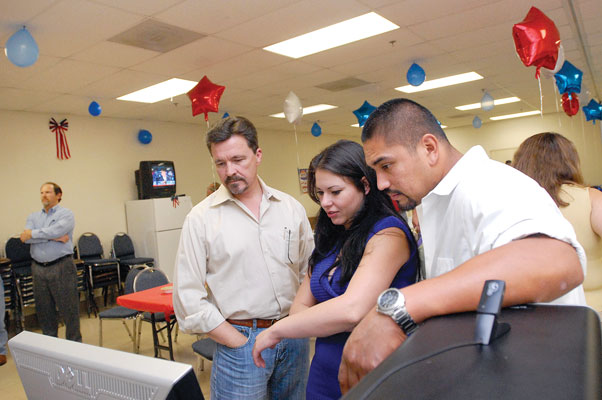
An incumbent mayor and two city council newcomers are ready to
take the reins, dig their feet in and … continue the city hall
policies that have persisted through the Great Recession.
An incumbent mayor and two city council newcomers are ready to take the reins, dig their feet in and … continue the city hall policies that have persisted through the Great Recession.
If the mantra for the 2008 presidential election was “Change,” Tuesday’s mid-term election results showed that, at least in Morgan Hill, voters’ appetite for a new or different direction has been satiated – particularly when it comes to the city’s response to a two-year (and counting) budget crisis.
The results aren’t final, but leading in the races for three votes on the city council are candidates who campaigned partly on the idea that Morgan Hill has fared well through the financial storm, and the city should continue its current budget strategy.
“I believe the majority of the residents think that we are headed in the right direction, we’re handling our finances properly and the council has been acting appropriately,” said city council candidate Rich Constantine, who enjoys a solid lead atop the field of eight hopefuls, and appears likely to be sworn in for the seat Dec. 1.
While the votes are not fully counted, with all 30 Morgan Hill precincts reporting results, Mayor Steve Tate, 66, is ahead in his three-way race by more than 22 percentage points, with 4,100 votes, according to the Santa Clara County registrar’s office. Challengers Art College, former city manager, and Marby Lee, a councilwoman elected in 2006, have received 2,336 and 1,303 votes, respectively.
In the council race for two open seats, no incumbents were in the running. Constantine, a fire engineer for the San Jose Fire Department, and Gordon Siebert, a redevelopment program manager for Monterey County are in the lead.
Constantine has received 2,850 or about 23 percent of the votes counted. Siebert has won 2,063 or about 17 percent of the votes.
Candidate Lee Schmidt trails Siebert by less than 2 percentage points, or 195 votes.
As of Thursday afternoon, the registrar’s office still has to count about 135,000 outstanding ballots, countywide, before the results are final, and about 3,000 of those were cast by Morgan Hill voters, spokeswoman Elma Rosas said. Statistically, Schmidt could pull ahead of Siebert once all the ballots are counted. However, Schmidt said Thursday that he doesn’t think the percentages will change.
Tate appears headed to be sworn in for his third term as mayor and his 13th year on the dais. A consistent vote in favor of the city’s budget policies, service reductions and redevelopment plans in recent years, Tate said he’s going to continue what he’s been doing.
“My priorities (for the city) are not going to change at all,” Tate said. “We’re still faced with an economic downturn, and we’re going to continue to manage that with our sustainable budget strategy,” a longterm plan to use general fund reserves to lessen the need for service cuts.
Tate added he looks forward to proceeding with redevelopment and streetscape projects in downtown Morgan Hill, await the results of an environmental study of the southeast quadrant which just began, and to help two new councilmembers “get on board.”
One concept Tate hopes to explore further in the next two years is the pursuit of regional solutions to problems that are common among neighboring communities. Doing so might reduce costs without sacrificing the level of service, and ensure “the best practices of each city can be taken advantage of,” he said.
That process is already in motion when it comes to fire and emergency medical services, as the three districts that provide those services in the area – Gilroy, Santa Clara County and South County – are in the midst of a study of how fire protection could be consolidated.
Other areas where sharing services with other communities might work include reducing the use of plastic grocery bags, public employee pension reform and the expansion of recreation services, said the mayor, who represents Morgan Hill on the Peninsula Division of the League of California Cities and the Santa Clara County Cities Association.
Tate added that running with opposition opened up a dialogue during the campaign, from which he learned ways to improve his governing style, particularly by interacting more with constituents. “I’m going to get out more, and keep the communication and dialogue going,” Tate said.
Constantine, 46, was “surprised” at his commanding lead in his first election, which he attributed to his door-to-door campaign efforts.
“If you can get your platform across, and they agree with it, they’ll vote for you,” Constantine said. “If they’ve never met you, they’re not going to vote for you if you just have a nice flyer.”
A key priority for Constantine is to remember while serving as councilmember that he was “elected by the community,” he said.
“I’m going to be taking their input, and do what’s best for the community as a whole,” he said.
The voters’ choice is partly a mandate for “smart growth,” which was part of Constantine’s platform, he said. Such a growth strategy should promote only development that is sustainable, and not to “overbuild” just for the sake of having new buildings.
“We need to have forethought” in development efforts, said Constantine. “You can’t just build and expect people to move in.”
That said, Constantine thinks that Barry Swenson Builder’s plans to build new condos, apartments, retail stores and a cinema downtown are viable. In fact, that project ties in with another aspect of his platform – to attract new businesses to Morgan Hill. However, he hopes the redevelopment will retain the “small-town” atmosphere.
Siebert, 60, noted that he and Constantine bring to the dais careers’ worth of “intimate” knowledge of the delivery of different public services – Siebert as a longtime public works administrator and engineer for cities including Morgan Hill, and Constantine as a firefighter.
Also a former interim finance director for Morgan Hill, Siebert “made no secret” during the campaign about his belief that the city’s budget strategies will be effective.
If he retains his current position in the vote count as of Dec. 1, he hopes to contribute his background to the upcoming development of the design and location of the California High-Speed Rail project, as well as downtown redevelopment and flood control.
“I was certainly pleased the residents of Morgan Hill chose me, and I hope it was because of my experience and background,” Siebert said.
The first thing Siebert wants to do after being sworn in is to make sure he is informed on all the current issues facing the council.
A proponent of volunteerism, Siebert hopes to immediately begin to use his position as councilman to promote citizens’ involvement in local volunteer programs. Also in the immediate future, Siebert said he will be able to look at downtown redevelopment plans with his engineering and design experience and contribute accordingly.
He also hopes to persuade the council to consider job sharing and more effective use of technology as ways to cut costs when budget time arrives next year.
It’s common in municipal elections for voters to choose public-sector employees to represent them, according to San Jose State University political science professor Terry Christensen.
He added that it’s not surprising, despite the “Republican wave” that swept the rest of the country in Tuesday’s election, that more conservative, pro-business candidates seem to have been defeated in Morgan Hill.
“The local election (usually) doesn’t come down to ideology – it comes down to the candidates themselves,” Christensen said.
And Schmidt isn’t hopeful that he’ll gain enough votes to overcome Siebert when the results are finalized, but he accepts the results.
“The people spoke in Morgan Hill, and said they want Richard and Gordon (on the council),” Schmidt said, adding the campaign for his first attempt at public office was rewarding. “The interesting thing for me is I learned there’s thousands of neat people in Morgan Hill, I made a ton of new friends, and I met a lot of people who care passionately about what’s going on.”