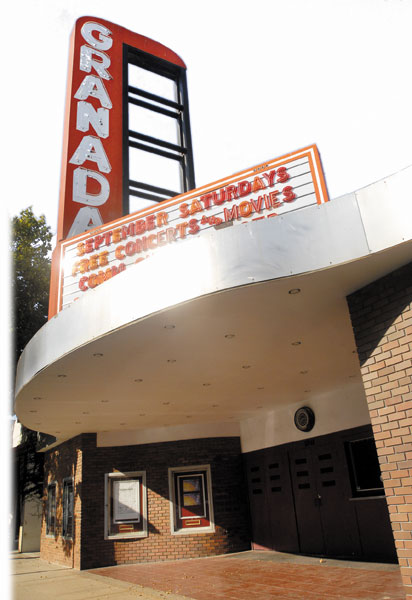
The Granada Theater still stands, but a study of the long-term
viability of saving the facility as a performing arts venue could
be the downtown landmark’s wrecking ball.
The Granada Theater still stands, but a study of the long-term viability of saving the facility as a performing arts venue could be the downtown landmark’s wrecking ball.
Although the theater has not been in operation since 2003 and is slated to be replaced with retail shops and homes in the city’s long-term redevelopment plan, the city council will revisit a previous decision to make room on the Granada property for a mixed-use development.
In part because of the heightened voice of the nonprofit Save the Granada foundation, the council last month asked city staff to return with more information on the financial viability of reopening the theater.
“One of our primary approaches to all this development is to stay flexible and adjust to conditions as we roll this all out,” said David Heindel, Morgan Hill assistant to the city manager.
City staff and Barry Swenson Builder, a San Jose developer that was chosen in April to redevelop the site, will present their findings about the Granada at Wednesday’s council meeting.
Although the builder had not completed its study of the feasibility of keeping the Granada open as a live entertainment venue and cinema at press time, the city’s conclusions do not bode well for the vacant facility.
Reopening the Granada and keeping it open would require more than $5 million in renovations, as well as an ongoing subsidy from the city, developer or other entity; and it would reduce the available space for new homes and retail establishments, according to a city staff report.
The city owns the property, which also contains the Downtown Mall and Morgan Hill Cigar Company. Also owned by the city is a property across Second Street, where Royal Clothiers is located.
Both properties comprise the next phase of downtown redevelopment, and the council selected Barry Swenson Builder to oversee the project, which will ideally consist of ground-floor retail and dining options, with a mix of housing and offices on upper levels, as well as parking. A permanent multi-screen cinema is currently planned for the Royal Clothiers site.
An interim part of the city’s long-term plan, known as the Downtown Specific Plan, is to temporarily reopen the Granada with two movie screens while the permanent cinema undergoes construction one block to the south. If and when the new theater opens, the Granada will be redeveloped for non-entertainment uses, while the marquis and sign in front of the building could be saved and used in the new development, the council decided more than a year ago.
But the voice of the Save the Granada foundation has risen since then, and the builder and city staff are awaiting final direction from the council before details of the downtown plan are finalized.
At the April 21 meeting, when the council chose Barry Swenson Builder as its downtown redeveloper, Councilwoman Marby Lee asked for more information on options to keep the Granada open in its current location. City staff will present that information Wednesday.
Also on the agenda for Wednesday’s meeting is the approval of an “exclusive negotiating agreement” with Barry Swenson Builder. The city will eventually sell the properties to the builder, who will agree to develop them.
In the coming months, the city and developer, with feedback from the community, will compile detailed plans for the two properties before they change hands. Two “community engagement” meetings are scheduled in the coming weeks.
Receiving feedback from the community early on in the $40-million-plus mixed-use project is “extremely important,” said Tina Viglizzo, project manager for Barry Swenson Builder.
“It’s part of what we had agreed to in our (proposal to the city), and we want to make sure we do right by the community,” Viglizzo said.
When the RDA sent out a request for qualified developers for the sites last September, Barry Swenson Builder submitted a tentative proposal that includes a boutique grocery as an “anchor tenant” on the corner of Monterey Road and First Street, and smaller retail and dining options surrounding it. Up to 70 residences, including condominiums, apartments and studios were also planned for the properties.
The builder will present those plans at the June 30 meeting, but will also take suggestions for possible tenants, as well as the design and layout of the properties. Construction on the two projects will not begin for at least another 12 months, but the builder wants to be sure the projects jibe with “the community’s overall vision,” Viglizzo said.
Barry Swenson Builder has met with the Save the Granada foundation to discuss the builder’s possible support of the nonprofit’s plan for the theater, but “the city is the lead on this,” Viglizzo said. The company has renovated historic theaters before, including one in Healdsburg.
The Save the Granada foundation is working on placing a measure on the November general election ballot, to let the voters decide if the theater should be saved, according to spokeswoman Pamala Meador.
“We would hope (the council) would hear the voice of the people and not the voice of the developers, and give us an opportunity to make the Granada Theater a success and a landmark for Morgan Hill,” Meador said.
When the city solicited interest from qualified developers for the site in September 2009, the foundation submitted a business plan that refurbishes the Granada as a 500-seat theater that can accommodate live music and theatrical performances, as well as movie screenings, up to 300 days per year.
Even though city staff and the council have said that such a plan would be costly and unsustainable, and does not remove the city from the risk of failure, the foundation and its supporters have crowded every public hearing on redevelopment in recent months.
According to the city staff report to be presented Wednesday, other aspects of a long-term Granada that are inconsistent with the current DSP are less of a chance for the city to recover the property’s purchase price of about $8.6 million; increased demand for parking elsewhere downtown; lower maximum property values on the site; and extensive modifications for dressing rooms, restrooms, and back stage uses.