He committed 30 years to teaching Morgan Hill’s high school
students how to form their own opinions and take a stand. Bob
Caredio was an independent thinker and expected the same of his
students. His passion was infectious, those who knew him say.
Caredio was a beloved Live Oak High School history teacher,
husband, father to five children, friend and mentor. He died March
6 at the age of 82.
He committed 30 years to teaching Morgan Hill’s high school students how to form their own opinions and take a stand. Bob Caredio was an independent thinker and expected the same of his students. His passion was infectious, those who knew him say. Caredio was a beloved Live Oak High School history teacher, husband, father to five children, friend and mentor. He died March 6 at the age of 82.
The influence of Caredio has reverberated in the community and elsewhere after he died from cardiac failure last month while living in an assisted living facility. His former students, colleagues and friends say he was eloquent, relentless, demanding and progressive beyond the times – the man was passionate.
“He was always the champion and advocate for the underdog, the underprivileged, the minorities of our community. He always encouraged them to take advantage of our state’s higher educational system to better themselves, their lives, their families, our community, our state and our country,” said Ed Ferri, a 1966 graduate of Live Oak. Ferri and his older brother Bob both took Caredio’s class and were so inspired by him they became teachers themselves.
It was because of Caredio’s example, encouragement and enthusiasm, Ferri said, that they and “hundreds, maybe thousands, of Live Oak students went on to higher education following the footsteps and inspiration of Mr. Caredio.”
Caredio was born Oct. 13, 1928 in San Francisco to two Italian immigrants from Northern Italy and Sicily. He attended UC-Berkeley and received his degree before taking his first and only job in education as a history teacher at Live Oak High School in 1952.
His only daughter Sharon Caredio remembers asking her father about his dedication to educating teens.
“I asked him one day, ‘Dad why didn’t you become a professor?’ He felt that he could really make a difference in a student’s life at that age level. They could really start thinking for themselves and not set in their ways,” Sharon said.
The Caredios: Bob, his wife Mildred, Bruce, Bill, Len, Sharon and John lived in Morgan Hill and all five Caredio children attended Live Oak while dad was teaching, and coaching track and football. He would walk to school with them most days. Sharon and John, who resides in San Jose, were the only children brave enough to take their father’s class.
“I have great memories of his class and how dynamic it was. It gave me a totally different perspective instead of being my father. He was a mentor and a teacher,” said Sharon, who lives in Capitola. She couldn’t recall the grade she earned in his class, but “my friends said, wow he’s tough on you,” she laughed.
The Caredio children, who among them have 15 children of their own and several grandchildren, describe their home at 265 Longview Drive as a revolving door, middle son Len Caredio said.
“Mom said that. The door was always revolving, kids were coming and going all of the time,” Len said. They would stop by to join in the Caredio debates about history or politics or theory – though often the reflection on Caredio was you never knew which side of the issue he stood. He wanted you to decide for yourself, research the topic and take a firm stand, Sharon said.
“He was a man that touched a lot of peoples lives. I kind of knew it, but now that he’s gone. It’s amazing,” said Bruce Caredio, his oldest son. Caredio was an avid reader; his children and friends say he was voracious about it. Bruce said Howard Zinn might have been his favorite author.
“I never really sat down and figured it out but he taught thousands of students over 33 years. And a lot went into teaching. He was a great recruit for teachers,” Bruce Caredio said.
Like Phill Laursen, who was Caredio’s student teacher in spring 1966.
“He set the bar very high for me, for his colleagues, and his students. I drove myself hard, worked long hours throughout the year, constantly strove to become better and better in the science and craft that is teaching. It took discipline to keep reasonable limits on my time and effort, I couldn’t forget how hard Bob worked and how much he cared. I heard he had never missed a day of school and I was determined to be strong too. Still, I could see how deeply Bob was devoted to his wife, Mildred, and his children, and how even a one-semester student teacher was accepted as a perpetual member of Bob’s school family,” Laursen wrote in a letter about Bob’s influence on his life.
Laursen desperately wanted to teach at Live Oak alongside Caredio, even saying it was his dream, but had to take an opportunity in Los Altos. “I never quit profiting from Bob Caredio’s influence. Morgan Hill was blessed to have such an amazing treasure,” Laursen said.
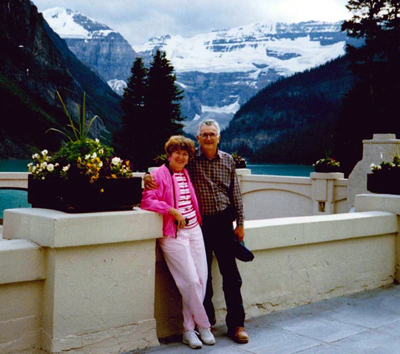
Bob Caredio married his wife Mildred in 1948 and they started their family. Mildred was Canadian, from British Columbia, and nearly every summer the Caredios would spend three months with Mildred’s family, hiking and fishing – the couple’s hobbies – and created fond memories for their children. Len lives in Idaho a few hours away from his mother’s roots in Canada, Bruce resides in Washington, and Bill lives in Eugene, Ore.
Mildred – Bob used to call her “his jewel” – died six years ago and the couple’s last wishes were to have a memorial at Lake Louise in Alberta, where Bob proposed to Mildred.
“They were a great team. She was there for him and supported him and helped him,” Len said. “I remember we had to know how to swim in those days to pass high school and Mom was a lifeguard. And several kids couldn’t swim in the ’50s and ’60s so she would help his students learn how to swim so they could pass.”
Caredio’s former student Roman Robledo considered Bob his second father after his father died when Robledo was in his 20s. He and his 12 brothers and sisters – 10 went to Live Oak – call Bob’s death a “great loss because our whole family cared a lot about Bob,” said Robledo, a Morgan Hill resident.
Robledo said he wanted to move to Arizona after school – “I had no plans of staying in California, but, I wanted to stay at Live Oak High School because I figured I could learn the art of teaching from Bob Caredio, from a master. He was a master,” said Robledo, who began teaching at Live Oak in 1969 alongside his 1963 high school U.S. History teacher.
“Bob started a Mexican-American club at Live Oak. When he did that I raised the question why would this white person do this? He’s not even Hispanic and I remember he would get dictionaries and reference books for the Mexican students who didn’t have those things at home. He did this because he cared especially about the plight of the minority students,” Robledo said.
At Live Oak, Caredio started teaching a Chicano Studies class that Robledo eventually took over.
The humanity of Caredio truly effected Robledo. His younger sister couldn’t swim at the time of her graduation, and thus wasn’t going to be allowed to walk in the ceremony. He said Caredio asked the principal to let her wear the cap and gown, give her a piece of paper like a diploma and let her go – he and his wife would teach her how to swim for the credit that summer.
“That’s what Bob was all about. That’s something that I will never forget as long as I live. He was quite an unbelievable human being,” Robledo said.
MEMORIES OF BOB CAREDIO, SUBMITTED BY HIS STUDENTS, COLLEAGUES
E-mail lw*****@*************es.com to submit your memories.
He always cared
Mr. Caredio had a huge influence on my brother (1962 LO grad) and me (1966). Like many of Mr. Caredio’s students, we both went to college inspired by Mr. Caredio’s example, encouragement and enthusiasm to become teachers ourselves. We are only two of hundreds, maybe thousands, of Live Oak students that went on to higher education following the footsteps and inspiration of Mr. Caredio. He loved this country and he loved teaching his classes in United States History, Current Affairs and Social Problems. Education and teaching were his life. He was always the champion and advocate for the underdog, the underprivileged, the minorities of our community. He always encouraged them to take advantage of our state’s higher educational system to better themselves, their lives, their families, our community, our state and our country.
Mr. Caredio taught during a golden age of education in Morgan Hill. Before Morgan Hill became a bedroom community for the “Silicone Valley.” A time when teachers lived here and were a part of our rural community of Morgan Hill and San Martin. They raised their kids here with us and they were like aunts and uncles to their students. They knew our names and our families. A time before state and federal mandated testing and etc. became so dominate in our schools. A time when teachers were highly regarded and respected. A time when teachers were allowed and encouraged to teach students how to think for themselves and how to write what they thought down on paper in a cohesive logical manner. Mr. Caredio always challenged his students to think and reason, not just repeat rote answers. He is what I would classify as a master teacher who taught many student teachers, such as you, how to be better teachers. How to get students motivated. He had extremely high standards as a teacher. I remember only essay exams in Mr. Caredio’s classes. And he read all those essays. And he graded them and marked them up with questions and comments for further discussion. In class, he was engaging and relentless but in an exciting and fun way with that wry smile of his that always made his class the highlight of our school day. No wishy washy, milky toast answers allowed in Mr. Caredio’s class baby!
I always circle back to the photo from my 1966 La Encina senior yearbook where he wrote “Good luck to you. Let me know how you are doing. R. J. Caredio.” That was Mr. Caredio in a nutshell. He always wanted to know how his students were doing. He always wished the best for them. He cared for them.
In a way, Mr. Caredio had two families. He had the traditional family consisting of Mildred, “Babe,” his wonderful wife (the crown jewel of his life) and five smart intelligent children (Live Oak grads of course) all very successful in their own right (some teachers). But he also developed this other family of former students. Students that remained in contact with him through the years and decades that followed their school days at Live Oak with lively debates on topics of the day or just “how are you doing” discussions. I was so lucky to have had Mr. Caredio as a teacher during that golden age of teaching in rural Morgan Hill, but it is the decades of friendship that followed that I remember and cherish the most. The discussions, hiking, family dinners, BBQs and just fun visits. My brother and I are only two of countless others, such as yourself, that feel the same way. Mr. Caredio had a positive influence on so many. He wanted the best for his students and he wanted to know how we were doing. He cared.
Ed Ferri,
Former student class of 1966
True-to-form ‘master’ teacher
It was the spring of 1966 and I was anxious about my first day as a student teacher at Live Oak High School. I met the two teachers who would be supervising me as I taught United States history, in turn they introduced me to their classes, then I sat back and observed. One of those teachers, Bob Caredio, gave me a room number and asked me to meet him there after my last class.
I’d expected a career at Certified Egg Farms, where my father was a partner. Poultry people said it would be best if I spent a maximum of time at the ranches, so I attended San Jose State rather than UC Davis or Cal Poly. I’ve long joked with students that I was trained to work with chickens, but wound up working with turkeys. The truth is, John Kennedy’s words were still echoing in my ears and when my father’s partner stirred up conflict, my Dad sold out and I didn’t want to work in a hostile place. Friends were becoming teachers, I had discovered a love of Social Sciences, and teaching was a splendid way to ask what I could do for my country. I felt a sense of mission, but Bob Caredio was yet to forge that sense into clear goals and objectives.
When my last class was over, I found the room was a work space for the janitors. We sat, Bob looked me in the eye and asked to know my philosophy of education. I was stumped; there were teachers I admired and I expected to emulate them, but I’d never considered a philosophy of education even existed. As Bob bored in with specific questions about what I hoped students would gain in my classes, it became apparent I DID have an evolving philosophy of education. Thus began the most meaningful learning of my life.
Bob turned his class over to me the very next day, knowing my learning would be greatest if I was right in the crucible. Still, I would discuss his observations of my class, observe his classes, and travel with the department to the wonderful conferences of the Santa Clara County Council for the Social Studies — a group Bob helped organize. Bob used department meetings as a platform for exploration of new theories and methods for teaching, I learned of bold thinkers and many excellent resources. Instead of filling kids’ heads with knowledge I’d gained in college courses, I was now on a 35-year path to continue my own learning and refine my approaches to helping students (and myself) become more effective thinkers — teaching “facts” was no longer the one and only goal, but was the basis for practice in processing information and ideas.
Bob Caredio set the bar very high for me, for his colleagues, and his students. I drove myself hard, worked long hours throughout the year, constantly strove to become better and better in the science and craft that is teaching. It took discipline to keep reasonable limits on my time and effort, I couldn’t forget how hard Bob worked and how much he cared. I heard he had never missed a day of school and I was determined to be strong too. Still, I could see how deeply Bob was devoted to his wife, Mildred, and his children, and how even a one-semester student teacher was accepted as a perpetual member of Bob’s school family. It was my dream to teach at Live Oak, but there was a reported scarcity in Social Studies positions, so when Los Altos High offered a job, I grabbed it but never quit profiting from Bob Caredio’s influence. Morgan Hill was blessed to have such an amazing treasure.
Phill Laursen,
Student-teacher in Caredio’s class 1966
Re-read, re-write and re-think
My favorite teacher was Mr. Caredio. I can still hear his booming voice: “Porrazzo, Baby! I’m waiting! And it’s MY time! You need to engage in the upper levels of cognitive thinking, Baby! I don’t care what you feel, I want to know how you think!”
He asked questions. He probed your mind. He argued with you on one side, and just when you thought you were done, he’d take the other side and make you think and argue and support your position some more. Hamiltonian or Jeffersonian? In favor of dropping the bomb on Hiroshima? The New Deal? The Vietnam War? He made you read, and write, and think, and re-read, re-write and re-think.
He absolutely refused to receive anything other than your very best effort. He was relentless. Relentlessly smart. Relentlessly demanding. Relentlessly good humored. He was meticulously prepared for each class, every day, all the time. He never took a day off, and never in my recollection had a bad day. He as always “on.” He was frightfully fierce, unfailingly loyal, and at the end of the day, downright funny. Class wasn’t just “I teach, you learn.” It was his stage, we were his interactive audience, and his daily performances were all Oscar worthy.
I suspect I never would’ve gone to college were it not for Mr. Caredio. No one in my family had ever gone to college. Few from Live Oak in the 1970s went to college, and even fewer still to a four year college. And I know only a handful of kids – less than five, perhaps – who would dare to go far outside of Morgan Hill, hundreds of miles to a great, private, prestigious school like the University of Southern California.
But I did. I did because of Bob Caredio. He inspired me to think beyond my abilities and dream beyond my circumstances. I lived in a trailer park. Dad was a butcher. Mom was a waitress. I was likely destined for a good, hourly paying job like my brothers. But I was lucky to take U.S. History in 11th grade, in 1976 from Bob Caredio, during the bicentennial. And everything changed.
And after USC, law school at Santa Clara. Passed the bar exam first time. My own practice. It’s a small firm, and I’ll never be a famous lawyer, nor a particularly wealthy one.
But I wouldn’t have been a lawyer at all were it not for Mr. Caredio. I wouldn’t have gone to college were it not for Mr. Caredio. I wouldn’t have valued independent thinking, crisp writing, passionate advocacy, or good, Socratic teaching, were it not for Mr. Caredio.
But he wasn’t just a good teacher. He was a good man. Honest. Kind. Encouraging. He believed in me – and in everyone else who took his class.
I’ve used a lot of his material with my own kids. And it’s working. They’re smarter than me. Good thinkers. College graduates. My son went to USC. He’ll probably go to law school. And my dear, sweet daughter – she wants to be a teacher. Imagine that.
Thanks aren’t nearly enough, Mr. Caredio – but I appreciate everything you did for me. I still listen for your voice, even now, 35 years later. I smile every time I think of you, except the other day when I heard you passed away. Then, I cried.
Godspeed, dear friend. Keep the debate going on in heaven. I can’t wait to see you there someday …
Porrazzo, baby!
Michael H. Porrazzo,
Former student
A lasting impression
As a member of the Live Oak class of 1958 I had the great fortune of having Robert Caredio as a teacher of Citizenship my freshman year, U.S. History my junior year, and a self directed elective research class as a senior, as well as my track coach. He challenged all his students to think, to gather factual data, analyze and synthesize those facts, then logically defend one’s position with facts rather than opinions. Of the numerous teachers I have had during my lifetime, Mr. Caredio had the most influence upon me than all others combined, not only on a personal level as a friend and advisor after graduating from Live Oak but as my role model in my own 30-year teaching career, challenging my own students of U.S. History to think, to justify their positions on issues with logical, factual information.
I always gave thanks to Mr. Caredio whenever my U.S. History students would leave my classroom arguing about whether or not I was a Democrat or a Republican or when a fellow teacher approached me one day asking if I could “calm down” my students prior to their departure from my class because they were coming into his science class arguing about issues from U. S. History thus consuming his time for teaching science. I considered such comments as a compliment to me as well as to Mr. Caredio.
Mr. Caredio always provided me with a goal to strive for as a teacher, to be as good a teacher as he was. If it had not been for Robert Caredio I would not have had such a wonderful role model to set my sights upon, always striving to obtain his high standards of academic and professional attainment. And no student of the master will ever forget his emotional involvement in the classroom, his voice frequently booming half way down the hallway.
I thank him for challenging my youthful conservatism, for forcing me to look beyond myself, to eventually becoming one of those “caring for others” liberals. His influence in my life goes far beyond my approach to teaching. I have been politically active, and still am, since the 1960s participating in the CDC (California Democratic Council) opposing the Vietnam War and presently opposing the present rape of America by American corporations and the wealthiest of Americans. My family background and Robert Caredio’s influence upon my using Socratic methods of thinking have made me what I am today, a man for the people, a man for true democracy, a man for what is best for all Americans rather than a select few. Thank you, Mr. Caredio.
Richard Phay
Prineville, Ore.